Although it has already been a week that the national football selection of Suriname lost 0-1 to the home country in Guatemala, the Concacaf Nations League match is still keeping people busy. Partly because of the racist chants, but also because of the reaction of Natio players. With national coach Henk Fraser watching the True Time back to a competition, of which the last word will not have been said even after today.
Text Desney Romeo
Image Terence Oosterwolde
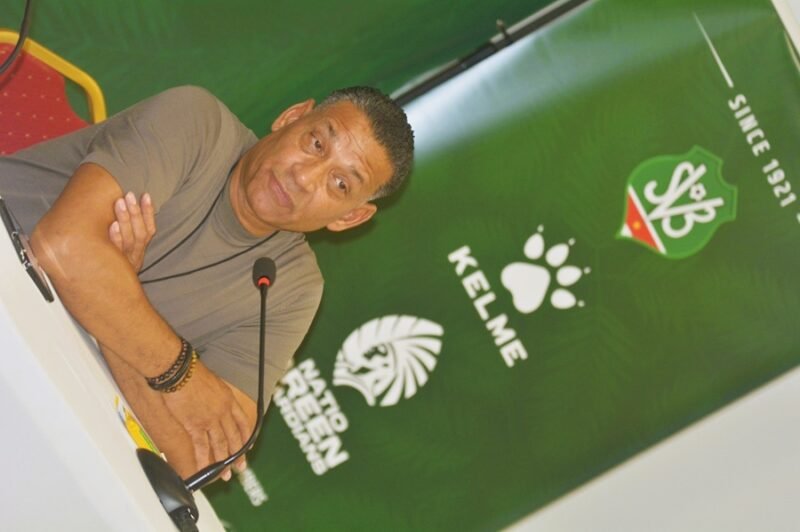
According to Fraser, no one can ignore the fact that Suriname footballers are often discriminated against and have racist comments thrown their way. “As difficult as it is and although I understand it, I have warned the players that this kind of thing could happen,” he says.
“I would really like to sit down and spar with the trainers in Suriname. I can learn from them, I can tell them what I have experienced, not from the point of view that I know better, because that is not my approach at all”
For the national coach it cuts both ways. “I think we should really do something to nip discrimination and racism in the bud. But I also think that we as athletes, in this case as Natio, should not react, because we are not going to win the battle against the supporters. There has never been a supporter who received a red card,” it sounds telling.
Fraser believes that players should realize what is going on. “I say: ‘choose your battles‘ and this is not the battle that we had to face. That’s why I was disappointed, because it affected the plan we had. I brought in (Richonell) Margaret just for the last part, where we will have more spaces, because that is a quality of his. And then you have a completely different story.”
Take a more mature approach
The national coach says that he would have handled things differently. “But anyway, I was raised not to show my weakness, which other people enjoy, but other people have more difficulty with it. These kinds of people, the ones who make monkey noises and gestures … honestly, it makes me laugh. I just laugh at them. I have other triggers.”
He thinks it’s a shame that players have reacted. “I think we have to realize that we could have laughed at them all that evening, at the end of that evening, because we were not in danger with eleven men. Even with ten men, I no longer had the feeling that it would fall. But you know, one such moment – a ball that falls the wrong way, in this case that we do not get out on time – can be crucial and that unfortunately happened.”
Punished three times
Given what has happened – a year ago during the period of national coach Stanley Menzo, Natio was also racially treated and El Salvador was punished by Fifa – Fraser was asked whether the national football selection was not a mental coach needs. “Football is still leading and those people – if it is mental coach is, a dietician or a performance coach – must be of added value and remain an added value. So I’m a little careful with that. I am not negative in relation to mental coachingbut sometimes it is also simple common sense”, he emphasizes.
The national coach repeats: “We can never win that battle against supporters, so we have to realize that if you can silence people in a sporting manner, that is the best way to arm yourself against these kinds of things. I don’t want to say that these kinds of people are brainless, but I think they have a maximum of one brain cell. You can’t fight against that.”
On the other hand, Fraser agrees that Suriname is now experiencing this too often. “The various organizations that could do something about this must take more decisive action. I also understand the problem for them, because what are you going to do against those types of people, especially because it is at the expense of a large group.”
The national coach honestly admits that there were enough people in Guatemala who enjoyed Suriname’s game or wished the group success. “So it would be very strange to tar all of Guatemala with the same brush. It is a group of people that needs to be tackled.”
He also acknowledges that Concacaf and Fifa may not have too many options. “I think they are bound by possibilities: fines, matches without an audience… but for us the damage has already been done. We also lose a player, which has direct consequences for the match and most likely players will be suspended, which is also understandable, but we are simply punished three times. Apparently it pays to exhibit this behavior,” sighs Fraser.
Local players
Like his predecessors, this national coach is also asked about the chances of local players to get through to Natio. In the current selection, only Robinhood goalkeeper Jonathan Fonkel was from the local competition. The rest of the (diaspora) footballers are active in (professional) competitions in Europe and elsewhere.
After the match against Guatemala, Fraser decided to come to Suriname to personally attend some matches of the Suriname Major League (SML). He was also present at the Presidents Cup match between national champion Broki and cup holder Voorsprong. “I want to create a real challenge for everyone. I don’t know whether that is possible, but I do think that I should have the intention to have a clear picture of the players of the SML. Sometimes you can help them by letting them train, sometimes you can help them by taking a few minutes. The threshold for them may then be less difficult.”
During the last window, the national coach allowed Alierio Belfor and Franklin Singodikromo from Broki to train. “Both have done well. Once they get past that threshold, who knows what else they can bring.”
Of course, according to him, there are things that local players will have to help with. “There is a substantial difference, especially in the physical. Technically, tactically there will also be a difference. Tactically, I expect something more than technically. They simply have technical skills.”
In any case, Fraser is clear about what needs to be done to get more SML players or footballers from Suriname into the selection. “You will have to create a platform from the youth onwards. Facilitating the youth… of course, many things are linked to finances.”
He uses Morocco as an example, but immediately admits that in that country the king is throwing a few millions at it. “I cannot see what it is like here in that respect, I don’t know, but I do know one thing: it ultimately starts with the youth. If your goal is to target players, then you cannot avoid investing in the youth. Let’s be honest: the youth have the future.”
The national coach insists on unity. “Connecting is what I support, if it is at government or association level… we need to strengthen each other instead of being suspicious. I think there are a lot of opportunities in this country, because we are naturally fantastic athletes, not just in football.”
“We can never win that battle against supporters, so we must realize that if you can silence people in a sporting manner, that is the best way to arm yourself against these kinds of things.”
A ‘problem’ in Suriname is that there are too many islands. That is why he gives wise advice: “You often go faster on your own, but with several people together you go further. That is cliché, but it is reality for me.”
Fraser is therefore looking forward to collaborating with the local coaches. “I would really like to sit down and spar with the trainers in Suriname. I can learn from them, I can tell them what I have experienced, whether it is in the Netherlands or in China, not from the point of view that I know better, because that is not my approach at all.”