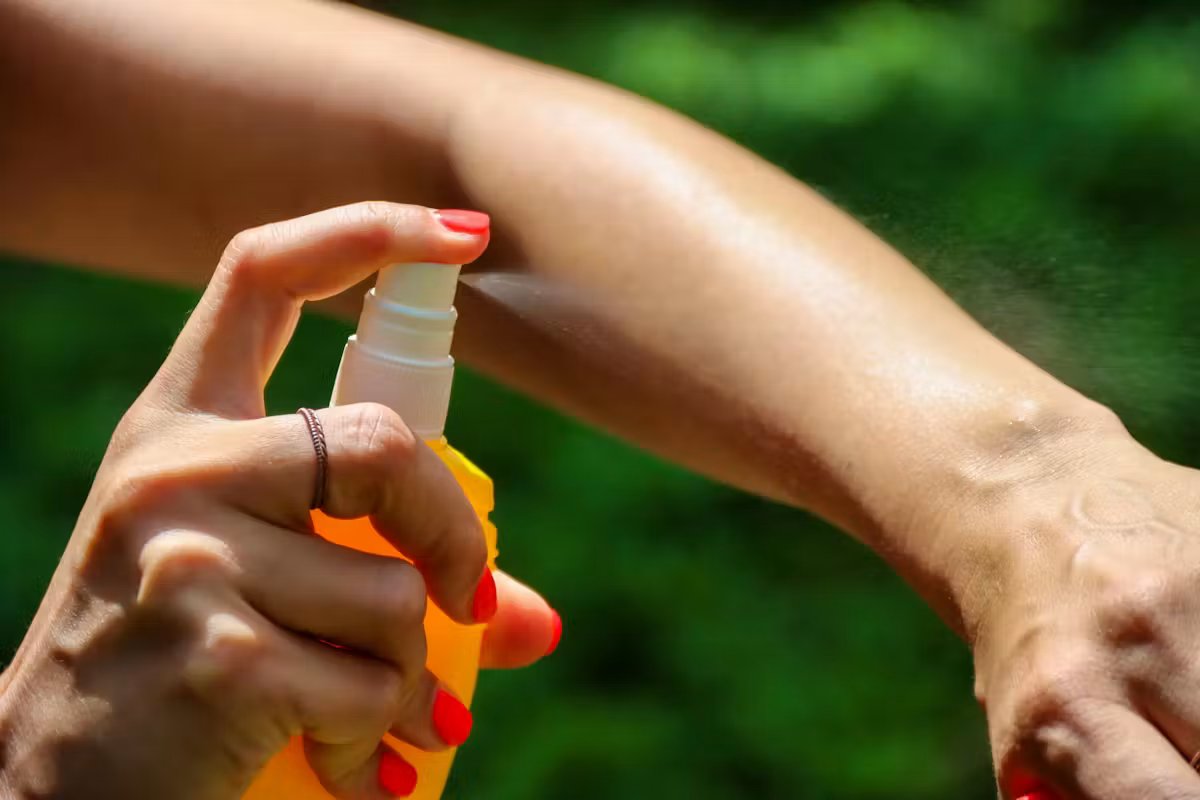
- Mosquitoes can learn to associate the smell of deet with food.
- A study shows that trained mosquitoes can be attracted to deet.
- Nevertheless, Deet remains the gold standard in mosquito repellent.
Mosquito bites are not just unpleasant: Through them you can too Infections enter the body. That’s why many people use defense sprays with things like Deet (see box). They are considered particularly reliable. But they don’t offer 100 percent protection – because the insects grow fond of the smell over time, according to researchers at the University of Tours.
Deet helps, but caution is advised
That’s why Deet attracts mosquitoes instead of repelling them
“Mosquitoes (Aedes aegypti) are attracted to Deet if they have previously learned to associate its smell with food,” says Claudio R. Lazzari’s team. Especially when the concentration applied decreases. The research group have now proven this for the first time. “We knew that Deet reduces its effectiveness as a repellent when mosquitoes come into repeated contact with it, but whether it could actually be attractive had not been tested before,” says Lazzari.
Fed mosquitoes with blood: This is how the researchers proceeded
In their study, the team followed a similar approach to that of the Russian physiologist Ivan Pavlov, after which the famous Pavlov effect was named: It fed initially Mosquitoes in the laboratory with warm blood and then sprayed her with the scent Deet. They repeated this process three times. Afterwards, more than 60 percent of the animals tried to sting when they smelled the smell of deet. In another experiment, the mosquitoes were given a choice between two human hands – one untreated and one treated with deet. Result: Untrained mosquitoes avoided the treated hand. Trained mosquitoes were attracted to it.
Are you a mosquito magnet?
“Until now, it was generally assumed that repellents work because of their chemical composition – that Deet simply smells unpleasant for mosquitoes and therefore they flee or that its chemical effect prevents mosquitoes from smelling us,” says co-author Clément Vinauger from Virginia Tech University.
“I think this is a paradigm shift.”
“However, we show that the mosquito’s brain can reprogram this response based on experience. What the insect has learned is just as important as the effect of the chemical. I think this is a paradigm shift.”
And now?
Until now, Deet products have been considered the gold standard when it comes to protection against mosquitoes. According to the researchers, nothing will change. “If you are in tropical regions where there is a real risk of disease, you should use it,” says Vinauger. However, their study suggests that timing and concentration could play a larger role than previously thought. “Instead of applying a lot at once, reapply it regularly so that it is always active and provides continuous protection,” says Vinauger.
The study is in «Journal of Experimental Biology» appeared.
Subscribe to the knowledge push!
Subscribe to Knowledge Channel notifications in the 20-minute app. You will be informed about groundbreaking research findings and discoveries, explanations of current events and curious news from the wide world of science. You will also receive answers to everyday questions and tips for a better life.
This is how it works: Install the latest version of the 20 Minutes app. Tap on “Profile” at the bottom, then on the “Settings” gear and finally on “Push notifications”. Select the topics you want here.

Fee Anabelle Riebeling (fee) has been working for 20 minutes since 2014. She is deputy. Head of Knowledge, History & Digital and Head of the Fact Check & Verification expert committee.