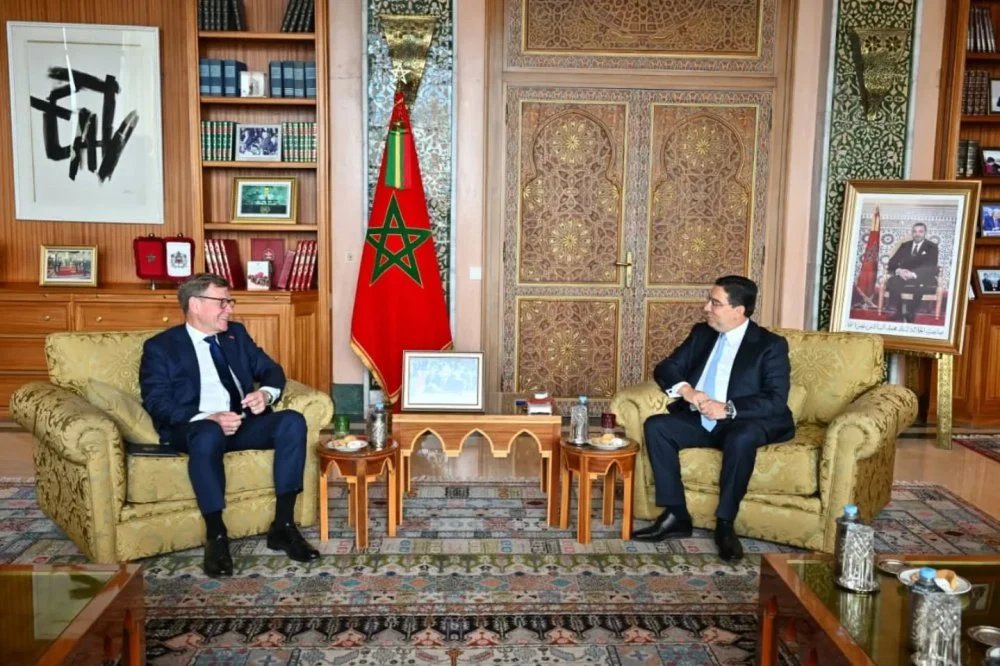
Seven billion three hundred and seventy million euros of exchanges in 2025, compared to 4.9 billion just three years earlier. Three hundred German companies established from Tangier to Kenitra. A 49th global position among German export destinations, neck and neck with much larger economies. The recent figures for the bilateral relationship are very eloquent: they show an uninterrupted rise in power, indifferent to the turbulence that the international environment is also going through. It is in this dynamic that the official visit of Johann Wadephul in Rabat on Thursday, as part of the multidimensional strategic dialogue which brings together every two years the heads of diplomacy of the two countries. A trip that has triple symbolic significance: it is the minister’s first trip since the Chancellor came to power. Friedrich Merzit coincides with the year of the 70th anniversary of the establishment of diplomatic relations, and it takes place against a backdrop of rapid consolidation of a partnership whose depth seemed improbable just four years ago.
Berlin’s direct message on X
Deutschland & Marokko verbindet der Einsatz für eine international Ordnung mit gleichen Rules für alle. Gemeinsam sind wir überzeugt, dass starke international Institutionen unseren Interesten dienen, insbesondere in gestärktes @A-System. (1/5) pic.twitter.com/rl4OOCynJx
— Johann Wadephul (@AussenMinDE) April 30, 2026
The head of German diplomacy also highlighted the human dimension of cooperation: “More than 300 German companies are investing in Morocco and meeting a young and well-trained population. At the same time, Moroccan skills provide important support in professions where Germany lacks workers, such as in the health and care sector.” A direct reference to the qualified labor mobility agreements signed in recent years between Rabat and Berlin.
The fourth message traces the economic roadmap for the coming years. “In our economic relations there is still considerable potential. In the field of solar and wind energy and green hydrogen, but also critical raw materials and battery production, in all these sectors of the future, we want to further diversify our supply chains,” wrote Johann Wadephul. The wording is clear: for Berlin, Morocco is no longer just a trade partner, but a central part of the German strategy for securing post-pandemic and post-energy crisis value chains.
To measure the progress made in recent years, we must look back to the spring of 2021. For eight months, the two capitals observed each other in silence, after a series of disagreements relating in particular to the Moroccan Sahara issue and the convening of a meeting of the UN Security Council to which Rabat had not been invited. The recall for consultations of the Moroccan ambassador to Berlin at the time stunned European chancelleries accustomed to the stability of the German-Moroccan relationship. The unblocking takes place in January 2022, thanks to a message sent by Federal President Frank-Walter Steinmeier to HM King Mohammed VI on the occasion of the New Year. The German Head of State welcomes the reforms undertaken by the Kingdom under the leadership of the Sovereign and confirms Berlin’s readiness to pick up the thread. Seven months later, the Joint Declaration of August 25, 2022 recorded, in Rabat, the opening of a “forward-looking” partnership, a diplomatic formula which marked the transition from a logic of crisis management to a logic of construction.
Since then, the milestones have come one after the other at a steady pace. First session of the multidimensional strategic dialogue in Berlin in June 2024. Signature of a Moroccan-German alliance for climate and energy the same week, which structures cooperation on green hydrogen, electricity trade and industrial decarbonization. Amendment to the agreement governing German political foundations in Morocco initialed in September 2025 in New York, on the sidelines of the United Nations General Assembly. And, now, this trip by Johann Wadephul which inaugurates the diplomatic mandate of the Merz era.
The Sahara, industry and the 2030 World Cup
The industrial component extends this political confidence. The reference plant for the production of green hydrogen, which is expected to start up in the coming years, supported by German cooperation, is targeting an initial capacity of 10,000 tonnes per year, sufficient to produce 50,000 tonnes of green steel. Designed as a demonstrator of economic viability for the entire African continent, it follows in the wake of the Ouarzazate solar power plant, the construction of which was supported by German cooperation. At a time when Berlin is reorganizing its African priorities and the Kingdom is refining its Euro-Mediterranean positioning, anchoring this bilateral relationship is no longer optional. For both capitals, it becomes an infrastructure.