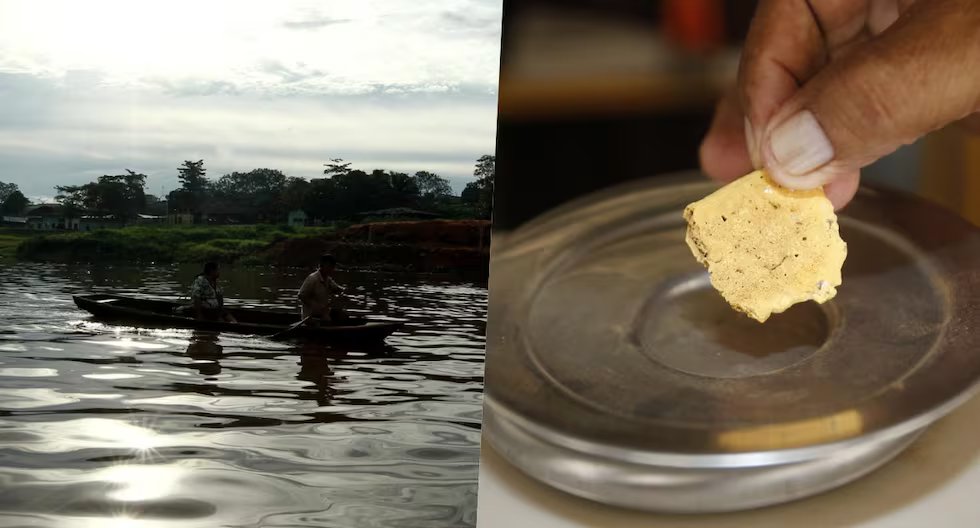
The high international price of this metal, the level of purity that can reach 24 carats and the weak control, has caused illegal miners to install their dredges in bodies of water, which are rustic rafts that stir river beds to suck out the gold mixed with gravel.
Calculations by authorities and measurements by non-governmental organizations estimate that 350 of these dredges would currently operate in the channels of 13 rivers in the region. Something that was ratified through satellite images provided by Amazon Conservation (ACCA).
Each dredge, operating continuously, is capable of extracting 7.2 kilos of gold per year, so it is estimated that the 350 dredges could be producing no less than two and a half tons each year. In the international market, this volume of gold extracted from these rivers exceeds S/ 1,000 million.
—The coveted metal—
Although the provisions prohibit the delivery of mining concessions in natural areas or river sources, illegal mining has taken over 13 rivers in the region. The Nanay, whose waters are destined for the population of Iquitos, is one of the Amazonian rivers where illegal mining has been established, and a report from the RAMI (Radar Mining Monitoring) platform – published in 2025 – indicates that there were 65 dredges. Recent information indicates that the number of dredges totals 80 to date.

“The gold that is extracted from that basin is the purest, which is 24 carats. It is the one that is extracted in large quantities,” said Fernando Castro, former prosecutor of the Specialized Environmental Prosecutor’s Office (FEMA) of Loreto.
Georeferenced photographic and satellite images – provided by the Peruvian Air Force (FAP) – show the existence of 45 dredges in the Marañón River. By 2026, the number has reached 65, and they are distributed between the section between the town of Borja (entrance to Pongo de Manseriche) and Saramiriza, province of Datem del Marañón.
El Tigre, the third river with the most records, has more than 60 dredgers that operate with total impunity due to the lack of control in said area. Until a few years ago, this river was only used to transport illegal mining supplies, in order to avoid the police controls located in the Nanay.
A dredge with four people – including an administrator, a diver, a cook and an operator – can extract up to 50 grams of gold in 20-hour days. In a week that same dredge can reach about 150 grams.
Due to police operations, some dredges are destroyed, but the miners are able to operate them again in a few days. “Bossers can have one to four dredges. Some are more difficult to destroy like the ‘strakes’ because they are built with metals. However, repairing a dredge and putting it afloat only takes a week at most,” explained Bratzon Saboya, from FEMA.
An investor known as ‘Patrón’ manages several dredges which are operated near a community that serves as a supply center. In exchange for the permission of the Apu (communal chief) and his residents, the so-called bosses agree to employ them as laborers, cooks or divers on their dredges.
Environmental lawyer César Ipenza warned that Loreto’s rivers will continue to be attractive for illegal mining. “These rivers have become suppliers of gold due to the lack of State control and because national and foreign criminal organizations, such as Colombian, Venezuelan and Brazilian, operate with total impunity,” he stated.