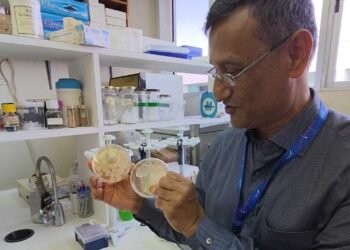
The government’s move to patent a group of microbes discovered by UWI Cave Hill science researcher Dr Bidyut Mohapatra could create multi-billion-dollar opportunities for Barbados, the country’s export promotion chief has said.
The push to patent began after Dr Mohapatra attended a major US conference, where three global pharmaceutical giants tried to buy his work. Instead of taking the money, the scientist turned them down to keep the discoveries at home and seek patents through the government.
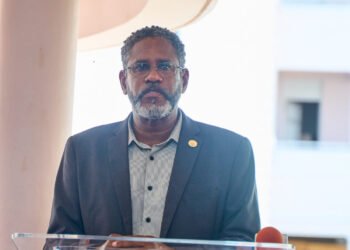
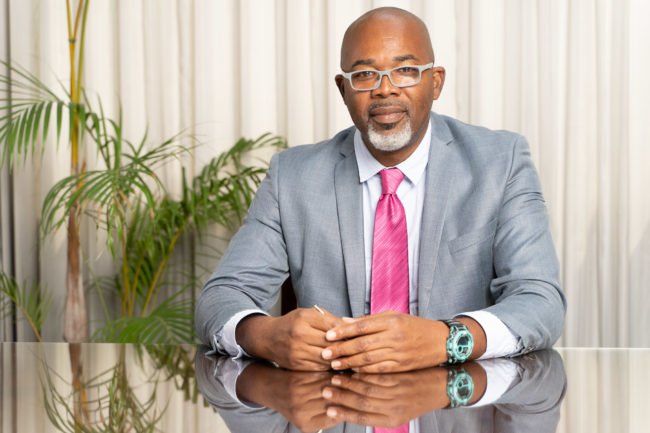
Praising the scientist’s loyalty and the government’s quick action, Chief Executive Officer of Export Barbados Mark Hill said it was a major opportunity for Barbadian industry.
He said: “Securing the intellectual property in the Barbados space is a critical step going forward. Dr Mohapatra is definitely moving in the right direction. There is significant commitment from both Dr Mohapatra and the government towards securing this [intellectual property] and leveraging it as a key part of Barbados’ industrialisation going forward.”
Minister of Industry, Innovation, Science and Technology Jonathan Reid is said to be leading the patent effort, following talks with Prime Minister Mia Mottley and Dr Mohapatra. Hill said the development fits Export Barbados’ goal of building industries around the 3Ms — molecules, microbes and materials — and turning basic biology, such as seaweed, into valuable medicines and foods.
“Barbados historically has been science-driven,” Hill said. “We were leaders in fermentology, and what the professor is doing is helping to put Barbados back on that footing as a space where great science happens. This is all part of the focus we have on re-industrialising the island around science and technology.”
Export Barbados is using its ‘ID to IP’ programme to give the researcher the legal and structural help needed to obtain international patents. The main goal is to protect Barbados’ ownership before signing any deals with global drug companies.
“The first step is to secure the intellectual property and support the patent,” Hill explained. “Once the patent is secured, then you enter into licensing arrangements with the different pharmaceutical companies. If you take the microbes over to the pharmaceutical companies without securing the intellectual property, basically you have transferred your equity directly into their factory and eroded your position to negotiate.”
Having legal ownership gives Barbados a stronger negotiating position, especially since the microbes are being explored for their potential to address drug-resistant infections, microplastic pollution and ocean damage.
Hill added: “At this point, it is going to be difficult to put it in exact dollars and cents, but the reality is that the doctor is solving three big problems that run into the billions of dollars.
“Antimicrobial resistance is a massive issue facing the global healthcare system, representing a billion-dollar opportunity alone. When you look at the capabilities of these microbes in tackling plastics and healthcare challenges, you are not looking at million-dollar opportunities—you are looking at billion-dollar opportunities.”
Beyond the immediate financial returns, the Export Barbados CEO said commercial royalties, licensing fees and reinvestment could revitalise the scientific community.
Barbados has established strong scientific credentials through sugarcane genetics, agricultural innovation and rum fermentation as far back as the late 1800s. A return to advanced biological research is being touted as consistent with the island’s established strengths.
“Barbados has a historical industrial relationship with the life sciences,” Hill said. “What this does is put Barbados back on the front burner of what we are extremely good at. It shows that while we are a small island, we have big scientific capability. The value that comes from that level of intelligence can only augur well for an exciting future in the industries that spring from the life sciences.”
In the 1880s, as the sugar industry came under pressure from European sugar beet producers, drought and plant disease across the West Indies, Barbadian agronomist John Redman Bovell financed his own experiments with different cane varieties. He moved away from the widely used Bourbon cane and focused on the White Transparent variety.
His breeding work helped establish Barbados as one of the Caribbean’s leading cane-breeding centres. Beyond sugar cane, Bovell also developed several strains of Sea Island cotton. Work on both cash crops began at Groves, St George, and continues to this day.
Bovell was honoured for his work with his portrait being used on the $2 bill when it was introduced in 1980, 52 years after his death.
(RR)