São Paulo
The announcement of the edition of Michelin Guide Rio and São Paulo this Monday (13), in a ceremony at Copacabana Palacebrought long-awaited news: for the first time, the country has restaurants with three stars, the highest rating in the French award.
Chefs Ivan Ralston, from Tuju, and Luiz Filipe Souza, from Evvai, both from São Paulo, are now the first to boast the classification in Latin America. Worldwide, 154 addresses hold the distinction.

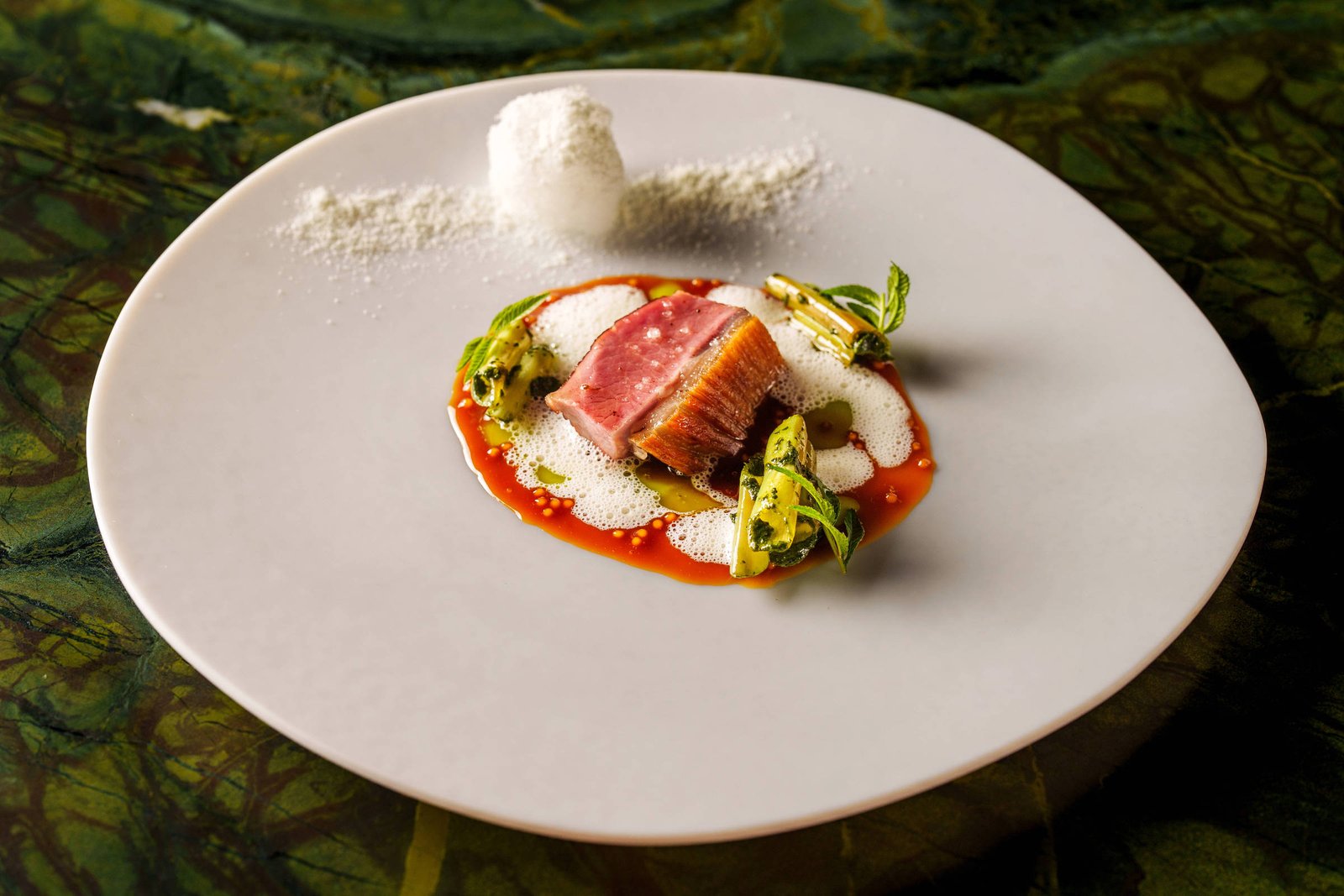
Dish served at Tuju restaurant, in São Paulo
–
@kato78/Disclosure
Born in São Paulo, Ivan studied at the Esculea de Hosteleria Hofman, in Barcelona, before working in the kitchens of starred restaurants such as Mugaritz, in Spain, and RyuGin, in Japan.
Today, Tuju offers a tasting menu (R$ 1,500) built with ingredients that vary according to the rain cycle that is part of the seasons — a logic developed and researched by the house. Products from the state of São Paulo also have a strong presence.
The house, opened in 2014, has been operating at its current address since September 2023, after being closed for three years. Hospitality is highlighted in the space designed from scratch to be a restaurant of fine dining, consisting of three floors of a house with clean and assertive lines in a dead-end street in Jardins.
“This award, firstly, has enormous importance for our team. They are the ones who drive it all. For Brazilian and Latin American gastronomy, it shows that people are reaching this level of excellence. There will be more tourism, people who want to know the starred restaurants and also the other restaurants”, says Ivan, over the phone, to Sheet.
Luiz Filipe Souza also mentions the potential of gastronomy for tourism: “It is hugely important for the country. Now, we can say to Brazilians, who travel a lot, that our restaurants, products, people, have the same level as internationally awarded restaurants”.
The chef, who opened Evvai in 2017, consolidated his own language that connects Brazilian ingredients with the influence of Italian cuisine brought by immigrants in a tasting menu (R$ 1,250). Before that, he worked in award-winning kitchens outside Brazil, such as Reale, owned by chef Niko Romito, a restaurant that has three stars in Italy.
“I thought I had lost the two stars,” said chef Luiz Filipe Souza, who was called to the stage only at the end of the ceremony.
The French publication gives restaurants three (exceptional cuisine), two (excellent) and one (refined) stars, in addition to the Bib Gourmand title (for establishments with a good relationship between quality and price).
In this edition, three restaurants maintained two stars: DOM, by chef Alex Atala, Lasai, by Rafa Costa e Silva, and Oro, by Felipe Bronze. There were no newcomers in the category.
The number of houses with one star fell to 19; in 2025 there were 20. Madame Olympe, a restaurant by chef Claude Troisgros, was the only new addition to the list.
The restaurants Casa 201, Fame Osteria, Jun Sakamoto, Kan Suke, Kanoe, Kazuo, Kinoshita, Kuro, Maní, Mee, Murakami, Oizumi Sushi, Oseille, Oteque, Ryo Gastronomia, San Omakase and Tangará Jean-Georges maintained one star.
The Bib Gourmand category brought new additions to the list such as Jiquitaia, Manioca JK, Ping Yan Thai Bar & Food, Taboa Cozinha Artesanal and Tanit — all in São Paulo.
The event also presented the restaurants that are part of the guide’s annual selection, but do not boast stars. Aiô, Borgo Mooca and Cais, in São Paulo, are among the recommended addresses. Also included in this list were Bar da Dona Onça and Simonein São Paulo.
The ceremony also gave special prizes. Three restaurants maintained the green star, given to restaurants with exemplary sustainability practices. They were A Casa do Porco, Corrutela and Tuju.
He was awarded the young chef Pedro Coronha, from Koral, in Rio de Janeiro. The professional has spent time at starred establishments such as Noma, in Denmark, and Eleven, in Portugal.
The recognition for best service in restaurants went to Raphael Zanon, from Rio’s Casa 201. The cocktail award, which honors the quality of drinks, went to Anderson Oliveira, from DOM, for the first time in Brazil.
The night featured a performance by actress Nathalia Dill. Eduardo Cavaliere (PSD), mayor of Rio, and Gwendal Poullennec, international director of the Michelin Guide, also participated in the ceremony.
In 2025Brazil had 25 restaurants listed in the Michelin Guide. Of these, 20 houses won a star, including newcomers Casa 201 and Osseile (RJ) and Kanoe and Ryo (SP). Fame, Jun Sakamoto, Maní, Picchi and Cipriani also joined the group.
Last year, five restaurants received or maintained two stars: DOM (SP)Evvai (SP) Oro (RJ), Tuju (SP), and Lasai (RJ). There were no representatives with the maximum rating, three stars.
Establishments are evaluated by inspectors anonymously. Professionals consider criteria such as quality of ingredients, harmony and balance of flavors, good technical execution, personality that the chef expresses in the kitchen and consistency of the menu over time. Restaurants are re-evaluated every year to ensure standards have been maintained.
In its Brazilian version, Michelin only evaluates starred addresses in the cities of São Paulo and Rio de Janeiro since it debuted in the country 11 years ago. The Brazilian edition of the Michelin Guide was the first published in South America.
The guide remained unpublished in the country from 2021 to 2023. The following year, returned to Brazil thanks to a joint investment of R$9 million from the city councils of São Paulo and Rio de Janeiro to make the award viable until 2026.
In contracts with the French Michelin, it is necessary to make extra investment for a ceremony to take place — the guide is published independently of the award event and has an online format, available on the Michelin website and app.
Created in 1889, the guide was launched by brothers Edouard and André Michelin, in France. The project was available free of charge and provided information on where to gas up and repair the car, as well as where to eat and stay.
The publication began to be sold in the early 1920s and, years later, began to hire professionals to visit establishments anonymously — today, known as inspectors. In 1926, restaurants began to receive stars and, five years later, they began to be classified on a scale ranging from one to three.
See the 2026 Michelin stars
Three stars
Evvai (SP)
Tuju (SP)
Two stars
DOM (SP)
Gold (RJ)
Lasai (RJ)
One star
Kan Suke (SP)
Kanoe (SP)
Kuro (SP)
Murakami (SP)
Fame Osteria (SP)
Picchi (SP)
Jun Sakamoto (SP)
Maní (SP)
Ryo Gastronomia (SP)
Kazuo (SP)
Kinoshita (SP)
Oizumi Sushi (SP)
Tanager Jean-Georges (SP)
Madame Olympe (RJ)
San Omakase (RJ)
House 201 (RJ)
Oseille (RJ)
Oteque (RJ)
Mee (RJ)