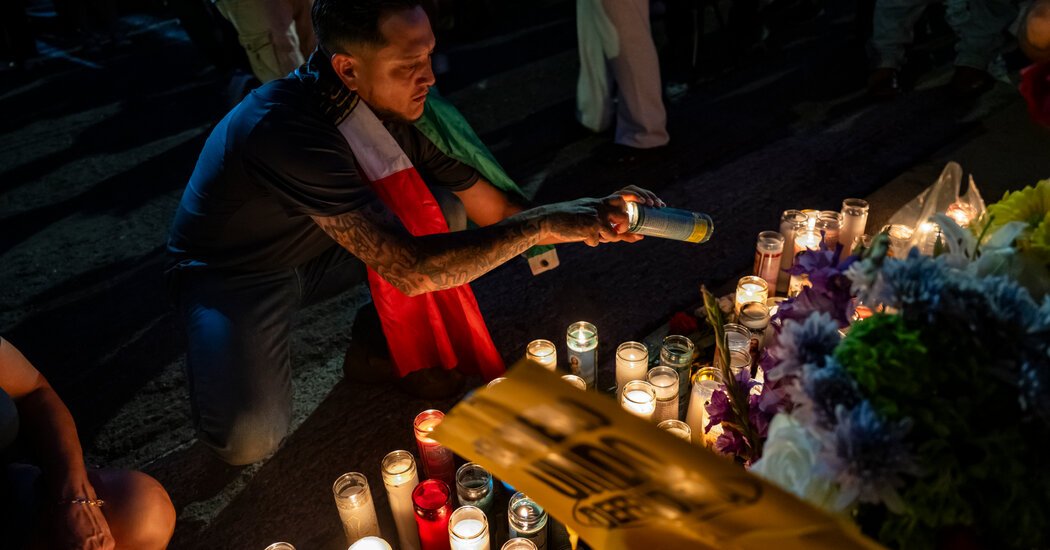
Mexican officials said on Thursday they planned to file criminal complaints in the United States over the deaths of several Mexican nationals during immigration operations, in the nation’s most confrontational protest yet against President Trump’s immigration policies.
Roberto Velasco Álvarez, Mexico’s foreign affairs minister, announced the move in a news conference on Thursday, two days after an Immigration and Customs Enforcement agent fatally shot a Mexican man who had lived and worked for decades in the United States and was trying to obtain legal residency.
Mr. Velasco said Mexico would file the complaints with U.S. state prosecutors and the U.S. Department of Justice, requesting criminal investigations into the deaths of 14 Mexican citizens in immigration detention centers and of three others during enforcement raids under the current administration.
In a statement, the U.S. Department of Homeland Security did not deny Mexico’s tally of its citizens who have died in the department’s custody, but rejected accusations that migrant deaths have spiked since Mr. Trump returned to office. The U.S. Department of Justice did not respond to a request for comment.
In Mr. Trump’s second term, relations with Mexico have grown increasingly strained, as he has lobbed verbal attacks and threats of tariffs at the country.
His administration has also increased pressure on Mexico to crack down on corrupt officials and cartels, threatening military action against the criminal organizations. President Claudia Sheinbaum of Mexico has pushed back, stressing sovereignty as a pillar of the two countries’ relationship. U.S. prosecutors have indicted 10 current and former Mexican officials — including a sitting governor — and demanded their detention for extradition. Mexico has refused to comply, arguing insufficient evidence against them.
The Trump administration’s treatment of undocumented Mexican immigrants has been another source of diplomatic tension. The fatal shooting of Lorenzo Salgado Araujo by an ICE agent in Houston on Tuesday was the latest killing linked to the Trump administration’s mass deportation campaign. Homeland Security officials said Mr. Araujo had tried to use his vehicle as a weapon, though no video or other evidence for that claim has emerged.
“We cannot allow our brothers and sisters in the United States to be mistreated,” Ms. Sheinbaum said at a news conference on Wednesday after a reporter asked about Mr. Araujo’s killing. “His only offense was lacking immigration documents.”
Mexican officials said on Thursday the country had already sent 11 requests to the U.S. State Department asking for investigations into immigrant deaths, raised the issue with the U.N. high commissioner for human rights and urged a regional human rights body to review the cases.
But “our goal is to go beyond diplomatic notes,” Ms. Sheinbaum said at the news conference on Thursday, adding that her administration was preparing “more important legal measures.”
Chimène Keitner, an international law professor at the University of California, Davis, said that “the first avenue is diplomatic engagement — and it sounds like this has hit a dead end.”
Some analysts in Mexico fear the move could backfire, lacking enough legal heft to change U.S. policy and further straining relations with the Trump administration.
Rifts between the two countries have persisted even as they host the men’s World Cup together with Canada. At the end of June, as the tournament was in full swing, immigration arrests in the United States quietly surged.
Elda Cantú and Emiliano Rodríguez Mega contributed reporting from Mexico City.