How it moves and returns to its own place to move again Jesuit Matteo Ricci’s map
1.
Spanish Prime Minister Pedro Sanchez gave an important speech at a Chinese university last month. The speech was built around the axis of the narrative when in 1583 “an Italian Jesuit named Matteo Ricci arrived in China. In his small luggage, he brought with him several books, an astrolabe and a map of the world.
It was a European map. Accurate in scale, highly advanced in detail, but lopsided in perspective. Because what he did was show the world as the West saw it: with Europe in the center and Asia at its right end. At the ends of the earth. Upon seeing it, the cartographers of the imperial court asked the Jesuit why China appeared right at the edge of the map. And the European scholar realized for the first time that the Mediterranean Sea was the center of his world, but not of others. Each world had its own center, so Matteo Ricci completely redrew his map. This time, using the Pacific Ocean as its axis and including the entire Eurasian continent within it.”
This part of the speech perhaps describes in a more condensed form the great geopolitical movement (or one of the tectonic movements) that our world is going through, something that Mr. Brzezinski had warned at the beginning of this century, that is, that the weight of history is shifting to the East, with a China reaching the strength of a superpower.
2.
This is a form of resistance. So, to take into account the increased weight of China and the development of Asia in general, and look at the world from the perspective where, as Ricci had redrawn, the Pacific is the axis and we, the Mediterraneans, are part of the Euro-Asian continent.
Between Ricci’s two maps, the one where the Mediterranean is the axis and the one where the Pacific is the axis, there is an intermediate reality, I think or I like to think. So there is an intermediate reality in which it is clear that China is already an accomplished power (not rising, as it was considered during the first quarter of the century), but it is also clear that this fact, as well as the fact that the other power facing it is the USA, does not mean that we live in a world dictated by the balance between these two superpowers.
In fact, we live in a world where there is no balance, that is, in a reality without balance, in a world without a new international order. And, that new international order will take into account, I don’t think, the weight of the two superpowers, but it will also take into account the weight of the middle powers, as the Canadian Prime Minister, Mark Carney, calls his own countries and others (South Africa, Brazil, etc.).
According to Carney, the new international order, moreover, should not be an act of submission to an isolated and transactional world and that “it can be rebuilt by Europe”.
3.
The Europe that Carney thinks can produce a new international order can be understood from where he spoke, the Summit of the European Political Community. The summit, a brainchild of French President Macron, is successfully transcending the narrow limits of the concept of European politics traditionally defined by the EU and its surroundings. In concentric circles that have included Turkey and countries that are not known to each other such as Kosovo and Cyprus or Spain, this year’s summit was held in Armenia and Canada was the guest of the Summit. Thus the mental Europe, that is the European political space, extends from Canada to the Caucasus.
This mental exercise paradoxically reverses Ricci’s first map; when mental Europe stretches from Canada to the Caucasus the Mediterranean takes on more of its symbolic weight. And moreover, it takes on its own value weight, that of the conceptualization of the new world order. The Mediterranean is the birthplace of the “agora”, the public square in which the arguments of free debate are weighed to make the decision of free people, that is, democracy.
And the Summit of the European Political Community in Yerevan had for me this specific weight, the one where Carney and other European leaders conceptualize the new world order in a debate of free and equal people.
It seems an easy thing to say, but at the global level there is no gathering of this type of heads of state or government in which the level of debate is not a protocol act, but an intellectual analytical exercise.
4.
The state of difference between one geopolitical map, Ricci’s first, and the one that will be produced by the new international order has a name, given by the Italian prime minister, Melloni, polycrisis. According to her, we live in times not of one crisis, but when several crises are simultaneously interacting – from migration, energy security, malicious actions by artificial intelligence, the destruction of credibility in democracy and so on. Consequently, it will address the “polycrisis” as a whole.
The address is always Europe’s best move. Be it the EU together with its circle or mental Europe or a powerful Europe with its alliances of open markets from Latin America to India (as the president of the European Commission, U. van der Leyen, will explain).
Or, as the French president, Macron, will explain in a practical way. According to him, the next challenge will be to move away from dependence on the USA and China. Dependence on the US means that of the American defense umbrella, which Europe has been accustomed to since the end of the Second World War. Dependence on China means that of the technology that Europe has become accustomed to since the end of the Cold War.
5.
In Yerevan, the European political community tried to prove that although it is not in the center, as in Ricci’s first map, it is not in the periphery, neither geographically nor politically. Moreover, at the summit before this the borders of this community were Great Britain in the West and Ukraine in the East; this time to the west was Canada and to the east was Armenia. Canada as a “middle power” which must find a modus vivendi with the USA and Armenia, an important strategic point which, being separated from Russia, becomes part of an important energy corridor, therefore also geostrategic from the Caspian Sea to the Mediterranean.
This is how I saw this Summit from the angle of the observer, in Kosovo, deep in the Mediterranean and paradoxically on the margins of Europe.
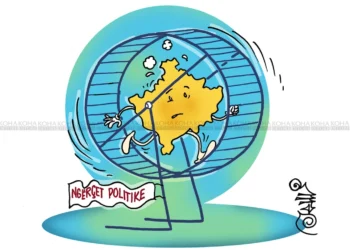
In this depth, far from the self-proclaimed centers of the world, it is perhaps more clearly understood that Ricci’s map is no longer a matter of geography, but of the capacity to produce order: whoever manages to conceptualize and organize the response to the polycrisis, he puts himself at the center.