There is nothing more similar to Sónar than the Rocío pilgrimage, the Niño de Elche recalled in cosmic songthe documentary of cardinal title (comes from Ernesto Cardenal) about his unclassifiable work. Musicians and footballers have been in charge of keeping alive a flame that the vertigo of industrial society has been suffocating: ritual. Everything seems new, but the stadium mystique U2 did not invent it with their version of Psalm 40: museums know the importance of another film in the 1980s—the fascinating Rock My Religionby the sculptor Dan Graham—to point out the relationship between the contortions of concertgoers and the ceremonies of some Protestant communities such as the shakers.
May 1968 put an end to everything that sounded like formality – and there is nothing more formal than a rite – but it facilitated the entry of guitars into post-conciliar masses by verifying that at Our Father it suited him a Simon & Garfunkel tune. The culmination of the rural exodus to the cities, the consequent erosion of community ties and the triumph of deceptive turbo-capitalist individualism—always connected, always isolated—confused the most impatient thinkers. Among them, to Byung-Chul Hanwhose books always have 50 pages missing or extra (they usually have 100). Thus, at the gates of the pandemic, he published The disappearance of ritualsan essay about the abandonment of the symbols that traditionally served to unite a society. Han’s thesis, of course, had the virtue of remembering that mass does not equal community and of pointing out that that abandonment did not translate into emancipation, although the latter is easier to sustain for someone who was born in Seoul and lives in Munich than for someone who has done so in a town on the Castilian plateau. Hence he spoke of “event management” to refer to current parties and festivals, which would have nothing to do with the “sublime” past time.
The problem is that the past never ends. For years, less apocalyptic scholars have been remembering that our time resembles late Antiquity, that very slow transition between the collapse of the Roman Empire and the triumph of Christianity. The feeling of emptiness and bewilderment is, they say, similar. This is said, among others, by the inventor of the formula —Late Antiquity―, historian Peter Brownwho dedicated a pioneering study to that liquid phase of the Greco-Latin heritage. He also dedicated another to the primitive cult of saints in that period in which fervor prevailed over the norm. The first Christians, he says, associated worship with euphoria (not the HBO series) and they did not go to the tombs of the martyrs to pray but to participate, to play, to rub against the tombs, to drink the oil from the lamps. It was his way of connecting with the “other world.”
Since fan and fanatic come from the same word ―fanum (temple)―, it is not surprising that, when it comes to collective identities, one that had millennia of experience and the best icons in the catalog reappeared: religion.
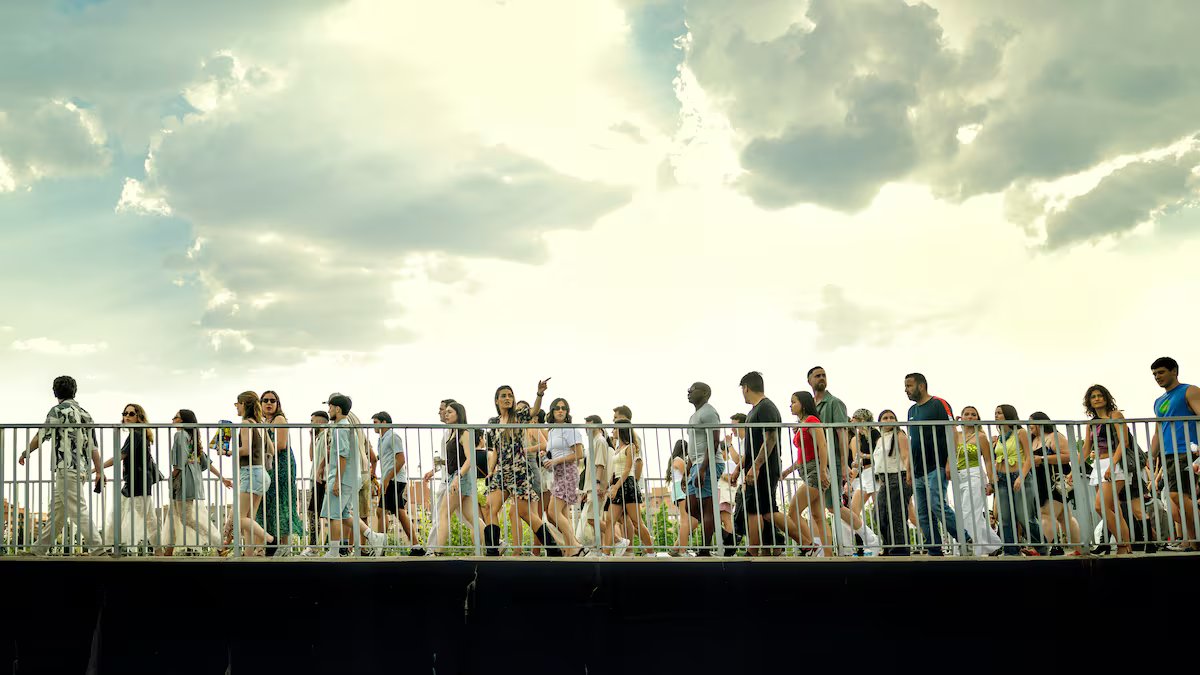
If the pandemic imposed a closure besieged by death, its end unleashed a renewed search for meaning and community rituals. It was about becoming part of something bigger than yourself again. Decades of secularism had turned those feelings into artifices such as the country, football and fandom. Since fan and fanatic come from the same word ―fanum (temple)― and in the case of collective identities with claims to transcendence, it is not surprising that one that had millennia of experience and the best icons in the catalog reappeared: religion.
The coincidence in Spain of the Pope and Bad Bunny is the squaring of the circle, more than just an example of prophetic coexistence between lion and rabbit. One has decided to stage his pagan week of passion on a football field and turn his little house into a sanctuary to which only the chosen ones who observe the rule of Saint Benedict have access. At one point in the concert, witnesses say, he asks the faithful to put their cell phones away and give each other fraternal peace. The other, Augustinian reader of The City of Godhas summoned the young believers not to the Cuatro Vientos desert but to the pure urban center. A sign that ―despite the accusations of fatphobia and pederasty― the spirit of the times blows in their favor.
Catholicism has many dimensions: ritual, social, doctrinal, moral and even spiritual (in Spain it even had a national one). Not all of these dwellings communicate: the procession may be full and the confessional empty (not Rosalía’s). But it is hidden from no one: religion has returned to the public space. Nothing to object as long as the civil and ecclesiastical authorities keep in mind the holy patience that non-denominational citizens are having during days that the mayor of the capital himself announced as “very complicated, very difficult for the people of Madrid.”
Before being liquid, modernity managed to separate Church and State, faith and reason to found individual freedom and social justice in an ethic without threats of divine punishment. And, above all, without the very respectable (and private) belief of some in the existence of heaven turning the lives of others into hell. During your visit Leo XIV will speak at the Congress, the place – with a Greek temple façade – called to embody that ethic. In your Decline and fall of the Roman EmpireEdward Gibbon picked up the phrase from which José Álvarez Junco extracted the title for his study on the historical construction of nationalisms: “The people considered all the religions that existed in Rome to be true; the philosopher considered them all false and the politician considered them all useful.” That’s where we are.