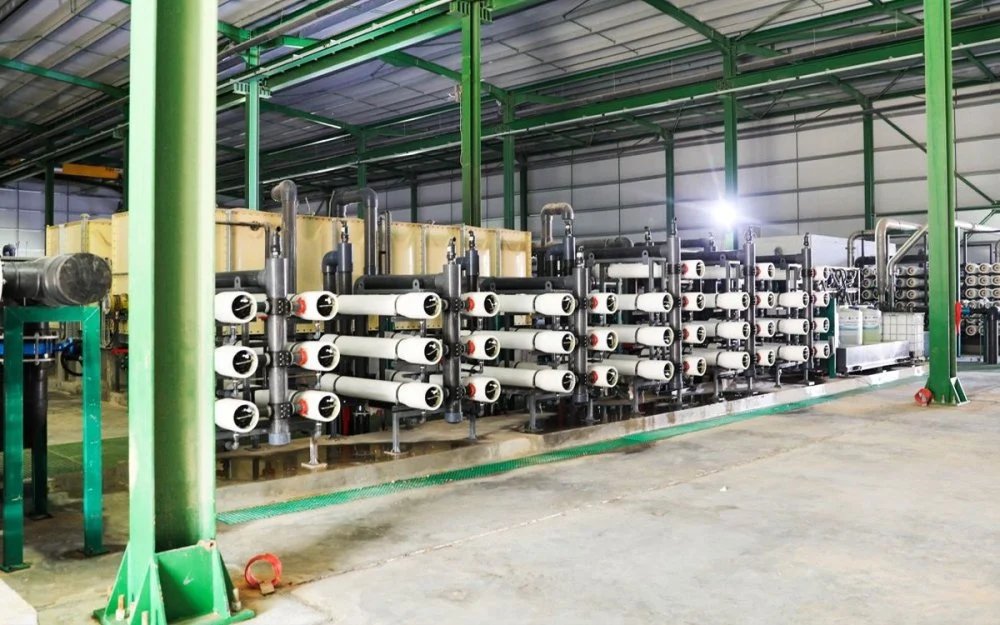
The connection of the Greater Marrakech to the Safi seawater desalination plant marks one of the first realizations of an innovative model of water resources managementbased on the transfer of water resources from territories with alternative production capacities to regions with a structural deficit. Carried by the Multi-service regional company (SRM) of Marrakech-Safithis project, which is scheduled to be commissioned at the end of July, aims to sustainably strengthen the drinking water supply of Cité Ocre, in a context marked by increasing pressure on water resources and the effects of climate change.
Part of the implementation of the High Guidelines of His Majesty King Mohammed VI, aimed at guaranteeing the water security of the Kingdom and accelerating the use of unconventional water resources, including the desalination of seawater, to diversify the water mix in Moroccothis infrastructure will make it possible to transfer a flow rate of 3.2 m3 per second, or nearly 100 million m3 of desalinated water per year, produced by the desalination station built by the OCP Group in Safitowards Greater Marrakech, through a network of 185.3 kilometers of steel supply pipes.
With a total cost of 4.2 billion dirhams, financed by the general state budget and the Ministry of the Interior, this project represents an appropriate response to increasing demand for water linked to demographic growth and the continued expansion of economic activity in the leading tourist destination of the Kingdom.
It should be remembered that Marrakech-Safi has been for several years among the regions most exposed to water stressn due to recurring episodes of drought and increasing pressure on water resources.
This situation made it imperative to resort to sustainable solutions capable of guaranteeing the secure supply of water for the benefit of the provinces of the region.
In a statement to MAP, Mohamed Mezianiprovincial director of SRM Marrakech-Safi in Safi and director of the project to transfer desalinated water from the Safi seawater desalination station to supply Greater Marrakech, indicated that this project constitutes “one of the most important projects carried out on a national scale” in terms of securing the supply of drinking water.
And to explain that the desalinated water will be transported from Safi through three large pumping stations connected by pipes designed to ensure secure and continuous transport, indicating that the volumes of water transferred will converge towards the main reservoir of RamRam, located north of Marrakech, with a capacity of 10,000 m3 while the distribution of water to users will then be ensured by the SRM of Marrakech-Safi.
Mr. Meziani specified that this structuring project includes 185.3 kilometers of main pipes and three pumping stationsnoting that the device also includes a first tank with a capacity of 20,000 m3, two other tanks of 10,000 m3 each, as well as a loading tank of 10,000 m3, from which the water will be transported by gravity to Marrakech.
In this context, he welcomed the fact that this project was carried out by Moroccan skills and financed by the general state budget.
The project enters its final phase
Referring to the progress of the work, Mr. Meziani indicated that the project is currently in its final phase, announcing the imminent launch of technical tests in order to guarantee transporting water to Marrakech in the best conditions.
He assured that, by the end of July, the desalinated water will reach the city of Marrakech and will contribute to sustainably securing its drinking water supply.
In a similar statement, Hicham El Haouhead of the drinking water works department at the Marrakech-Safi SRM, indicated that the project to transfer desalinated water from the Safi desalination station to Marrakech includes four major technical works, namely three pumping stations as well as a loading tank (regulation tank).
He explained that this reservoir, located near the 44 Oulad Dlim center (Marrakech prefecture), receives water transported by the pumping stations with a flow rate of 3.2 m3/s, before transporting it to the city of Marrakech by gravity, in a continuous and fluid manner, through a steel pipe to a distribution chamber which then supplies the different distribution network pipes.
Mr. El Haou recalled that the project provides for two steel pipes: the first will supply the RamRam tanklocated northwest of Marrakech, with a capacity of 30,000 m3, while a new 60,000 m3 reservoir is currently being built to receive desalinated water.
The second pipeline, approximately 35 kilometers long, will supply the Ourika road reservoirswith a capacity of 85,000 m3, to ensure the distribution of water throughout the city.
Once operational, the desalinated water transfer project from the Safi seawater desalination station to supply Greater Marrakech, will contribute to strengthening the distribution network and ensuring for Cité Ocre a sustainable additional water resource not impacted by the context of water stress.