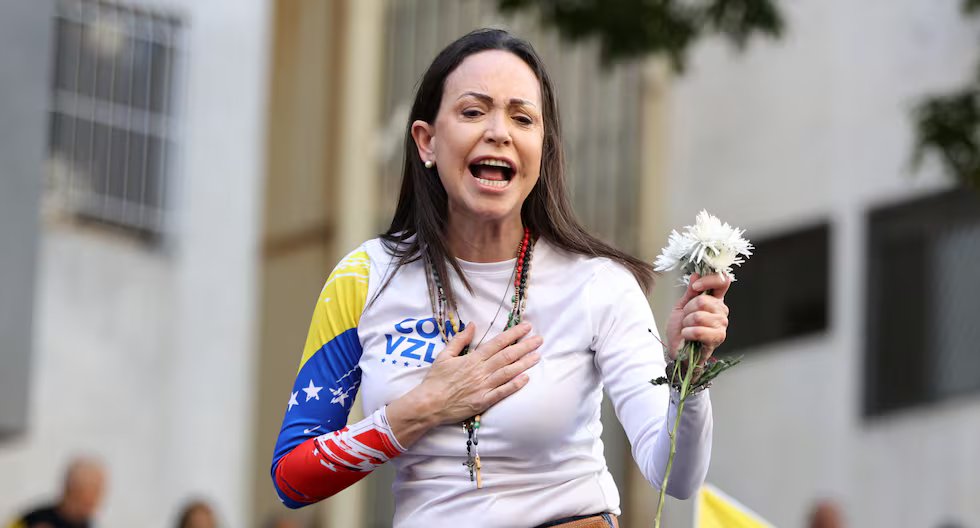
“The time has come, It is my duty to accompany my people, we need to be together to hug each other, to cry, “to grieve together, but also to give each other strength in this very difficult time,” said Machado in an interview with the American network Fox.
The also prize Nobel Peace Prizewhich is in the exile from 2025, stated that “Very soon I will be back in Venezuela, alongside the Venezuelan people.”

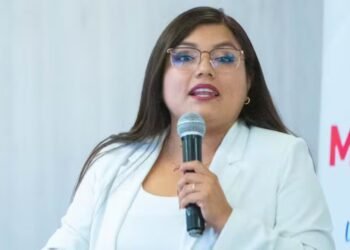
Venezuelan opposition leader María Corina Machado watches during a press conference in Panama City, May 23, 2026. (MARTIN BERNETTI / AFP)
/ MARTIN BERNETTI
On Monday, Machado published a video where he denounced that the Delcy Rodríguez regime closed Venezuelan airspace to prevent his return to Venezuela from Panamacountry where it is located.
“I am in Panama City, from where I planned to travel to Venezuela. The regime closed the airspace of our country to try to stop me,” said.
USAwhich has a pragmatic relationship with the interim president Delcy Rodríguez, I would not agree with the return of Machadoaccording to a report in The New York Times.
Two officials of the President’s Administration donald trump They told the NYT that Machado has asked Washington for help to return to his country, but His return is seen as “untimely” by the White House.
On Wednesday, June 24, Venezuela suffered two earthquakes of magnitude 7.2 and 7.5 less than 40 seconds apart.
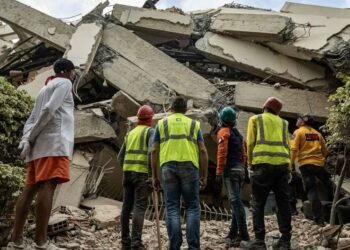
According to official figures, The earthquakes leave at least 1,450 dead, 3,150 injured and an undetermined number of missing people. In addition, serious material damage was recorded in the coastal state of La Guaira, close to Caracas.

The rubble of a building destroyed by earthquakes in La Guaira, Venezuela. (EFE/ Ronald Peña R).
These are the four scenarios that open up for the possible return of Maria Corina Machado to Venezuela:
1. The first obstacle: will you be able to enter Venezuela?

María Corina Machado is surrounded by the press as she leaves the US Capitol after meeting with US senators on January 15, 2026. (Photo by Drew ANGERER / AFP).
/ DREW ANGERER
For the Venezuelan political analyst José Vicente Carrasquerothe possible return of Machado faces significant obstacles, especially if you try to do it by air.
Carrasquero said to The Commerce that Venezuelan authorities could even prevent Machado from boarding a flight to the country, although he did not rule out other means of entry.
“When she says something, she does it. But Venezuela will probably deny her boarding on the plane”, stated Carrasquero.
He added that if entry by air is impossible, Machado could try to enter through land border crossingsalthough he warned that this option would involve greater risks.
“That does not mean that it cannot enter by land. Now, entering by land means entering by trails and that is dangerous”he noted.
Carrasquero indicated that an operation of this type would require special security measures due to the political context and the existing risks in Venezuela.
2. Would they arrest her if she manages to enter?
Although Machado faces restrictions on engaging in politics and accessing public office by popular vote in Venezuela imposed by Chavismo, There is no public confirmation that there is a current arrest warrant against her.
The Venezuelan political analyst Leandro Rodríguez Linarez said to The Commerce that the Venezuelan authorities have the capacity to prevent entry or act judicially against Machadobut considered that An arrest would have a high political cost for Delcy Rodríguez.
“I particularly believe that, in the event of a return, she will not be detained.”, he pointed out.
He explained that An arrest of Machado could aggravate internal political tension and affect stability which, in his opinion, both the Venezuelan Government and the United States seek to preserve in the midst of the emergency and subsequent reconstruction after the earthquakes.
“Acting in this way would lead to a scenario that would scare away investments and generate other political consequences”he indicated.
Carrasquero agreed that An arrest of Machado would have a high political cost for the Government.
“The first thing is that this is going to represent an international scandal”he assured.
He added that an arrest would generate a rapid reaction from the international community and estimated that The United States would be one of the first actors to speak out.
However, he clarified that this would not necessarily prevent the Venezuelan authorities from adopting restrictive measures against the leader.
During the Nicolás Maduro regime (2013-January 2026), High-profile opposition political leaders have been arrested. In 2014, Leopoldo Lopez He surrendered to the authorities after an arrest warrant was issued against him and spent years between prison and house arrest before going into exile. The former metropolitan mayor of Caracas Antonio Ledezmaarrested in 2015, escaped from the country two years later and has not returned due to the judicial proceedings opened against him. More recently, Juan Pablo Guanipa He was arrested in 2025 after remaining in hiding and later released as part of an amnesty. Other opposition leaders such as Carlos Ocariz, Yon Goicoechea, Lester Toledo and José Guerra did manage to return to Venezuela in 2026 without being detained, in a context marked by the amnesty measures promoted by the Government.
3. The role of the United States

María Corina Machado presented Trump with the Nobel medal framed as “gratitude” (EFE).
/ NETWORK TRACKING
Rodríguez Linarez maintained that Machado maintains its own strategy and that, despite the reservations of USA Regarding an immediate return, she seems determined to make it happen.
“She has her own agenda (…). The Trump administration does not want her to return yet, but she insists on returning”, he stated.
This difference in criteria, the analyst indicated, would not necessarily prevent the opposition leader from trying to enter the country.
However, he believes that The most favorable scenario for Machado would be to return with some type of support or protection from the United States.although he admitted that this will depend on the times defined by Washington.
He added that, if Machado decides to bring forward his return, there is a possibility that he will not initially have that support.
“If she rushes her return she probably won’t have that support; however, politically it would be very positive for her to return to the country”he stated.
Carrasquero also doubts that Machado’s eventual return will have the support of Washington.
“If the United States had wanted her to return, they would do it themselves, since they have control in Venezuela (…) Which means that she would be going on her own”, he opined.
4. What would change in Venezuela if Machado returns?

Video capture of a broadcast by the state channel Venezolana de Televisión (VTV) of the president in charge of Venezuela, Delcy Rodríguez. Photo: EFE/ VTV
A survey of Meganalysis published in May by El Pitazo revealed that the 93.8% of those consulted rejects Delcy Rodríguez leading the transition in Venezuela.
While in a hypothetical presidential election scenario, María Corina Machado obtained between 69.8% and 74.5% of voting intentionwell above Rodríguez, who registered between 3.7% and 3.9%according to different questions from the same survey.
Rodríguez Linarez maintained that An eventual return of Machado would further increase his political support within the country.
“María Corina already maintains over 60% popularity and, returning to the country, that support would increase”, he assured.
He stated that the presence of Machado in Venezuela would accelerate the debate on the country’s political future and would reinforce demands for change among the population.
“With it in Venezuela the political changes that the vast majority of the country is crying out for would be brought about more quickly”, he emphasized.
Rodríguez Linarez considered that the poor management of the emergency caused by the earthquakes has increased citizen discontent and could strengthen Machado’s political position.
He pointed out that the institutional deterioration and the response of security agencies to the crisis have increased the desire for change among the population.
“The desire for change is much greater and the return of María Corina would refresh that optimism”, he insisted.
While Carrasquero considered that The magnitude of the emergency makes it unlikely that the national debate will focus on a call for democratic elections in the short term.
“The moment is not for elections. It is a very serious moment”, held.
He recalled that the structural damage caused by earthquakes affects not only La Guaira, but also to Caracas and other towns on the central coast, so, in his opinion, the priority should focus on addressing the emergency.
But at the same time Carrasquero warned that Nor should the crisis serve to prolong the country’s political situation indefinitely.
“Nor can this become a reason for the regime to remain in power”, he stated.