Various route maintenance, supervision and rehabilitation projects, regulated by the Priority Road Infrastructure Law, They were awarded in March past by the Ministry of Communications, Infrastructure and Housing (CIV), through several of its executing units, according to data published on the Guatecompras portal.
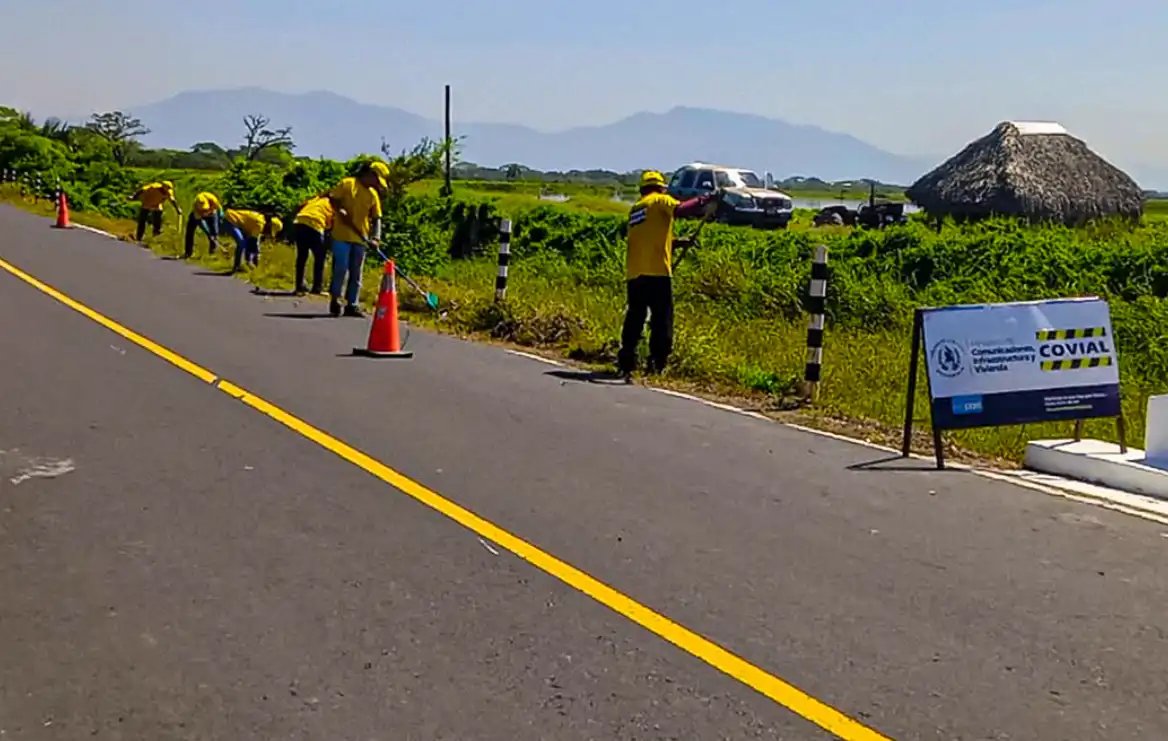
According to the information, nine projects are maintenance and eight are supervision of those worksboth in charge of the Road Conservation Execution Unit (Covial). The rehabilitation of the Río Dulce vehicular bridge, on route CA-13, in Livingston, Izabal, was also awarded. as well as the technical, administrative and environmental supervision for said rehabilitation; Both projects are in charge of the Purchasing Unit of the General Directorate of Roads (DGC).
In total, due to maintenance work on the main routes in the country More than Q1 thousand 95 million will be spent, with contracts that range between eight, nine and ten months, with an estimate for its completion in October, November and December of this year.
The largest maintenance contract amounts to Q. 176.3 million to intervene 39.2 kilometers on the CA-02 Oeste route, in Quetzaltenango, through a package of works that includes milling, laying of asphalt, stabilization, drainage and signaling for eight months.
Regarding the amount of the contracts for the supervision of maintenance projects amounts to more than Q37 million. In relation to the rehabilitation of the vehicular bridge in Río Dulce, Izabal, the amount amounts to Q83 million, and the technical supervision of the same amounts to exactly Q5 million. In total, there are more than Q1,200 million that will be invested by the CIV in these projects.
Maintenance and supervision work will be carried out on the routes established in the Priority Road Infrastructure Law, such as the Central American routes that cross the country, such as CA-1, CA-2 and CA-9 among others.
According to the Minister of Communications, Norma Zea, During the press conference last Monday at the National Palace of Culture, these projects will have “priority” during this year, with the aim of addressing the needs of the country’s road network.
“These projects or these emergencies with the modality of the Road Infrastructure Law have been fully structured in strict compliance with this law. As we have already signed contracts, the companies that will go there, that will supervise these sections, are in the management of enabling the electronic log with the Comptroller General of Accounts,” said Zea.
The Priority Road Infrastructure Law (Decree 29-2024) was approved by the Congress of the Republic of Guatemala in April 2024 and came into effect that same year. Your goal is establish a comprehensive legal framework to plan, develop, contract and execute road infrastructure projects considered strategic for the countryprioritizing national connectivity and economic competitiveness, through special management, financing and supervision mechanisms that seek to expedite the construction and maintenance of the road network.
Dipp should be in charge of projects
The former Minister of Communications, Aldo García, affirms that, to provide an immediate response to the current needs of the road network in the country, it is necessary that the Directorate of Priority Road Projects (Dipp) begin to operate immediatelytaking into account the little time that the current Government has left to be able to carry out some improvement on the roads and national routes.
“The newly formed executing unit for priority infrastructure projects – Dipp – is the one that should begin to act throughout this year, carrying out the technical studies and launching all the tenders so that, next year, at least the projects begin, and since they are multi-year, the next government could finish them,” says García.
According to the former official, the current Government “still has time” for the Ministry of Communications to carry out maintenance and patching of the country’s main routes, but it does not have enough time to carry out new works, such as roads, bridges and other larger projects.
“In terms of maintenance, I think that, if they have time, if not to cover all the kilometers needed in the country, at least they can do a good job so far this year and the next year of the government,” he says.
According to Christians Castillo, analyst at the Institute of National Problems of the University of San Carlos (Ipnusac), The Executive has very little time left to amend the situation of the road network. He states that one of the aspects that affects the portfolio is the slowness with which the funds are executed, which is why it is necessary to expedite the processes through the regulatory framework related to priority road infrastructure in the country.
“Concrete steps must be taken to expedite the execution of these resources by taking advantage of the regulatory framework of the priority infrastructure law that, unfortunately, Congress approved with a deferred period of entry into force, two years if I remember correctly, but despite that there are also other projects that are advancing with the issue of public-private alliances. There is the institutional framework, there is the regulatory framework, we must strengthen the executive capacities of the ministries and the system of development councils to take advantage not only of the resources but also of the legal tools that has been approved by the Congress of the Republic,” he says.
Poor responsiveness
In the opinion of the former Minister of Communications, Aldo García, The current management of the Ministry of Communications has had “little capacity” to respond to the current situation of the road network, which has also been affected by the continuous change of authorities at the head of the portfolio.
“Just the fact that more than three ministers have rotated in this administration, in less than two years, already gives one the feeling that the Ministry of Communications has not been efficient. This generates instability and slowness in the response to the needs of the population,” he says.
Castillo also agrees in this sense, who assures that the work of the Communications portfolio has been affected by the continuous change and rotation of ministers since the beginning of the current Government administration.
“Unfortunately, this ministry has been one of those with the highest turnover of ministers and that has weakened its execution capacity. I believe that strong decisions must be made about who is appointed to that portfolio with the aim that, in this remaining year and a half of management, they can at least urgently address the most critical situation of the country’s road infrastructure,” he assures.
Castillo also considers that another aspect that has affected the work of the Communications portfolio is the prioritization of payments made to hauling works, corresponding to previous administrations, which has reduced the capacity to execute resources for works specific to the current administration, which are not planned for this year by the Ministry of Communications, he concludes.