Mennonites as experts
With three cooperation agreements between the Ministry of Agriculture, Livestock and Fisheries (LVV) and Braganza Marketing Group, the government wants to strengthen national food production, reduce imports and position Suriname as an agricultural export player within the region and beyond. The agreements were signed on January 13 this year, says Lionel Blokland of Braganza Marketing Group, in conversation with the True Time.
Text Ivan Cairo
Image Mike Rodriques
With these contracts, the government is opting for a long-term strategy within the agricultural sector. Mennonites will play a leading role in agricultural activities as ‘international experts’. Recently, environmentalists have expressed concerns about accommodating Mennonites in the interior.
The government has been striving for decades to fundamentally improve results within the agricultural sector. The premise is that this sector must become a crucial pillar for the national economy, especially when income from finite resources, such as gold, gas and oil, will decline in the long term. To make a substantial contribution to the national treasury, revenues in the order of billions of dollars are necessary.
In addition, according to Braganza Marketing Group, the government has expressed the ambition to transform Suriname into the ‘food shed’ of the Caricom. This directly supports the regional aim to reduce food imports by 25 percent. The collaboration with Braganza Marketing Group has been entered into to reinforce these ambitions, with transparency towards society as an important principle.
Strategic use of state land
Blokland states that the collaboration concerns projects that are carried out on domain land that was already reserved for LVV. An essential legal aspect here is that the state of Suriname remains full owner of these lands and retains sovereign authority.
‘The collaboration concerns projects that are carried out on domain land that was already reserved for LVV.’ – Lionel Blokland
The agreements stipulate that the government is authorized to make this state land available under strict conditions and on a temporary basis to achieve specific policy objectives. There is therefore explicitly no question of a transfer of ownership, but of a controlled use of national resources to stimulate economic development.
The choice of specific project locations was inspired by a scientifically based shift in agricultural policy. While the traditional focus was on the Surinamese coastal plain for decades, people are now consciously choosing the Zanderij formation along the Road to West Suriname. After all, the coastal plain is increasingly struggling with salinization, rising sea levels and soil depletion.
According to the initiators, the higher sandy soils of the Zanderij formation offer a more stable and sustainable foundation for large-scale exploitation. In total, this concerns an area of 34,185 hectares, divided over two pilot areas: 10,000 hectares in Kabalebo and 24,185 hectares beyond Goliath, but well before Tibiti.
Expertise and role of Mennonites
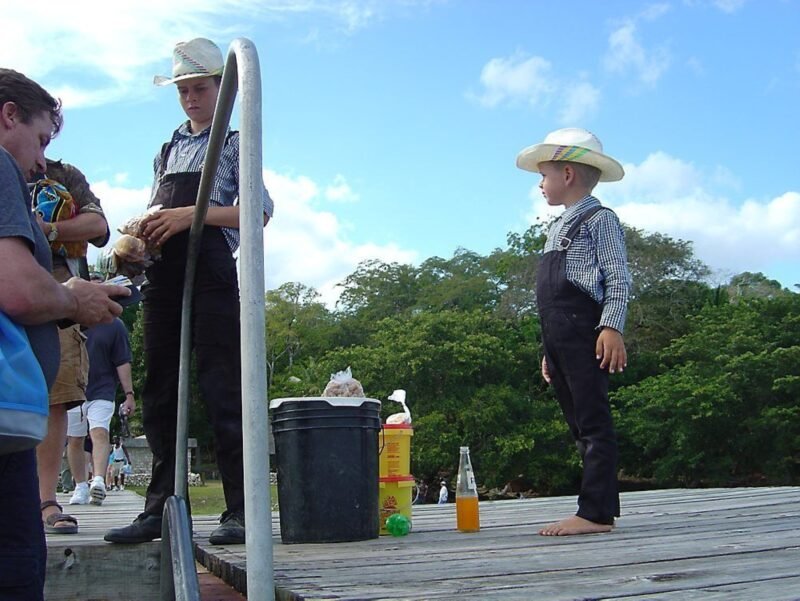
A striking element within the collaboration is the involvement of international experts, including Mennonites. This community is known worldwide for its large-scale and efficient agricultural production, especially in the field of grains. Its participation should contribute to knowledge transfer and increase in productivity within the Surinamese agricultural sector.
Production primarily focuses on strategic staple crops, such as corn, soy and various other grains. These crops are crucial for the domestic market, as they form the basis for the local livestock farming and feed industry.
Although the ambition extends to the international export market, Blokland emphasizes that the absolute priority is to meet local needs. Surinamese companies in the animal feed sector have already shown great interest in future harvests. In addition to the local market, the Caribbean region is the next target, where clear interest has already been shown in Suriname as a supplier of agricultural raw materials.
Economic value versus environmental management
In the national discussion about land use, the potential of climate financing is often pointed out carbon credits. However, the parties involved qualify this picture by citing economic reality. Although the value of undisturbed forest is great, carbon credits on the open market often only small amounts per hectare.
Braganza proposes a model of active, sustainable development. The projected gross annual sales of approximately US$78.8 million represent economic value creation many times that of passive carbon models. Furthermore, it is argued that the double crop cycle on these areas acts as an ‘active carbon pump’, which on balance would sequester more CO2 than a static or degraded forest plot. This would support national climate commitments while stimulating the economy.
‘In total, this concerns an area of 34,185 hectares, divided over two pilot areas: 10,000 hectares in Kabalebo and 24,185 hectares beyond Goliath.’
To monitor the balance with nature, international rules are applied and environmental impact assessments are mandatory. The baseline measurement for this report has already been completed and submitted to the National Environmental Authority. The selected areas cover only 0.2 percent of Surinamese territory, limiting their impact on the total forest balance and the international reputation as a country with high forest cover.
Social impact and local development
A crucial part of the strategy is social embedding in the interior. The choice for these areas was partly inspired by the need for development in the local communities. Braganza Marketing Group has now entered into formal partnerships with the villages of Apoera, Section, Washabo and Witagron. These village communities will have an active role in the project’s control instruments, which should lead to a sustainable ‘Social License to Operate’.
The collaboration provides concrete benefits for the residents. In this way, the communities receive 100 percent priority in filling employment opportunities, ranging from transport services to land work. This is seen as a full-fledged and structural alternative to small-scale gold mining, giving young people the opportunity to continue working in their own region.
In addition, joint responsibility has been agreed for the maintenance of the infrastructure. To directly stimulate local development, a total of six hundred thousand US dollars will be deposited into the community funds of the villages involved for specific projects.
Although the organizational and legal frameworks are in place, actual production has not yet started. Information about the exact size of the investments is not being released at this time, as Braganza Marketing Group considers this to be internal company data. The focus for now is on carefully completing the remaining permit procedures and preparing the pilot areas for the first phase of large-scale agricultural development.