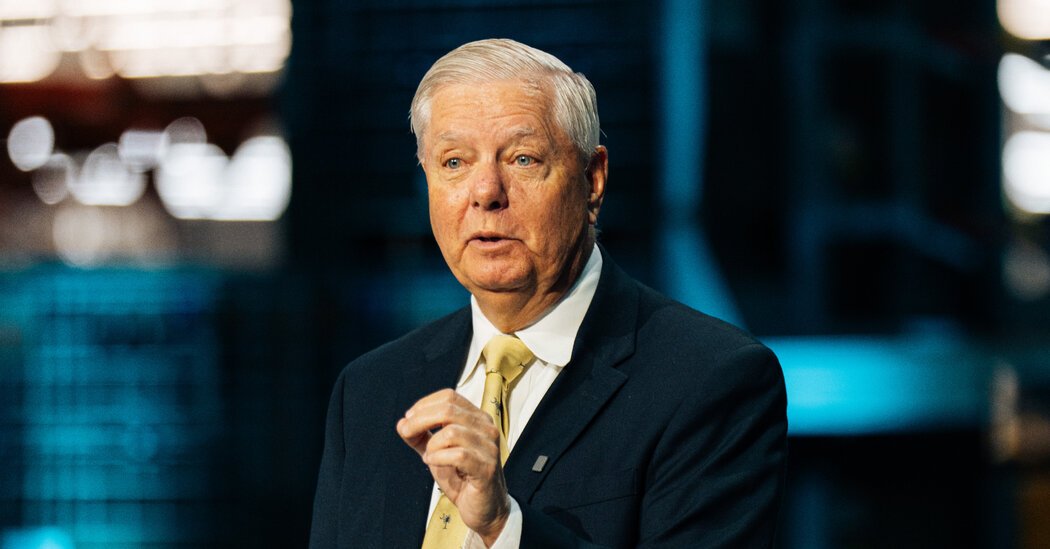
Lindsey Graham, a Republican senator from South Carolina and a onetime opponent turned stalwart ally of President Trump who was a forceful advocate for an interventionist U.S. foreign policy, died on Saturday evening. He was 71.
His office announced the death in a statement early Sunday. Mr. Graham had returned earlier on Saturday from a trip to Ukraine. According to recordings of dispatcher calls obtained by The New York Times, emergency workers responded on Saturday night to a call about a person experiencing chest pains at the senator’s Capitol Hill address.
A preliminary report from the Washington, D.C., medical examiner’s office indicated that the cause was an aortic dissection, a tear in the main artery that carries blood from the heart, caused by arteriosclerotic cardiovascular disease, a gradual weakening and hardening of the arteries.
A former Air Force lawyer who served in the Air Force Reserve while in Congress and was briefly deployed to both Iraq and Afghanistan as a senator, Mr. Graham was first elected to the U.S. House of Representatives in 1994, before winning his Senate seat in 2002. Last month, he fended off five challengers to win the Republican primary in his bid for a fifth term.
Mr. Trump offered his condolences on social media early Sunday, calling Mr. Graham “one of the greatest people and Senators I have ever known.”
“He was always working, and was a true American Patriot,” Mr. Trump added. “Lindsey will be greatly missed!!!”
Gov. Henry McMaster of South Carolina, a Republican, can immediately appoint a temporary replacement to fill Mr. Graham’s seat. Mr. Graham was set to face Annie Andrews, a Democrat and a pediatrician, in the general election in November.
Mr. Graham’s death comes as another influential Republican senator, Mitch McConnell of Kentucky, has spent several weeks in the hospital for undisclosed reasons. It leaves Senate Republicans without a senior lawmaker and reliable vote as they face pressure from Mr. Trump to continue advancing his legislative agenda.
Mr. Graham, who made a long-shot bid for the 2016 Republican presidential nomination that went to Mr. Trump, consistently argued for the use of American military power overseas. He was a fierce supporter of Israel and Ukraine, making multiple trips to both countries, and he recently supported aggressive military action against Iran. He was a familiar face for many world diplomats and leaders, several of whom paid tribute to him on Sunday.
Prime Minister Benjamin Netanyahu of Israel called Mr. Graham a “beloved friend” in a social media post.
“Lindsey understood that the security of Israel and America are inseparable,” Mr. Netanyahu wrote, adding, “Israel has lost one of its greatest friends.”
Mr. Graham helped navigate Ukraine’s often strained relations with the Trump administration after Russia’s invasion in 2022 and often visited Kyiv, the capital, despite regular Russian bombardment of the city. On his recent trip to Ukraine, his final visit overseas, Mr. Graham visited a drone factory and met with President Volodymyr Zelensky.
Mr. Zelensky wrote on social media on Sunday that he was “deeply saddened” by Mr. Graham’s death.
“Lindsey was a true defender of freedom and the values that make our world safer,” Mr. Zelensky added.
Mr. Graham was one of many powerful Republicans who changed their public position on Mr. Trump. As Mr. Trump was rising in his first presidential campaign, Mr. Graham lambasted him as a “demagogue” and a “race-baiting, xenophobic, religious bigot.”
“You know how you make America great again?” Mr. Graham said in a CNN interview in 2015. “Tell Donald Trump to go to hell.”
He later said that he had voted in the 2016 election for Evan McMullin, an independent candidate, rather than for Mr. Trump or Hillary Clinton, the Democrat.
A decade later, though, he was regularly and effusively lauding Mr. Trump. In a speech celebrating his South Carolina primary victory last month, Mr. Graham joked, “Mr. President, you’re not far behind God.”
Over his Senate career, Mr. Graham rose to lead two influential committees, Judiciary (from 2019 to 2021) and Budget (starting in January 2025).
As chairman of the Judiciary Committee, he oversaw the confirmation of Amy Coney Barrett to the Supreme Court after the death of Justice Ruth Bader Ginsburg in 2020. Before he was chair, he played a key role on the committee during the 2016 fight over President Barack Obama’s nomination of Merrick Garland to the court, aiding in Republicans’ success in blocking the pick. In 2018, he vehemently defended Brett Kavanaugh, one of Mr. Trump’s Supreme Court nominees, when sexual assault allegations threatened to derail Judge Kavanaugh’s confirmation.
More broadly, Mr. Graham was instrumental in advancing Mr. Trump’s effort to reshape the federal judiciary. During his tenure at the helm of the Judiciary Committee, the Senate, with Mr. McConnell as majority leader, confirmed more than 200 federal judges, cementing one of the defining conservative legacies of the Trump era.
As chairman of the Budget Committee, Mr. Graham played a central role in translating Mr. Trump’s second-term domestic agenda into legislation. He oversaw the budget resolution that, through a procedure known as reconciliation, allowed Republicans to advance much of the president’s sweeping tax, immigration and spending package without support from Senate Democrats. The effort required months of negotiations among warring factions within his party before the tax package became law last year.
It was a defining accomplishment of Mr. Trump’s return to Washington with a Republican-controlled Congress, and highlighted not only the growing influence of Mr. Graham within his party but also his transformation from a Trump critic into a steadfast and outspoken ally.
After Mr. Graham’s volleys of criticism during Mr. Trump’s first presidential run, the two men became close associates, bonding over regular golf outings. Interviewed on NBC’s “Meet the Press” on Sunday morning, Mr. Trump said Mr. Graham was “like a member of the family.”
While Mr. Graham occasionally voiced disagreements with Mr. Trump, they largely remained in lock step on most policy issues.
“If you want somebody who can go to Washington to help him, I’m your best choice,” Mr. Graham said of Mr. Trump during his recent campaign.
Lindsey Olin Graham was born in Central, S.C., a town in the western part of the state, on July 9, 1955, the elder of two children of Florence James Graham, known as F.J., and Millie (Walters) Graham.
His parents operated a restaurant and bar, then known as the Sanitary Cafe, that Lindsey and his sister, Darline, worked in as they grew up. The family at first lived in a room behind the establishment, eventually moving into a trailer and then into a house next door.
“My home was a bar,” he recalled in his 2015 memoir, “My Story,” adding that he “was loved inside those walls, as much as any child could be loved, by two devoted parents.”
He graduated from high school and went on to become the first member of his family to attend college. In 1976, when he was 20 and his sister was 11, his mother died of Hodgkin lymphoma; 15 months later, his father died of a heart attack.
After their deaths, Mr. Graham became his sister’s legal guardian, later adopting her so she could receive his military benefits.
“Lindsey was always my parent,” his sister, Darline Graham Nordone, told The New York Times in 2015. “There was no doubt in my mind or anyone else’s mind that Lindsey was my guardian.”
Mr. Graham never married or had children. His sister is his only immediate survivor.
After earning a bachelor’s degree in 1977 and a law degree in 1981, both from the University of South Carolina, Mr. Graham served as a lawyer in the U.S. Air Force from 1982 to 1988 before beginning his career in politics. He served a single term in the South Carolina House of Representatives before winning the 1994 race to replace a longtime Democratic congressman who was retiring.
He spent four terms in the House, and was one of the Republican representatives who presented the impeachment case against President Bill Clinton during his trial in the Senate in 1999.
After Strom Thurmond, who had been a senator from South Carolina for nearly half a century, announced his retirement, Mr. Graham sought his seat in 2002, and beat his Democratic opponent by 10 points in the general election.
Mr. Graham was known, especially early in his Senate career, for having something of an independent streak, and he participated in some prominent efforts to find bipartisan solutions to major problems.
He was a member of the so-called Gang of 14 that broke an impasse on judicial nominations during President George W. Bush’s second term, and he voted to confirm two of Mr. Obama’s Supreme Court nominees, Sonia Sotomayor and Elena Kagan.
In 2009, he joined with his Senate colleagues John Kerry, Democrat of Massachusetts, and Joseph I. Lieberman, Independent Democrat of Connecticut, to try to create a framework for compromise climate change legislation. He, Mr. Lieberman and Senator John McCain, Republican of Arizona, were known as the “three amigos” for their many shared international trips as they pressed for American military intervention abroad, particularly during the Iraq War.
Mr. Graham was also part of the Gang of Eight, a group of senators that tried, unsuccessfully, to create a bipartisan overhaul of the immigration system in 2013. In 2022, he was one of 10 Republican senators who supported a bipartisan agreement on gun control.
These moves infuriated conservatives. Rush Limbaugh called him “Lindsey Grahamnesty” for his relatively moderate position on immigration. In 2009, Mr. Graham was censured by local Republican officials in his home state who rebuked him “for many of the positions he has taken that do not represent the wishes of the people of South Carolina, such as: passing a ‘cap and trade’ energy bill, bailing out banks and granting amnesty for illegal aliens,” according to the censure resolution.
But Mr. Graham was a deft politician and a prodigious fund-raiser. Though it was widely expected that he would face a primary challenge from his right when he ran for re-election in 2014, no serious challenger emerged. He was also perceived to be vulnerable going into the general election six years later, but he beat his Democratic opponent, Jaime Harrison, by more than 10 points.
After his vociferous criticism of Mr. Trump in 2016, Mr. Graham softened his tone the following year, as he became an influential voice in the Trump White House, particularly on foreign affairs. In April 2018, he announced that he would be supporting Mr. Trump’s re-election in 2020, when Mr. Graham would also be seeking re-election in a state in which Mr. Trump had commanding approval ratings, especially among Republicans likely to vote in primaries.
What he sought from cozying up to the president, Mr. Graham told Mark Leibovich of The New York Times Magazine in 2019, was “to try to be relevant.”
“I’ve got an opportunity up here working with the president to get some really good outcomes for the country,” Mr. Graham said.
In November 2020, soon after Mr. Trump’s loss to Joseph R. Biden Jr. in the presidential election, Mr. Graham called Brad Raffensperger, the secretary of state in Georgia, one of the states on which Mr. Trump and his advisers were focusing their efforts to question the election results.
Mr. Raffensperger later said that Mr. Graham had suggested rejecting all mail-in votes from counties with high rates of questionable signatures. Mr. Graham, who at the time was chairman of the Judiciary Committee, said that he was acting in his official capacity as a senator.
In 2022, he was forced to testify before a Georgia special grand jury that was investigating election interference by Mr. Trump and his advisers. He was among those who were recommended for indictment but were not ultimately charged in the case.
Asked by The Times in 2019 if he ever worried about being seen as a toady to Mr. Trump, Mr. Graham said: “No, here’s what I worry about. That we’re going to get it wrong in Syria and Afghanistan. I worry more about the policy stuff. And I have more influence than I’ve ever had.”
Senator John Thune, Republican of South Dakota and the majority leader, wrote in a social media post on Sunday morning that Mr. Graham “was a strong advocate for the United States and a strong ally to freedom-loving countries across the globe. He believed in the might of America to achieve good in the world.”
Andrew E. Kramer contributed reporting from Kyiv, Ukraine, and Yan Zhuang from Seoul.