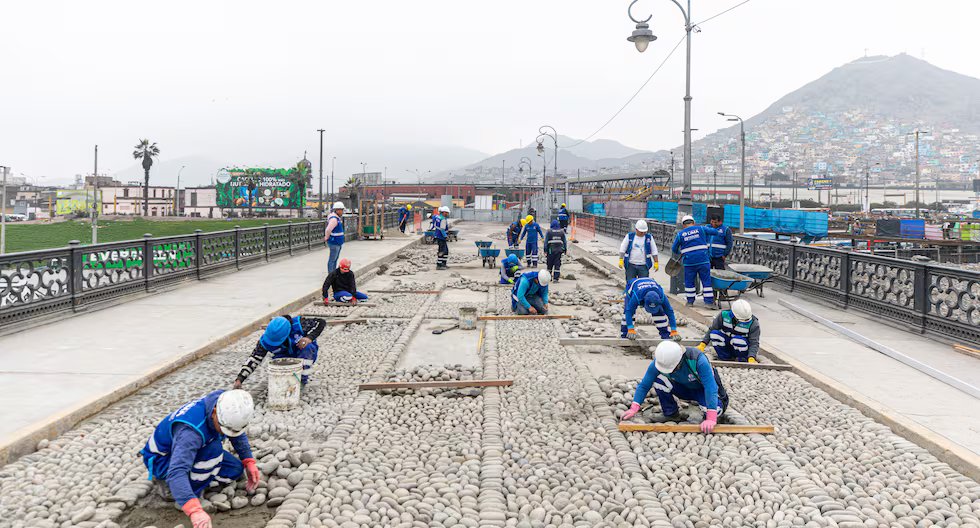
The Municipality of Lima began the recovery work on the Balta Bridge as part of the process of pedestrianization and enhancement of the Historic Center of Lima. The intervention contemplates the replacement of the deteriorated asphalt pavement with one of boulderin line with the Master Plan of the area, with the aim of improving pedestrian safety and recovering the harmony of the urban landscape.
The project, executed by the Municipal Program for the Recovery of the Historic Center of Lima (Prolima)responds to the state of wear of the bridge surface, which represents a risk to passers-by. The work includes the temporary closure of the structure and is part of a broader strategy to restore public spaces and monuments in the city center.
Balta Bridge: key in the modernization of Lima
Thanks to the archives of The Commercewe can learn the history of the Balta Bridge. This dates back to 1869, when the contract for the construction of the then called “new bridge of Lima” was signed, during the government of President José Balta, from whom he would later take his last name to be registered as “Puente Balta” in official documents. The work, directed by the engineer Felipe Arancibia and executed by the constructor Enrique Armeromarked a milestone in urban infrastructure by becoming the capital’s first iron bridge, manufactured by the French company Boignes Rambourgs.

Plano de Lima locates the Balta bridge between the districts of Barrios Altos and Centro de Lima in 1924. (Photo: EC archive.)
From its beginnings, the structure was a symbol of the modernization process that Lima was going through in the second half of the 19th century. Over time, the bridge – which crosses the Rímac River – underwent various transformations, from its vehicular use to its subsequent restriction to pedestrians in the 1970s. Two years later, in December 1972, it was declared a “Historical Monument” during the military government of Juan Velasco Alvarado.

Archive photograph on the Balta bridge in March 1962. (Photo: EC archive.)
/ THE TRADE
Throughout the 20th and 21st centuries, it has received various interventions, such as temporary closures and structural problems that demonstrate its age and the need for conservation.
The bridge has also been the scene of different urban episodes, such as the installation of a craft fair in 1962, problems with the accumulation of waste in the sixties, traffic restrictions due to its weakened structure in the 1990s and renovation work due to structural risks in 2012.
Urban intervention and recovery of the environment
Prolima’s current intervention is not only limited to the bridge, but is integrated into a broader recovery plan for the Historic Center. The project also includes the improvement of the surrounding streets, which will be remodeled with a cobblestone finish similar to that applied in the Rinconada de Santo Domingo, in order to unify the urban environment.
The work seeks to recall the original appearance of ancient Lima, reinforcing the heritage value of the space and promoting its use by pedestrians and tourists. In this way, the restoration of the Balta Bridge is positioned as a key area within the municipal strategy to revitalize one of the most emblematic sectors of the city.
Progress of the work and future views
The restoration of the Balta Bridge It currently presents an approximate progress of 45%concentrated mainly on the execution of the new paving of the road, where the pebble stone that will replace the old asphalt pavement has already been installed. According to Luis Martín Bogdanovich, manager of Prolima, the intervention model is based on historical, technical and archaeological criteria that seek to reproduce the original appearance of the bridge without compromising its structural resistance or its heritage value.
The proposal contemplates the use of mortars compatible with the construction tradition of the Historic Center of Lima, reinforced with Portland cement type I to improve durability and humidity control.. In addition, the conservation of the cast iron railings, whose bases show deterioration due to corrosion, is being evaluated, as well as the future installation of sidewalks with basalt tiles and granite stone sardines, scheduled for the end of September.
The total investment amounts to S/ 155 thousand and is financed entirely with municipal resources. Prolima highlights that the intervention will not modify the historical use of the bridge, maintaining its pedestrian priority, although it will allow optimizing passability and reinforcing security for neighbors and visitors. Informative signage will also be incorporated that will allow citizens to learn about the history and heritage relevance of the place.
Bogdanovich pointed out that this work is part of a larger strategy to recover historical infrastructure within the center of Lima, with the possibility of replicating this model in other heritage spaces. Although there are still no confirmed projects for other bridges, Prolima is evaluating future interventions in areas such as the Puente de Piedra environment, within the Río Rímac Special Landscape Project.