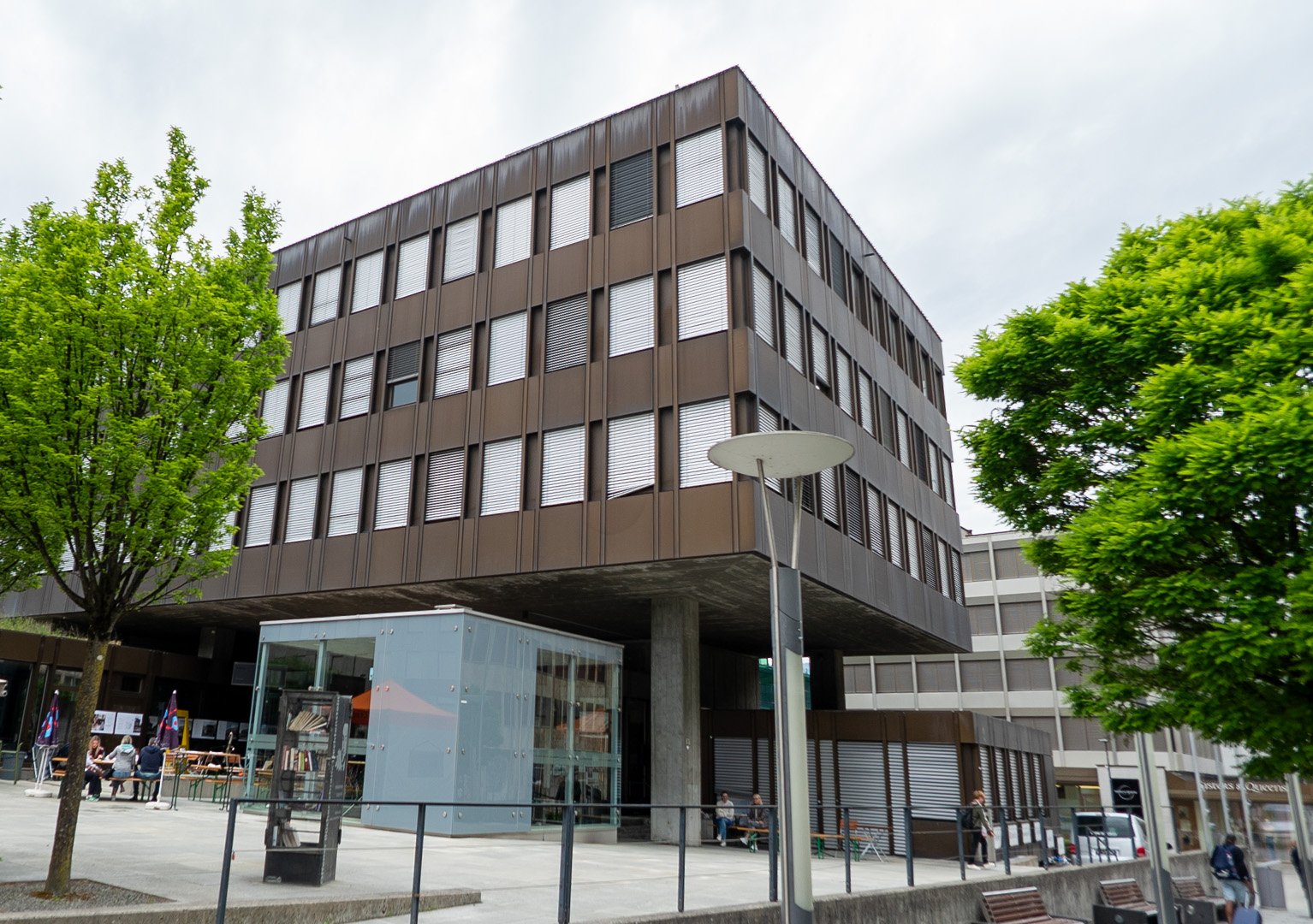
The old post office building in Vaduz | Photo: Gregor Meier
In June 2024, the state parliament rejected the supplementary loan for the new state library in Vaduz. The municipality of Vaduz then stepped in with 5.43 million francs – and since then there has been one question: Does the government still have to submit the project to parliament again before it can continue building? A legal opinion from the Vaduz lawyer Dr. Michael Ritter, which is available to the Landesspiegel, now gives an answer – and it is more nuanced than many would expect.
Review: A project with an eventful history
The plans for converting the striking post and administration building in Vaduz into the new home of the state library go back to 2019. At that time, the state parliament approved a commitment loan of 22 million francs. Because costs rose, a supplementary loan of 2 million francs followed in 2023 – the approved state funds total 24 million francs.
In June 2024, the situation escalated: The government applied to the state parliament for a further supplementary loan of 7.57 million francs – 5.43 million for increased construction costs and 2.14 million to increase the builder’s reserve. Only seven MPs agreed. The project seemed to be over.
Prime Minister Daniel Risch left no doubt about the state parliament session on June 13, 2024: “If we say no to that, then it means we won’t build anything there.” Government Councilor Graziella Marok-Wachter was also unequivocal: “If they don’t accept it, then it’s clear that this project is finished and we’ll start over.”
Vaduz steps in – and changes the starting position
What followed was surprising: the municipality of Vaduz agreed to cover the rejected 5.43 million francs for the construction costs itself – without the need for additional state funds. Vaduz voters approved this loan in a financial referendum. The financing gap in pure construction costs was thus closed.
Commitments from private institutions and donors of 1.45 million francs are expected for the builder’s reserve. Together with the existing reserve of 1.32 million francs, this would result in 2.77 million francs – around 8 percent of the project costs. The government itself described a reserve of 10 percent, equivalent to 3.46 million francs, as necessary in 2024. According to the report, the gap is around 690,000 francs. It is unclear whether this amount can be covered elsewhere.
What the report states
The Ministry of Infrastructure and Education commissioned Dr. Ritter in August 2025 to clarify the legal question. His report from August 28, 2025 distinguishes between two scenarios.
When is it necessary to refer the matter again to the state parliament?
If the available funds are not sufficient for construction costs or the builder’s reserve, another supplementary loan is required – and therefore a state parliament resolution. The same applies if the municipality of Vaduz receives such extensive usage rights in the building in return for its financial commitment that the original project must be considered significantly changed. The permanent transfer of entire floors or a fundamental change in the purpose of the building would be considered essential. As an extreme example, the report cites the allocation of an entire floor to the municipality.
When is the state parliament not allowed to vote?
Here the report goes further than many assume: If no additional state funds are necessary, the government may not even submit the deal to the state parliament for a formal vote – that would be constitutionally inadmissible. Ritter notes that “it is not at the discretion of the government to transfer certain business to the state parliament for formal approval if the responsibility legally lies with the government.” Formal approval from the state parliament is only possible if it is formally responsible for it. The increased participation of the municipality of Vaduz or the commitment of private donors do not justify this responsibility.
According to the expert, the earlier announcements by government councilor Graziella Marok-Wachter – she had promised a new report and application to the state parliament in February 2025 – are not legally binding for the current government: they are political statements, not legal obligations.
Consultation rather than consent: a possible middle ground
Even if there is no legal obligation, the government can involve the state parliament voluntarily and consultatively. Ritter describes this possibility explicitly: A report and application could be submitted to the state parliament for information and not for approval. The formal decision-making authority would remain with the government; the state parliament would simply be informed and could signal its position. This would allow the government to obtain political support without being legally bound.