-
By Sam Garcia / Staff writer, with CNA
The Legislative Yuan yesterday passed a bill governing childcare, including requiring institutions to install surveillance cameras and imposing penalties of up to NT$600,000 for childcare providers found guilty of abuse or harassment.
The Executive Yuan in May last year approved the draft Childcare Services Act (兒童托育服務法) to establish a standalone law governing childcare for children aged two or younger. The legislature yesterday passed a third reading of the act.
Key provisions of the act include adjusting qualifications for in-home childcare providers, improving management of childcare institutions, expanding childcare options and handling improper treatment.
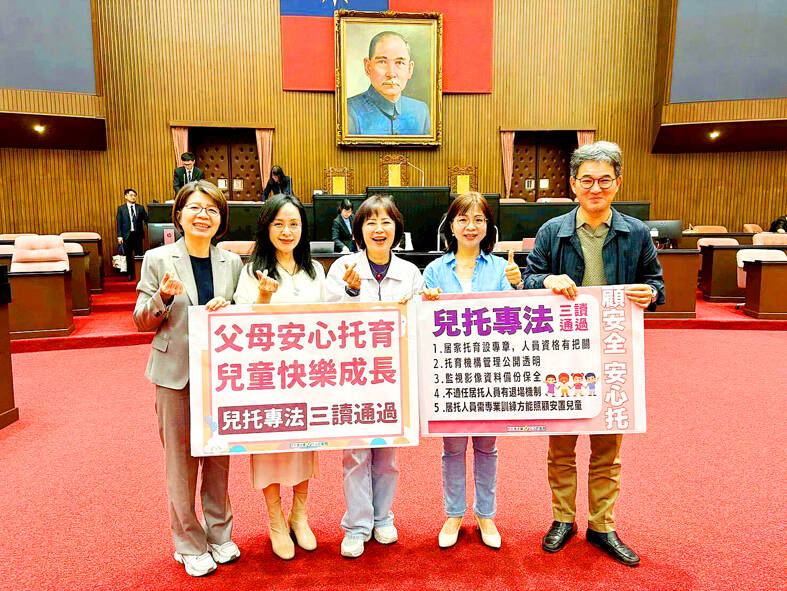
Photo: screen grab from Legislator Lin Shu-fen’s Facebook
The act stipulates that childcare institutions must install surveillance cameras, keep footage confidential and retain it for at least 30 days. The footage must be uploaded to an online system established by local authorities with subsidies from the central government.
If a childcare provider physically or psychologically abuses, bullies, sexually harasses or otherwise harms or mistreats a child, they would face a fine ranging from NT$60,000 to NT$600,000 and their name would be publicly disclosed, the act says.
Childcare institutions operating without a license would be fined NT$60,000 to NT$300,000 and ordered to stop providing care, it says.
Institutions that have accumulated a certain number of contraventions within two years would be suspended from accepting new children, it says.
If they are suspended from new admissions twice within five years and commit other contraventions, their registration would be revoked, it says.
The Ministry of Health and Welfare is the central authority responsible for national-level childcare policies and programs, conducting regular childcare requirement surveys and collecting data on childcare services, including fees and quotas, it says.
The act also stipulates that the central authority shall convene a childcare advisory committee to coordinate, plan and promote childcare services, and set guidelines for fees and refunds for home-based and institutional childcare services.
Qualified childcare professionals should register with the local authority and obtain a home-based childcare services certificate before providing such services, it says.
The central authority must set principles for in-home childcare fees and refunds, and local authorities must set regional standards and review them at least every two years, it says.
Home-based childcare providers must submit to inspection by local authorities and charge fees according to regional standards, it says.
They must also sign a contract with the child’s legal guardian, which would be based on a template set by the health ministry, and obtain professional liability insurance, it adds.
The Childcare Policy Alliance lauded the passage of the act, calling it a milestone that elevates infant and toddler care to a key national-level system.
The act marks a fundamental policy shift by acknowledging that childcare is a shared government responsibility rather than solely a family burden, the alliance said, adding that the final version adopted many of the alliance’s proposals.
Under the new law, the central government is mandated to expand public childcare capacity and ensure that services remain high-quality, universal, affordable and accessible, it said.
Additional reporting by Yang Yuan-ting