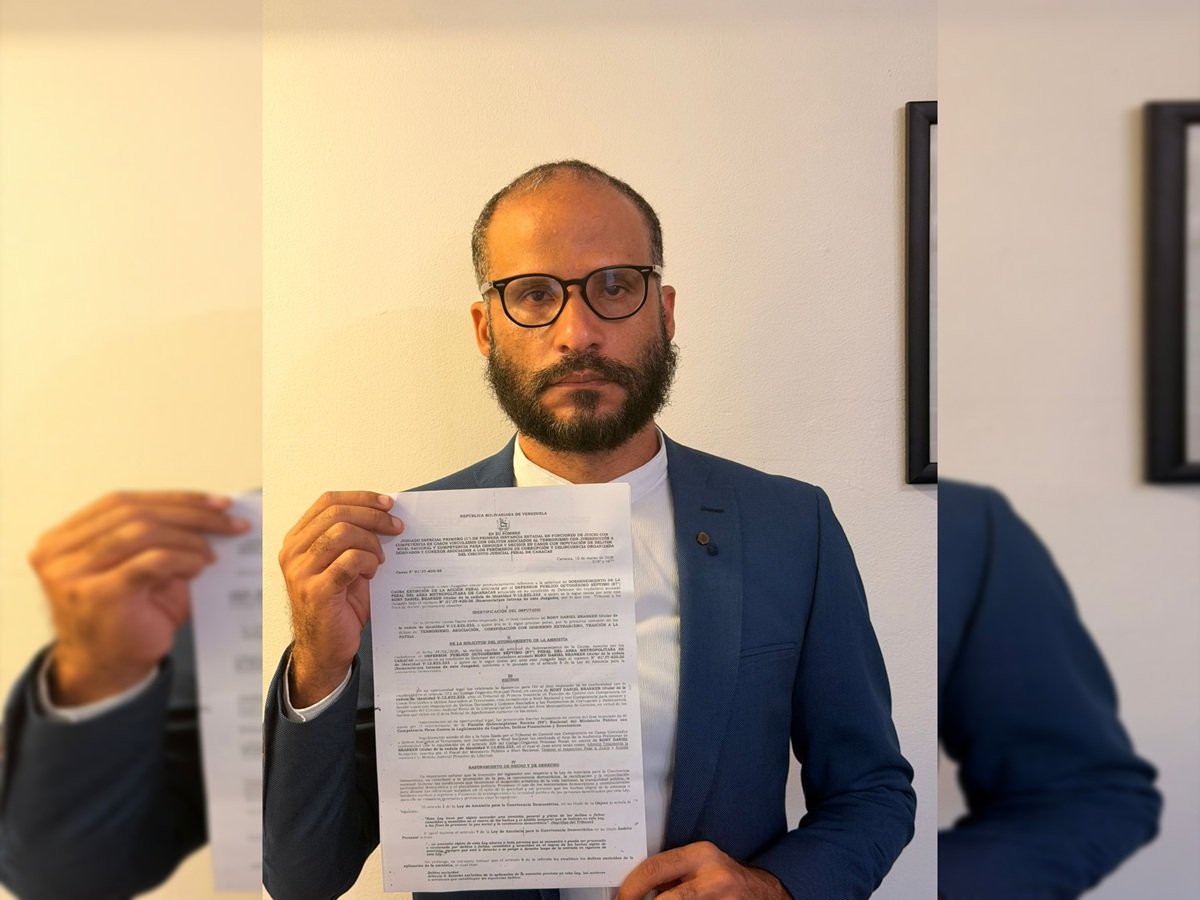
The National Union of Press Workers (Sntp) and the NGO Justicia, Encuentro y Perdón (JEP) denounced once again the discretionary application of the Amnesty Law enacted in February, after courts denied the dismissal or annulment of cases to at least two communicators, who still have criminal charges against them despite their previous release.
“The selective application of the Amnesty Law has not brought freedom for all, but rather deep emotional damage and heightened vulnerability for those who have been arbitrarily excluded,” JEP noted.
The organization described the case of journalist Rory Branker as “reliable proof” of how judicial persecution in Venezuela has become an “eternal cycle of revictimization.”
Branker, editor of the digital media La Patilla, was arrested on February 20, 2025 by officials of the Bolivarian National Intelligence Service (Sebin) and remained imprisoned for eleven months. He was released on February 4, 2026 within the framework of the release process announced by the Government in charge; However, on April 6, a court notified him that the dismissal requested in accordance with the Amnesty Law “is not appropriate,” so the charges of terrorism, criminal association, conspiracy with a foreign government, and treason remain in force.
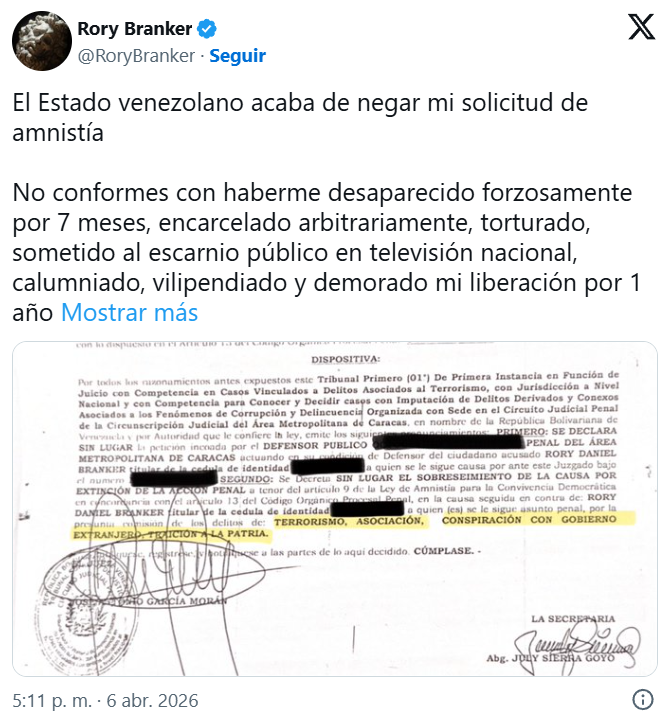
The Sntp, the main Venezuelan press union, warned that the judicial process against Branker “lacks guarantees” and that the refusal confirms that his release did not put an end to the persecution.
The same union reported a second case: that of Social Communication student Jonathan Carrillo, who was detained from July 2022 to February 26, 2026. The Third Trial Court with functions in Terrorism rejected his request for dismissal, arguing that his case does not fit into the “13 specific facts” contemplated in article 8 of the Amnesty Law.
The decision was even notified to him by WhatsApp, and the court told him that he himself should appeal.
JEP warned that these arbitrary exclusions turn victims into “hostages of discretionary justice” and asked for an immediate and definitive procedural pardon “to stop the arbitrariness and return full freedom and, with it, life to all victims.”
The Amnesty Law, enacted in February, covers a period of 27 years (since 1999), but limits its application to 13 specific events that occurred on specific dates. It expressly excludes cases linked to military operations, corruption, homicide and human rights violations, which has generated criticism for its restricted scope and selective application.
Meanwhile, in contrast, the First Trial Court with jurisdiction over terrorism issued an acquittal on April 6 in favor of journalist Julio Balza Maldonado, a member of the Vente Venezuela communications team, who had been charged as an “unnecessary accomplice in conspiracy” after covering a demonstration in Chacao.
Balza was detained between January 2025 and January 2026. Human rights unions and organizations consider that these rulings show that the Amnesty Law, far from closing cycles of persecution, perpetuates judicial discretion and leaves dozens of communicators and press workers in a situation of permanent uncertainty.