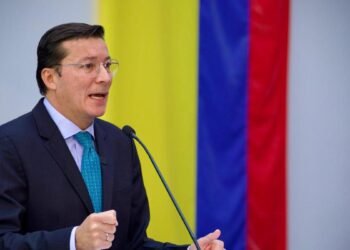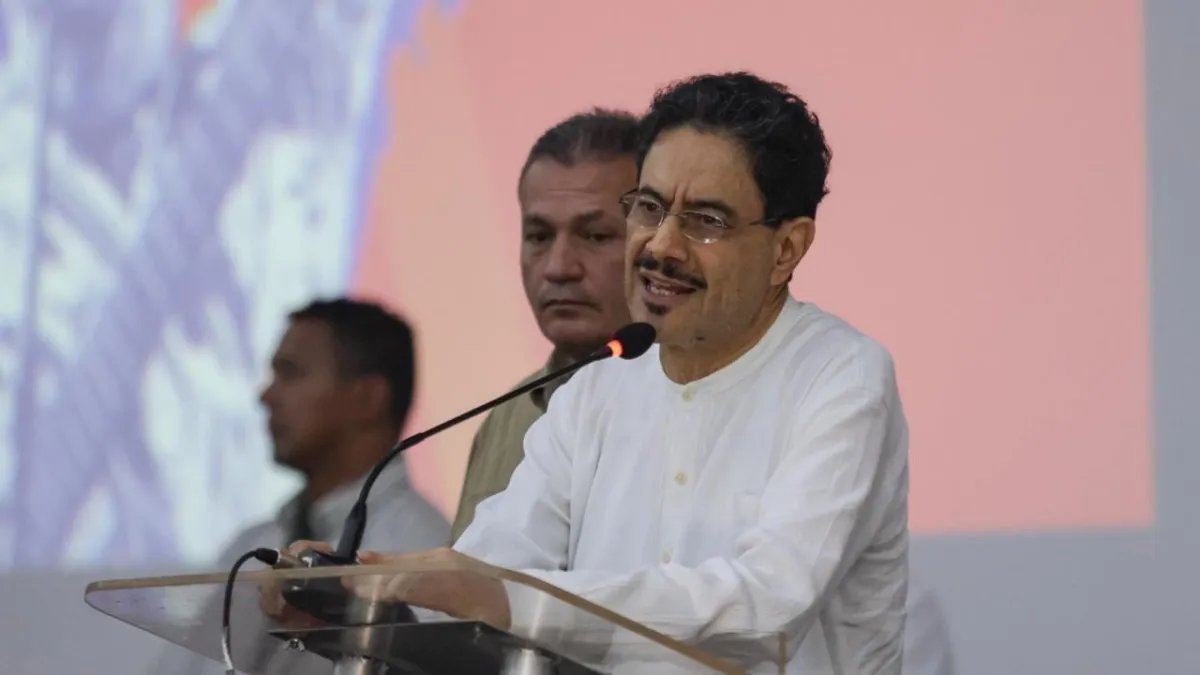
No references to a constituent assembly or the ‘constituent power’with mentions of a ‘comprehensive peace‘and with a markedly more technical tone than the one used until now by the campaign, Iván Cepeda presented yesterday a new government plan facing the presidential second round.
The document, close up 100 pagesappeared as the new programmatic navigation chart of the formula of Historical Pact. According to experts consulted by EL TIEMPO, it is a play to get closer to the centerprecisely with what those sectors have demanded.
READ ALSO
Its proposals include a 100 day crash plan for centralize the purchase and distribution of medicineswhen before he only talked about health from a public approach and bringing it closer to remote areas; also now mentions the installation of large scale renewable energythe massive delivery of school kits and a strategy of “comprehensive peace“which combines the implementation of 2016 Peace Agreement with the search for what he calls a “effective peace“in the face of the different expressions of violence that persist in the country.
The publication attracted attention because would replaceat least like main reference documentthe compilation of speeches and reflections that the campaign had been using until now: a text of more than 400 pages.
Cepeda’s new government plan. Photo:Supplied
“Iván Cepeda’s campaign has a real concern about seeking center votes. It has not achieved the support of any important figure in that sector (…), but it is concerned,” explains Cristian Rojas, head of the Political Science department at the University of La Sabana.
And he adds that basically, he has not made profound changes, “one could say that he has suddenly abandoned some flags (such as the constituent), but I do believe that he has simplified it so that it is also understood with those points in which he wants to show moderation, for example, that the minimum living wage is something that they are going to defend and that has to respond to the cost of living, but that also responds to productivity and that dialogue is maintained with businessmen.”
For his part, for political analyst Jairo Libreros, these are “legitimate” changes that any candidate can make, but he points out that in this case they are more “cosmetic and opportunistic” modifications. And it is no wonder that the change in its programmatic strategy is made almost a week before the elections. “I believe that there is already clarity about the lines of government. He had already taken a step aside with the issue of the constituent assembly, but it is not going to have a special impact,” he adds.
Another fact is that the “new” text would not be entirely new, since it follows the same structure of another document presented as a book in October 2025, just a few days before the internal consultation of the Historical Pact, and which brought together public interventions, essays, reflections and proposals from Cepeda, only the version presented this week is more ‘technical’.
Cepeda had already launched a similar program in October. Photo:@IvanCepedaCast
Details of the new plan
This new plan is built around a central idea: “The three revolutions for a Colombia world power of life“: the ethical revolutionthe economic and social revolutionand the political and democratic revolution.
They appear, however, common proposals with the previous program as the creation of a National System against Macrocorruptiona agrarian transformation aimed at strengthening the food sovereigntythe construction of a great national agreement to promote social reforms and the commitment to a productive economy with greater state presence.
Iván Cepeda at an event in Cali. Photo:Iván Cepeda Press
That biographical component which contemplated its first government program disappears almost completely in it new plan. In its place there is quantifiable objectives in different sectors.
Also included chapters that did not have a comparable development in the previous text. This is the case of the proposals related to artificial intelligence, digital transformation of the State, energy transitionadministrative modernization and some institutional reforms.
He speaks, for example, of the “elimination of the National Electoral Council and the creation of an autonomous and independent electoral court, in charge of jurisdictional and electoral functions today dispersed among different entities.”
It also proposes changing the Commission of Investigation and Accusation of the House of Representatives to create an independent Commission of Jurists “in charge of investigating and sanctioning senior officials of the State, strengthening the fight against impunity and corruption in the highest spheres of power.” However, it does not mention details about what that commission would be like.
In matters of healththe document establishes a emergency plan for the first 100 days of government that guarantees the centralized purchasing and distribution of medicinesin addition to the resolution of procedures dammed through the public and private network.
In it energy sectorthe technical goal to achieve at least 10 gigawatts of installed capacity from non-conventional renewable sourceslike the solar and windto bring electricity to municipalities that currently lack service.
Finally, in educationthe plan incorporates quantitative objectives like him strengthening comprehensive training in 5,500 educational establishments, the construction and provision of 80 higher education infrastructure projects and school access through the delivery of kits to nearly 2 million students in rural and peripheral areas.
The result is a program that preserves political vision presented by Cepeda, but that seeks to translate it into a language closest to planning and the execution of public policies.
The new document seems to stop speaking only to militants and sympathizers of his political project, and begins to do so to a broader electorate. Its publication coincides with the campaign’s efforts to convey a image of greater moderation.
Paula Valentina Rodríguez
Political Writing
More news in EL TIEMPO
Will there be presidential debates? Photo: