Israel and Hezbollah agreed on Friday a cease fire, according to a US official, after fighting between the Israeli army and the Lebanese group threatened the recent agreement to end the war in the Middle East.
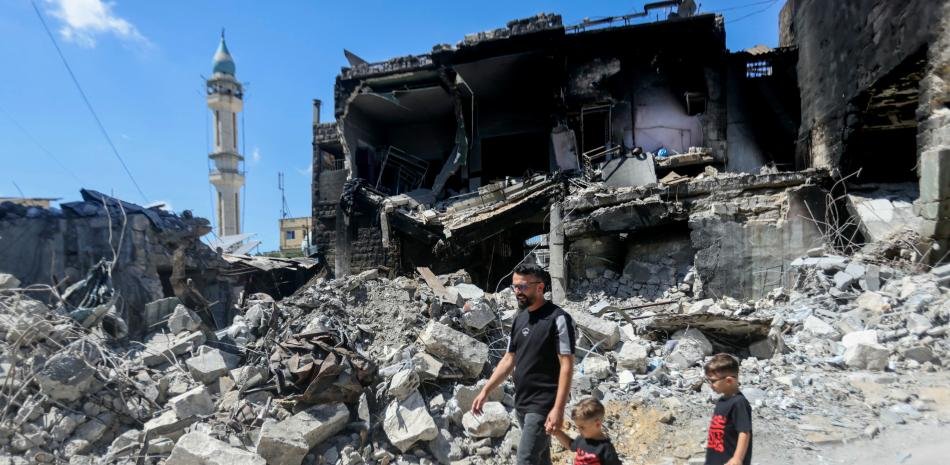
After announcing the death of four soldiers in Lebanon, Israel launched bombings on the country that claimed the lives of at least 47 people, the Lebanese Ministry of Health announced, in the largest episode of violence since the announcement of an agreement between Washington and Tehran this week.
That agreement provides for a ceasefire “on all fronts, including Lebanon”, a condition that Tehran, an ally of the Hezbollah movement, had insisted on to end the conflict.
Earlier, a US official told AFP that Israel and Hezbollah agreed to a ceasefire with immediate effect, negotiated by US mediators after holding talks with Israel and Iran.
A Gulf diplomat, who requested anonymity, confirmed the truce mediated “by Qatar, the United States and Iran.”
However, shortly after the announcement, the Lebanese state news agency NNA reported an Israeli attack in the town of Sejud and an AFP correspondent heard artillery fire in the town of Nabatieh, both in the south.
Planned talks between the United States and Iran in Switzerland to develop the deal and work toward a lasting settlement were postponed.
Lebanese President Joseph Aoun said in a call with U.S. Secretary of State Marco Rubio on Friday that a comprehensive ceasefire must be secured so talks with Israel could move forward.
The State Department announced the resumption of negotiations in Washington from June 23 to 25.
These discussions will offer an opportunity to “make progress towards lasting peace”, declared the State Department spokesperson, Tommy Pigott.
He added that, during the call with Aoun, “Rubio reiterated the need to disarm Hezbollah and reestablish control over all Lebanese territory.”
Israel’s ambassador to the United States, Yechiel Leiter, said his country would commit to a ceasefire if Hezbollah respected it.
“All Lebanon must burn”
During the day, Israeli Prime Minister Benjamin Netanyahu had threatened to make Hezbollah “pay a very high price” and insisted that his forces would remain in southern Lebanon.
“All of Lebanon must burn,” launched the Minister of National Security, the far-right Itamar Ben Gvir, which led Iranian Foreign Minister Abbas Araqchi to accuse Israel of wanting “permanent war.”
Many residents fled the south of the country after these attacks, packed into cars, some with mattresses and personal belongings tied to the hood, an AFP correspondent in the Tire region noted.
“We were at home when, suddenly, the bombing started. No city, no house was spared,” said Zeinab Naser, 69, in the middle of a traffic jam in Sidon, southern Lebanon.
“Israeli military planes never leave the sky. We hope this poison (Israel) leaves our country and we can live,” he added.
“There is no rush”
At the diplomatic level, the Swiss government announced the postponement, until an undetermined date, of the negotiations scheduled this Friday.
At first it was announced that this meeting should serve to seal the pact, but finally the signing was done electronically by the presidents of both countries, Donald Trump and Masud Pezeshkian.
Iran’s supreme leader, Mojtaba Khamenei, declared that he had approved it, although with reservations. In the future there will be “face-to-face negotiations” with the United States, but that does not “mean accepting the enemy’s point of view,” he said Thursday.
As the text has already been signed, “there is no rush to hold the said meeting in Switzerland, but we plan a meeting in the coming days,” explained the spokesman for the Iranian Foreign Ministry, Esmail Baqai.
For now, there will be a meeting in Egypt on Sunday of Iranian negotiators with diplomats from Pakistan, Saudi Arabia, Türkiye and Egypt, sources in Cairo and Islamabad said.
“The next 60 days will be crucial. We could reach a global agreement but we also expect an incomplete agreement with some gaps,” said an Emirati diplomatic source.
Maritime traffic in Hormuz
Traffic that had resumed on Thursday in the Strait of Hormuz, strategic for global hydrocarbon trade, was reduced on Friday in the face of new Iranian demands. Boats wishing to cross must submit a request 48 hours in advance.
Iran had closed this strait at the beginning of the war, and the United States, in retaliation, had imposed a blockade of Iranian ports, lifted on Thursday.
In accordance with the terms of the protocol, no fee will be charged for 60 days, Tehran reminded.
Reflecting an uptick in fears, oil prices stabilized around $80 per barrel of North Sea Brent.