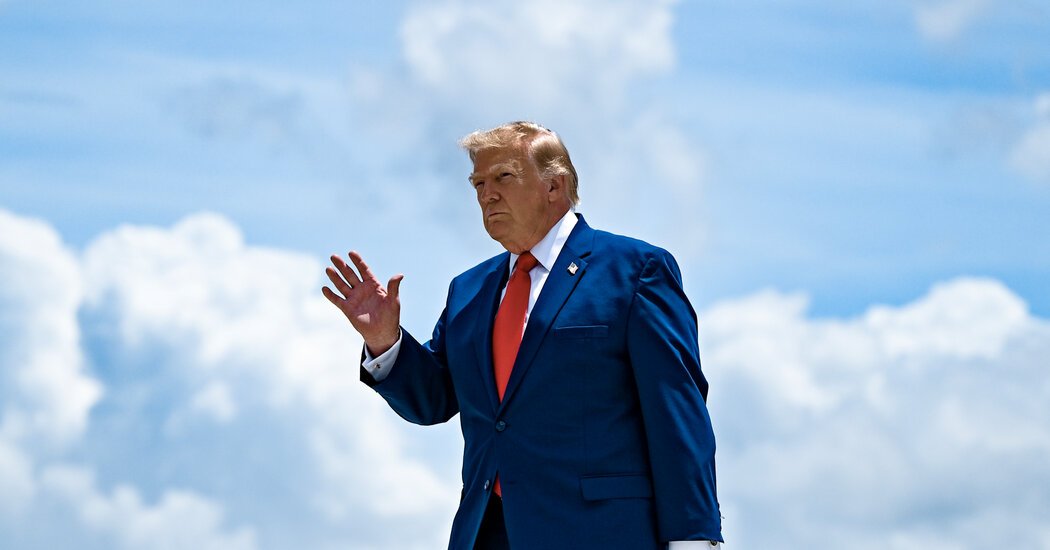
Soon after the war began on Feb. 28, President Trump declared that Iran was “totally defeated and wants a deal.”
Then in March, Mr. Trump said the U.S. military would wrap up its campaign against Iran in two to three weeks. “We will be leaving very soon,” he said.
Now the conflict is entering its sixth month and a period of deep uncertainty. After nearly two weeks of attacks and counterattacks, Mr. Trump has held off a major escalation. But major issues between the two sides remain unsettled.
The cycles of fighting have resulted in staggering losses.
An estimated 1,700 Iranian civilians have been killed in airstrikes, which have devastated Iran’s infrastructure and deepened the country’s economic crisis.
Eighteen U.S. service members have died in the war, which the Pentagon estimates has cost $37.5 billion.
Here’s a rundown of the biggest moments of the war, and some of its deadliest incidents.
February
After the United States and Israel launch the war, Iran begins firing on ships in the Strait of Hormuz, effectively closing the waterway and sending oil prices skyrocketing around the world.
Feb. 28: In the opening barrage of the war, a salvo of Tomahawk cruise missiles launched from U.S. Navy warships kills 175 people at an elementary school in Minab, in southern Iran, most of whom are children.
March 7: A U.S. Army soldier dies of wounds suffered in an attack on Prince Sultan Air Base in Saudi Arabia.
March 12: Six U.S. airmen are killed when their KC-135 aerial refueling tanker crashes in western Iraq.
March 31: Mr. Trump says the United States will be out of Iran in two or three weeks.
The average price of a gallon of regular unleaded gasoline in the United States, which according to AAA had been $2.98 before the war, jumps to $3.98.
April
In early April, another F-15 is shot down — this time over Iran. The pilot is quickly rescued, but the jet’s weapons systems officer is rescued later. Multiple U.S. aircraft were destroyed in the second rescue operation, which involved hundreds of Special Operations troops and other military personnel. Another U.S. warplane, an A-10 Warthog, crashes and the pilot is rescued.
April 6: Central Command, which directs military operations in the Middle East, says the U.S. has hit more than 13,000 targets in Iran. It is the last update Centcom offers on the numbers of targets struck until airstrikes resume in earnest in July.
April 12: The U.S. announces a blockade of Iranian ports.
April 19: A U.S. destroyer fires on an Iranian-flagged cargo ship in the Arabian Sea, and Marines seize the vessel. It is believed to be the first vessel that has tried to evade the U.S.-imposed blockade.
April 21: Mr. Trump extends the cease-fire.
The national average price for regular unleaded gasoline rises to $4.30 per gallon.
May
May 3: Mr. Trump announces “Project Freedom” to help stranded civilian merchant ships leave the Strait of Hormuz. The president is forced to pause the operation after less than 48 hours.
May 5: Defense Secretary Pete Hegseth and Gen. Dan Caine, the chairman of the Joint Chiefs of Staff, give a briefing to reporters on the Iran war. They have not given any since then.
May 7: Mr. Trump says his cease-fire is still in effect.
May 10: Mr. Trump rejects an offer from Iran to return to peace talks.
May 13: The Congressional Research Service says the U.S. military has suffered losses or damage to 42 warplanes, helicopters and drones in the war.
May 23: Mr. Trump says a peace deal is near.
In the three weeks leading up to the end of March, Centcom said it had guided around 70 commercial ships through the strait using a new route that hews tightly to the Omani coastline.
The national average for regular unleaded gasoline is $4.42 per gallon.
June
Mr. Trump began the month by saying peace negotiations with Iran are “very boring” and told a news outlet that he “couldn’t care less” if those talks with Iran break down.
June 17: Text of the “memorandum of understanding” between the U.S. and Iran is released. But its language is vague, and the two sides have contradictory interpretations.
June 20: Mr. Vance departs Washington for more peace talks.
June 22: Mr. Trump eases U.S. economic sanctions on Iranian oil.
June 23: Iran attacks a commercial ship transiting the Strait of Hormuz. Over the next two days, U.S. forces launch airstrikes in response.