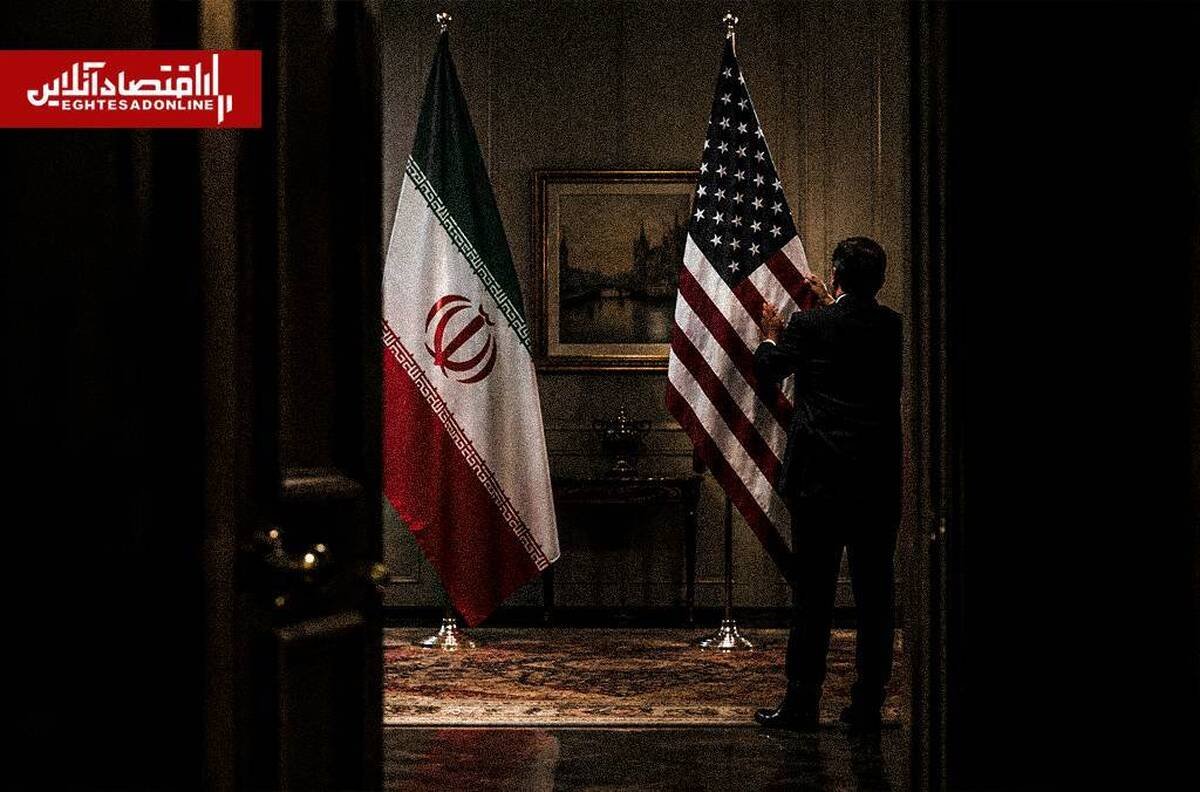
Economy Online, Amir Mohammad Hosseini: Field and diplomatic developments around Iran and America are changing at an unprecedented speed; It is not so clear whether the negotiations will finally come to a conclusion or war will break out again.
Iran’s claim to present a “revised proposal” at the same time as the maritime blockade is being intensified and Washington is considering new military options, indicates that the two sides are entering a decisive stage.
Iran’s revised offer?
According to some published reports, the United States of America is waiting to receive Iran’s new offer; A proposal that, according to sources close to the mediation process, could change the course of negotiations.
Earlier, Foreign Minister Abbas Araghchi had delivered the three-stage proposal of the Islamic Republic of Iran to Pakistan. According to what has been leaked from this proposal, Iran has first demanded a complete stop to the war, then the reopening of the Strait of Hormuz in exchange for lifting the naval blockade, and in the third stage of negotiations on the nuclear program. US President Donald Trump has rejected this proposal.
Of course, Trump has announced the continuation of the talks by phone and at the same time, he has maintained his threatening tone. He has openly claimed that we have “destroyed Iran” from a military point of view and considered the only option for Tehran to be “surrender”. The current position of the White House is more than a sign of readiness for compromise, it shows an attempt to impose conditions from a position of power.
New plans for military attack
Meanwhile, US Central Command (CENTCOM) is preparing new military options to be presented to Trump on Thursday, sources told Axios. Plans that include “short and powerful attacks” on Iran’s infrastructure, limited ground operations to control parts of the Strait of Hormuz, and even a special forces mission to secure Iran’s enriched uranium reserves.
These scenarios, especially the option of ground operations or direct intervention in nuclear facilities, if implemented, could quickly lead to the spread of war in the region.
Continuation of naval blockade efforts
At the same time as these movements, the Islamic Republic of Iran is also recovering its military strength and is still in control of the Strait of Hormuz. But America is also trying to increase the economic pressure through the maritime blockade in an unprecedented way.
According to the statement of Centcom commander, currently 41 oil tankers carrying 69 million barrels of Iranian oil cannot be sold. A figure that has a value of more than 6 billion dollars. These data show that Washington’s energy strategy is focused on creating export bottlenecks and reducing Iran’s foreign exchange earnings. However, Mohammad Baqer Qalibaf, the speaker of the parliament, has rejected the claims of the American side.
It is said that Pakistan has activated six land routes to send goods to Iran. An incident that shows that the Iranian government is trying to reduce the consequences of the naval blockade.
How likely is Iran’s preemptive attack?
As the naval blockade continues, Iran’s reactions have become increasingly alarming. The central headquarters of Khatam al-Anbiya warned America that the continuation of “siege, banditry and piracy” will be met with the response of the armed forces.
The commander of the army navy also spoke about the imminent unveiling of a weapon that, according to him, is “very scary” and is stationed near the American forces.
These statements can be seen as a sign of Tehran’s effort to create active deterrence and send a clear message to Washington regarding the costs of any military action.
In the meantime, one of the most important variables is the possibility of preemptive action by Iran. Due to the intensification of the naval blockade and the direct threats of the United States, some analysts believe that Tehran may take measures to upset the current balance if this trend continues. Actions that could include targeting US interests in the region or disrupting energy routes. Such a scenario, although costly and risky, can be explained within the framework of the preemptive defense doctrine.
Will the war start again?
On the other hand, the possibility of resuming large-scale US attacks is also discussed as a tool to break the deadlock in negotiations.
Some reports suggest that Washington may use the military option to force Iran to accept the new terms.
The rise in the price of oil and the prediction of an increase in the price of oil up to $150 also show that the global markets have taken this possibility seriously. Some have also raised the possibility of massive infrastructure attacks and then announcing a unilateral victory by Trump as another possible option.
In addition, the “Fox News” report about the possibility of American intelligence agencies trying to take advantage of the ceasefire conditions in order to destabilize Iran’s internal affairs, reveals another dimension of this confrontation.
One of the less prominent but important scenarios is the possibility of limited ground operations aimed at seizing resources or strategic points. Focusing on the Strait of Hormuz or even the Iranian islands in the Persian Gulf, if realized, can fundamentally change the geopolitical equations of the region. However, such a move is accompanied by many uncertainties due to its wide-ranging consequences, including regional and international reactions.
what will happen
All in all, what emerges from putting these data together is that Iran and the United States are entering a stage of maximum multi-layered pressure. At this stage, diplomacy and military threats proceed simultaneously, and both sides try to force the other side to retreat by maintaining their leverage. It is as if any retreat is a failure for Iran and America and neither side is willing to accept an intermediate solution.
In such a situation, Iran’s revised proposal, if it is really presented, can provide an opportunity to reduce tensions, but in the current climate of mistrust, there is no guarantee of its success.
If the diplomatic track is strengthened, there is a possibility of reaching a temporary or managed agreement. But if the military approach prevails, the region will face the risk of entering into a massive conflict. A conflict that will affect not only Iran and America, but the entire geopolitical and energy order of the Middle East and the world.