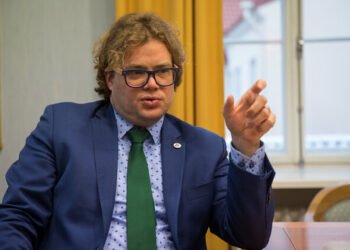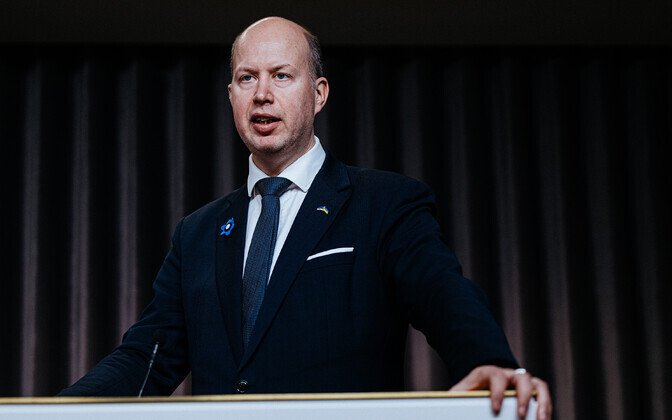
Interior Minister Igor Taro (Eesti 200) on Monday banned the Riigikogu’s Security Authorities Surveillance Select Committee from publishing data he presented regarding covert surveillance permits in Estonia.
“Yesterday, Interior Minister Taro presented the Riigikogu’s Security Authorities Surveillance Select Committee with data on how many permits have been granted in Estonia for covert surveillance of people and what kinds of surveillance measures have been used, and against how many individuals, over the years. In plain Estonian: how many people have been secretly monitored, how many phone calls have been wiretapped,” wrote committee member Raimond Kaljulaid (Social Democratic Party, SDE) on social media. “After the committee meeting, an email came from the minister stating that this overview is for internal use only. I have challenged this.”
“This is complete nonsense that the minister has let himself get tangled up in out of inexperience and without thinking it through,” Kaljulaid added.
“I find no legal basis whatsoever for classifying such information,” Kaljulaid continued. “On the contrary, the law says that generalized statistical overviews must not be designated for internal use only. The overview presented to the committee by the minister did not have any marking that it was internal information, nor any legal basis for such a designation. During the committee meeting, the minister did not even know whether it was internal information or not. We asked several times.”

Kaljulaid noted that he could publish the overview himself, but out of respect for the state he will not do so, instead giving Taro the opportunity to lift the restriction and release the information himself.
“The information we are talking about is directly connected to [attorney-at-law] Paul Keres’s recent observation that nobody knows exactly how many people in Estonia have been wiretapped or covertly surveilled. [Attorney-at-law] Carri Ginter has also drawn attention to this. Does anyone actually know? Based on the minister’s tables, I claim that unfortunately they do not,” Kaljulaid said.
“The current crisis of trust harms the rule of law; nobody wins from this. Secrecy and evasiveness only make the situation worse,” the MP added. “[Journalist] Madis Hindre wrote in Eesti Ekspress last week about how top politicians essentially live with the understanding that security agencies are listening to their phone calls.”
Kaljulaid pointed out that covert surveillance affects thousands of people in Estonia, most of whom do not hold public office and whom the state has not suspected of any legal violations.
“The Prosecutor’s Office has also recently clarified under what circumstances people are informed that they have been wiretapped. From this clarification it appears that, for example, if members of parliament — or even the Prime Minister, the President, or the Chancellor of Justice — are incidentally wiretapped for hours, they do not have to be informed about it. Interesting…,” Kaljulaid concluded.
Taro: what Is said in the secure coom must stay there
Interior Minister Igor Taro responded to criticism from Kaljulaid, saying that as a member of parliament he had always been of the view that everything said in the Riigikogu’s secure room and all documents seen there must remain in that secure room.
“I adhere to the same principle now at the Ministry of the Interior — there are meetings and briefings involving information intended for public release or internal use, and there are discussions held in the secure room that do not reach the public. Regardless of how the documents shown there are marked, or how public or non‑public what is said there may seem. For me, this is basic security hygiene.”
He said that when the Riigikogu’s Security Authorities Surveillance Select Committee invited him to give an overview of surveillance activities and the meeting took place in the secure room, he followed his long‑standing principle that everything stays in that room.
“I now know that the parliamentary special committee, or at least some of its members, does not share this view. It’s good to know this, because in the future I will be able to calibrate myself more precisely.”
According to Taro, summary data on surveillance measures is, in itself, public, and members of parliament who wish to discuss it in substantive terms can do so without obstruction by using the publicly released data.
This story was updated to add comments from Interior Minister Igor Taro.
—