Sonoma, California
This valley knows a thing or two about weakness. Years of patience, failure and rebirth are baked into its volcanic soil. The grapes here are vulnerable: pick them too early, and they become bitter; wait too long, and they wither in the heat. The winemakers understand the stakes.
And behind an imposing gate, in a beautiful house, the stakes feel just as high. Three men are being reborn. They’ve paid several thousand dollars to be here: to cry, hug, yell, and learn. They’re as fragile as the vines that dance in the northern California breeze. By the time they leave, they hope to be different men.
This intensive five-day retreat welcomes only America’s dudes, bros, lads, sons and fathers. With a crucial exception: The project is the brainchild of a woman, Lori Jean Glass, and her mostly female roster of coaches. It is, Glass says gleefully with a clasp of her hands, a “man camp!”
Glass has run male mental health retreats for over a decade, with her team of around two dozen coaches, working with hundreds of men in the process. At first, many reluctantly signed up at the urging of their wives, some of whom had previously attended her women’s retreats. But demand has surged and more men are coming on their own terms, she says, as they become increasingly lost in a lonelier, more divided and seemingly more macho society.
“Men are struggling,” Glass tells CNN. Some lack positive leaders, she says. Others get canceled too quickly, she believes. Employment opportunities are drying up for many, and others learn from an early age not to talk about their feelings.
To her, it all adds up to one thing: Throughout the country and across all age groups, “men are having a hard time.”
There is plenty of evidence Glass could point to. A Gallup study last year found that one in four young American men felt lonely the previous day. Around one in six men say they have no close friends, the Survey Center on American Life (a part of the American Enterprise Institute) found in 2021, five times more than three decades earlier. American men are less likely than women to be diagnosed with depression, but four times more likely to die by suicide – a disparity that, researchers say, indicates many are suffering in silence.
And now, Glass’s camps have a new challenge. The intoxicating pull of the manosphere – the hyper-online community led by men who tout misogynistic definitions of manliness – has given Glass a boisterous brigade of rivals. Vulnerability is out; after a few post-#MeToo years in the wilderness, the alpha male is back. With a vengeance.
If there is a counterweight to the manosphere, this is it. Glass says her camps provide disillusioned men a better way forward. She works directly to understand and reframe her participants’ understanding of masculinity. But it’s a lonely fight; for every five men who enter her camp, tens of millions watch influencers like Andrew Tate, Adin Ross and Myron Gaines, who preach the importance of making money, getting ripped and emotionally dominating their wives and girlfriends.
Glass’s own past is littered with tragedy and heartbreak. But she says she knows the way out. She wants her process taught in every high school in America; she wants to pull boys away from her “red-pilled” rivals. Or at the very least, she says: “I would sure love to try.”
CNN reporters Rob Picheta and David Culver attended one of Glass’s recent camps, run by her coaching non-profit, Pivot, to witness her experiment. Glass granted access as long as we underwent her “Pivot process,” participating alongside three men at different stages of their lives. We signed up, traveled to Sonoma, and immersed ourselves among the group.


The schedules were full. Days began with morning yoga and consisted of one-on-one therapy sessions, emotionally exhausting group exercises, and experiential lessons like art therapy and roleplaying. Glass’s coaches – Gaby Fabian, Deb Reid and Markus Weingart – taught us in her method, honed through the years from a wealth of psychological theory.
Still, we entered skeptically. It’s easy to roll your eyes at the Californianess of it all: The surroundings were luxurious, the camp costs more than $5,000 a head, and the self-help space is filled with unconventional approaches and unproven treatments. These men, you might assume, are too soft and too sensitive; more Pinot Noir than Cabernet.
But we found something far more complicated. Each of the three participants came here on the cusp of change, or in the throes of grief: Matt Sanders, 61, and Jason Owens, 52, are grappling with the deaths of a father and a wife, respectively; while Geoff Granger, 42, is nervously awaiting the departure of his children to college.
Over the coming days, they will dig deep into their own pasts and reckon with long-hidden trauma. Their journeys will spiral in unexpected directions. And against all odds, they will find new hope.
He’s a man’s man. And he’s falling apart
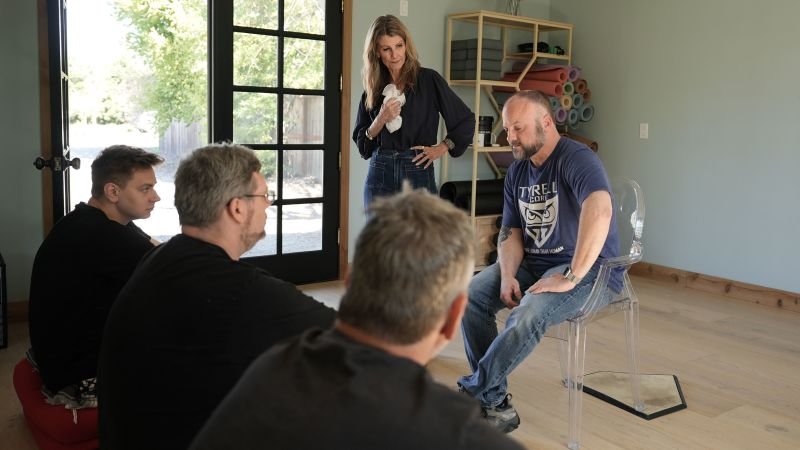
“I’m Matt Sanders,” Matt Sanders says. He’s holding back tears, until suddenly he isn’t. “And this,” he says, pointing out to a purple rag on the floor, “is my dad.”
It’s day four of man camp, and Sanders is about to have an epiphany. He’s “running the bases” – an exercise devised by Glass that transports participants back to their childhood, adolescence and adulthood. He’ll speak to his father from each stage of his life. And he has a lot to say.
Sanders is a buff, plaid-shirted guy, educated in locker rooms and raised on Bruce Springsteen and the Western New York cold. He’s ruggedly handsome and boastfully jacked. Picture a man’s man: Sanders is the guy who would beat him in a fight.

But he’s falling apart. He’s grieving his dad, his hero, who died just a month before this camp began after a decades-long illness.
There is a parallel track in Sanders’s life; one that leads towards the deep caverns of the manosphere. “I’m kind of relating to those guys who feel nihilistic,” he tells CNN. He could feel himself “seething” after his father’s death. “I really do feel a rage. A deeper rage.”
He sees anger around him, too. Sanders works as a counselor in Tucson, Arizona, and lately, the toxicity he’s been hearing has demoralized him. “I’m seeing it in a lot of young men I didn’t expect,” he says. “It’s like (men) woke up angry, and hyper masculine, and wanting to take control – like an activation of a sleeper cell.”
So Sanders decided to confront that rage. Amid the complicated storm of grief, he’s doing something rare: He’s fighting his father’s teachings about masculinity. He adores his dad. And he wants to be a different man.
The room quietens to a hush. Sanders takes an uneasy step, into his wonderful, painful childhood.
Sam Sanders grew up in anger; his father, an alcoholic, would come home from work furious, Matt says, beating Sam with his belt.
But Sam found a way to channel that aggression: football. He was a hard-hitting middle linebacker, and he was good. Sam played for the University of Buffalo, and then in the NFL for the hometown Bills. It was the early 1960s, when the sport resembled a street brawl and a concussion meant you were doing it right. Then he coached, turning small colleges into tough units nobody wanted to see on their schedule.
Matt remembers his father as a gentle giant — towering, but disarmingly kind. Until the game began, and Sam transformed into a “wild animal.”

But being a coach’s son is tough, Sanders says. “Winning and losing would really set the tone for Sunday night dinner. It could get very quiet in the house. You had to read the room.”
Those rooms would change constantly; the family moved whenever Sam switched teams. “Anytime I showed up in a community, I was the local bully’s target,” Matt says. It was like prison: Everyone wanted to beat up the football coach’s son. On his first week at school in Alfred, New York, where Sam would eventually become a local coaching legend, “three guys threw me up against the locker and beat the hell out of me.”
Matt wanted to fight back. But he was being watched: “I didn’t want to make him look bad,” he says. “I had to take a lot of punishment.”
Matt and his brother grew into an adolescence sculpted by their dad. Sam Jr. played wide receiver for Alfred University, and in the backyard, Matt threw him spiral after spiral. “If he dropped one, we’d add another,” Matt says. They developed perfect timing. And with each throw, Matt’s own place in the world was defined, little by little. “Complaining felt like a sin,” he says. “To be ‘enough’ was to be the person with the ball in your hands at the end of the game.”

But Sanders wanted out. As he grew into his imposing frame, Western New York shrunk all around him. There’s one man Matt idolized as much as the Coach – the Boss – and like many of Springsteen’s small-town heroes, he heard the open road calling. We’ve gotta get out while we’re young. So he and his brother bought bikes and cycled from New Jersey to Oregon, then down the West Coast, towards these luscious Californian hills.
For the first time, they saw America through their own eyes. A violent wind whipped their faces as they rode, and every night, over a campfire, the brothers would talk. Matt knew when Sam Jr. would break outside on an out route, but he didn’t really know his brother at all. “He had his own journey of trying to be successful in the shadow of my dad,” Matt discovered.
After that trip, Sanders wanted to see more of the world. He met a girl, and they moved to Japan. His life was taking shape.
And then he got a phone call.
Sam Sanders wanted his story to end where it began: his alma mater, the University of Buffalo Bulls. He took the head coach’s job in 1990, knowing it would be his last. And he interrupted his son’s travels with a request: Would you join my staff?
Matt had never coached football; he’d tried to break away from the rough world of locker rooms altogether. But his dad told him: “You know my offense.” He’d been living it his entire life, with each backyard toss to his brother. He knew the routes, the timing, the audibles. It was all he knew. Sam was asking, but there was only one answer.
Matt remembers the two years he coached with his father as a blissful kind of torture. Their players were tough – “concussed and battered and beat” after each series – but Matt saw something in his father for the first time: weakness. He was tired. He had trouble walking. He had a secret: Multiple sclerosis was chipping away at his body.
After two seasons, Sam Sanders never coached again. The boys split into the world, and their father kept hanging on. Until early this year, when finally, he couldn’t.
In 1997, as Sanders was reckoning with his father’s pain, Glass was giving in to hers. “I don’t really want to die,” she told herself in a hotel room in Chicago, nothing but darkness outside the window. “But I don’t know how to live.”
“I was under the wave,” she says. “I didn’t know how to come up.” So she stopped trying. Glass curled up into a fetal position and attempted suicide. She shut her eyes, waiting for the pain to end.
Glass and Sanders are just four years apart in age, and for decades, their lives spoke in rhymes.
“I was born into love,” she tells us one calm evening, a pink California sunset swirling overhead. Her father was a hero: a record-setting college basketball player-turned-coach, his legacy cemented by the time Glass was born. “He was tall, dark, and handsome. Like my prince,” Glass says, a pure smile stretching across her face. “Like a little girl wants to see their daddy.”

Glass has photos of her father, his arms engulfing her with a love she still feels today. But when she was three, he sailed out onto a river in a canoe. The boat tipped over, and he disappeared, forever, from view. It took a long time for his body to be found. The color disappeared from Glass’s life.
Her mother remarried, and at the advice of her doctor, began drinking to numb the pain. “People didn’t talk about trauma or tragedy,” Glass says. “And the wine, over time, took the essence of who she was away.”
Their joyful home turned rough. “My stepdad used to take the belt to us if we did something wrong,” she says. Eventually, her mother’s grief snatched her from Glass, too; she died by suicide when Glass was a teenager.
These are the thoughts that swirled in Glass’s mind in what, she believed, were her final moments alive. “(The) guilt I was carrying around about not being able to save my mom from her alcoholism … and the deep, deep guilt (that) somehow, some way, I should have jumped in that water and saved my father.”
“I was really longing for that connection with my father. And that longing never left my heart,” she says. “I was drowning.”
But as her life slipped away, another thought hit her: her boys. They were three and five. She phoned her therapist, wanting to leave her a voice message she could pass onto them.
Instead, her therapist picked up. She’d left the office but had forgotten her keys; the phone rang precisely as she returned to her desk. Glass believes something in the universe, or perhaps something above it, was responsible for the two women talking that evening.
She stammered into the phone, but the response grabbed her collar and pulled her back, just as the ground beneath her started to open up. “If you kill yourself, you’ll leave your boys with what your mother left you.”
“That woke me up.” Glass made herself throw up. She’d been given a second chance. And she didn’t want to waste it.
A few years later, Glass was rummaging through a closet in Tiburon, California. This was her life now: she was working as a personal stylist, helping people in the San Francisco suburbs re-imagine their wardrobes.
But in this home, something was off. Her client’s closet filled with new items, the tags still attached. The woman was beautiful, her style immaculate. She did not need fashion advice.
“I’m sensing that what I have to offer is not what you necessarily might need,” Glass tactfully told her. “And she started bawling,” Glass says. Her husband was cheating, the woman revealed, but she was afraid to leave him. “Her heart was breaking,” and so was Glass’s.
“She opened up something inside of me,” says Glass, who had an epiphany: “I want to help people.”
So she studied psychology, and one fortuitous day, she overheard a woman talking about plans to start a women’s treatment center. Glass made her case, and she was hired as a coach.
But over time, she noticed a pattern.
“It’s hard to speak to it and be politically correct,” she says uneasily. “But I’ve seen what both sides do when they’re in pain: how they hurt people.” She says she saw women “bonding in their male-bashing,” expecting Glass to join in as they toss generalizations about their husbands, brothers and fathers. She wondered how those sentiments would feel if they were reversed. “Do you want men to say that all women are batsh*t crazy?”
Glass needed to hear from the men.
Everything – the tough love, the repressed feelings, the cruelty of his father’s illness – is tumbling out of Sanders. He’s back on base, in that hot, quiet, room, only his tears breaking the silence. His week – in some ways, his life – has been leading to his moment.

Matt Sanders confronts his upbringing

Sanders isn’t fixed. The complicated scramble of grief still presses down on him every day. But something is shifting; he’s learning, at last, to think about himself.
“I’ve always suspected it would be a woman that would be the mirror and pull it out,” he tells CNN that evening. “I can hide that in my noble acts as a man. But it’s a f**king lie,” he says. “There’s aspects of me that have been lying to myself, just to fulfill some destiny that I learned early.” Like Granger and Owens, he wants to teach his own sons a different path.
Sanders has a lot to say, and he says it all. He leaves everything out on the field. But before he’s done, it’s Glass’s turn to tell him something.
“I lost my dad very young,” she tells Sanders, her words catching in her throat. “My dad was a coach. And when I envisage my dad … I know he was a man like you.”
This camp is a rare space. Friendships are formed instantaneously; by day four, these men know each other more deeply than many of their friends and relatives.
Matt bonded quickly with Granger and with Owens, whose wife, Sara, died from breast cancer. They ate, cried and hugged together. And they helped lift each other’s grief, just a little bit.
It was a grief that Owens had no roadmap for. But his wife knew what was coming: “When she got the stage-four diagnosis, the first thing she said to me was, ‘I’m sorry,’” he says. “Because I know what you’re gonna go through.”

That diagnosis started a race that Owens never stopped running. In her final weeks he’d sleep on the couch next to Sara, lucky to get two hours a night. There was a new crisis whenever he woke up. During one trip home from the doctor, his wife had a seizure that depleted her portable oxygen tank. They’d passed the “point of no return,” Owens said. He did the math: “Twenty minutes from home. Twelve minutes of air.” His wife’s eyes started rolling back in her head. “We’re not going to make it.”
So he hit the gas. “I’m (doing) 120 on the highway, weaving in between cars,” he says. He wasn’t panicking. He wasn’t worried about getting pulled over, or wrecking his car. “I don’t give a sh*t. I’m not stopping,” he says. “Because if I do, she’s going to die.”
Owens made it home and attached a new tank with seconds to spare. He knew he was suffering caregiver fatigue. “It’s exhausting,” he says.
And then, suddenly, it ended. His wife died in October. “Then you stop. And it’s quiet,” he says. “That was my identity for so long — being the caretaker.” He was always doing something. And now, there’s nothing more to do.
Owens arrived at this camp lost in the same sea of grief that had engulfed Sanders. He finds it in the most unexpected places. “For years, there was a bathroom that needed remodeling,” he tells the group. “Finally did it last week. And felt like sh*t when I was done. Guilt. Because it was something my wife always wanted, and I didn’t do while she was alive.”

Jason Owens reckons with the loss of his wife.

Glass insists she’s never seen a man leave her camp in a worse place than he began it. And she’ll work with anyone: She talks warmly about a former participant who had hit his wife and confessed the abuse to the other men in the group. “He had so much shame around it,” she recalls. But his revelation prompted others from his fellow participants. “They started talking about their aggression … one man had hit his boys a couple of times when they were growing up, and he had so much guilt about that.”
“It’s not okay to hit someone else. I don’t want this to be misunderstood,” Glass says. But she notes that the participant had a difficult upbringing and controlling father. “Sometimes, people have reactions in life to behaviors that were done to them.”
“I’ll never forget him and his courage,” she says. “He was very, very brave.”
The trauma being exposed here is real, and Glass is a life coach, not a licensed therapist — so it’s fair to wonder whether the camp has the tools to heal deep wounds.
“We vet them pretty carefully,” Glass says of her team. Each is trained in her “Pivot process” before joining the camps, though an independent qualification isn’t required. “We don’t tell people that we are going to completely heal them in five days,” she adds. “Those wounds live in our bodies.”
But she is adamant: This works. The price tag is prohibitive for many, so Glass recently turned her group into a non-profit, hoping to offer grants to lower-income men. “I wish we could teach this in every junior high school across the country,” she says. “I want this to live beyond me.”
The manosphere, Glass says, is hurting men. “Men are being misunderstood as a result of it,” she told us. “The gender war feels like a civil war to me … two sides just go to battle.”
But she understands the anxieties that thrust men towards the movement’s leaders, and their promises of control – because many of the same forces bring them to her door. “Who am I going to be in this world? Where do I fit in? Am I valuable?”
She bemoans a lack of opportunities for men; she says they’re stereotyped and misunderstood; and she condemns what she considers the hasty public cancellation of many prominent men in the court of public opinion. “Unfortunately, we convict people before they’ve been convicted,” she says.
What’s a man to do? “You (can’t) be controlling, especially in today’s political climate. You don’t want to be too powerful, because then somebody might think you’re overpowering them … So you hide your own emotions.”
But Glass’s solution is radically different to Tate’s, Gaines’ and the other manosphere figureheads. Where they preach strength, she promotes vulnerability.
It’s dark, and the men are exhausted. Emotions, it turns out, are hard work. A flickering firepit and flaming s’mores illuminate their faces as they unpack another tiring day. The real world, kept at bay all week, is starting to return to their minds.
That world feels very different now. It’s angry and bitter and reactionary – and toxicity, they say, is flourishing.

The participants discuss the pull of the manosphere

“Men (are) trying to find their way in what feels like a pretty bleak future,” says Sanders. “They want things right now.” So some turn to those who tell them to take it – like Tate, the patron saint of the manosphere, who boasts to his 10-plus million X followers that “I can look at a man and instantly know he’s a coward b*tch.”
“It’s still a locker room out there,” Sanders says. “But now, it feels like it’s everywhere.”
But not if these three have anything to do with it.
Sanders, Owens and Granger leave the camp with a mission. To talk to men who might be quietly suffering. To grab them by the collar and pull them away from the manosphere. To them, this isn’t just a retreat: It’s a male-improvement clinic, and it’s turned them into warriors.
“I’ve got a ton of men in my life, who I respect – I need to get them here,” Sanders tells Glass. “This is (a) watershed for me. I didn’t realize how much I needed this.”
He knows it’s a battle. Sanders has seen enough young men, in locker rooms and in his office, turn angry, bitter and radicalized. But he insists that there are solutions out there. Talking, and crying, may be one of them. “Men need this,” he says. “Badly.”