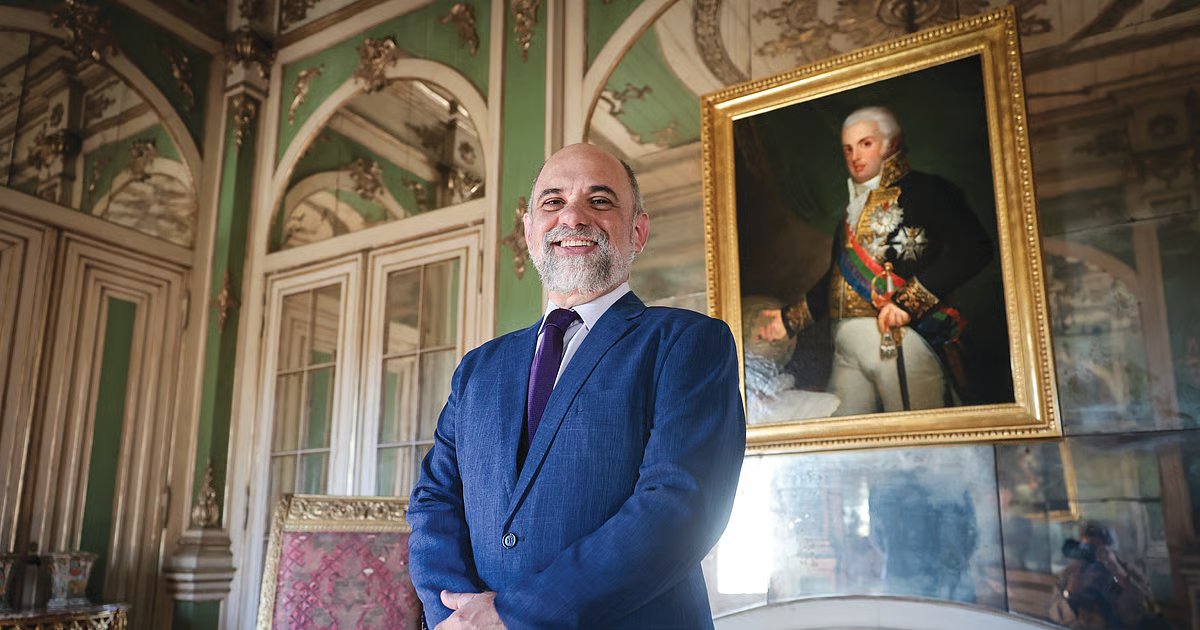
When Paulo Rezzutti allows himself to be photographed at the Queluz Palace next to a portrait of D. João VI, he knows that the monarch who appears richly dressed was an important figure in the History of Portugal and also in that of Brazil, but initially it wasn’t supposed to be like that. After all, D. Maria I’s heir was Prince D. José. D. João was the youngest brother, in theory destined for a life of little relevance at court. However, the death of the Prince of Brazil at the age of 27, in 1788, changed everything.
The Brazilian historian, author of this recently published Among Us D. João VI – The untold storyagrees that it was a big change in the plans of the Braganças Dynasty, in addition to the personal tragedy for D. Maria I, already widow of D. Pedro III, but rejects the thesis that the new heir to the crown was unprepared: “A prince is really always prepared for this eventuality. The point is that there was a whole influence on D. José’s education even from Pombal’s time. So, Pombal managed to influence the education of the two princes, but he gave more emphasis to D. José. And he dies as an adult. No one is expecting to lose a brother at the age of 27. And at 21, suddenly, D. João has this issue of having to assume the position of first in succession to the throne. But What happens to him is not the issue of lack of preparation, it is the issue of how to deal with the internal parties of the court, which is still a court fragmented by the division created by the Marquis of Pombal. There is still a nobility eager to return to positions of power, command, with their privileges and everything else, and there is a bourgeoisie on the rise. For example, when he is forced, because of his mother’s illness, to assume the regency, his first regency is interim. There were ministers he inherited from his mother who wanted to call cuts to confirm whether he could take over. There is even a question as to whether he could take over as regent.”
After the death of King D. José, in 1777, the Marquis of Pombal, the all-powerful prime minister, fell into disgrace, but even with D. Maria I on the throne there were admirers of the man who ordered Lisbon to be rebuilt after the great earthquake. AND The initial rise of D. João, for a long time prince regent as he only became king in 1816, was marked by this clash of factions, as well as by his mother’s madness and the post-French Revolution European turmoil.
Rezzutti even argues that D. João surprises with what he knew: “we see several things, such as, for example, a clarification on his part that wasn’t even with his mother. For example, she doesn’t vaccinate her children with smallpox. D. José dies with smallpox. D. João himself catches smallpox, but gets a mild form. D. João vaccinates his children, runs a vaccination campaign here in Portugal, that the Duke of Lafões will be the person who will take the lead, and even though he dies firstborn, he continues to reaffirm that it is important. With D. João the issue of vaccination in Brazil begins. So much so that when he goes to Brazil, he sees that the vaccine pus, from which the inoculation was made, was no longer as potent. when it goes to Brazil, it invades French Guiana and brings species already acclimatized in the tropics from Jardim La Gabrielle to Rio”.
Rezzutti is excited. But before we talk about D. João’s 13 years in Brazil, let’s look at the time, with his mother going crazy and Europe in turmoil. Pressured by Napoleon’s France, and at the same time by his ally Great Britain, the prince regent gained a reputation for being indecisive. “D. João’s big question is the following. If he stayed in Portugal, he would lose. He lost the War of the Oranges. So, if in a war with Spain Portugal was defeated, imagine what could happen to that famous La Grande Arméewho at that moment had not lost anything in Europe. Napoleon had already deposed kings, changed rulers and so on. And you have, on the other side, England also putting pressure on him not to be allied with the French. D. João’s decision was like this: if he stayed in Portugal, an ally of the French, he would lose Brazil to the English. So much so that one of the communications made before informing the viceroy of Brazil that the court was changing, was to strengthen the Brazilian coastline against British attacks. So, I already knew that losing Brazil was a possibility. In a letter he laments, he tells Napoleon, ‘I can’t be your ally, because Portugal doesn’t produce enough wheat. If I stay allied with the French, the English will close my ports with their ships and I won’t get wheat for the people. And for people without food, the position here would be very complicated.’ Within this context, I also wouldn’t know how to decide and would mess up both. That’s what he does, he screws England. And rolls France. Even with bribes”, explains Rezzutti.
When D. João, with Carlota Joaquina and his sons and daughters, embarked for Brazil, at the end of 1807, there was talk of escape. French troops are at the gates of Lisbon. “The departure was really tumultuous, the Ajuda library is packed and is on the pier. It was not shipped, but it was packed so well that it was raining, and the books remained perfect. I joke, when they say that D. João fled, that no one runs away with a library”, says Rezzutti, remembering that The court’s departure to Brazil was an old plan, although never put into practice by the Portuguese kings, until it was necessary.
“Since the 16th century, the prior of Crato, you already have this. Then this will resume in the time of D. João IV, who is the first Bragança on the throne. He gives his eldest son the title of Prince of Brazil, already with an idea of a plan, because there have been 28 years of struggle with Spain. Resuming Portugal’s independence was not a walk in the park. So he thought about marrying D. Teodósio with a niece of the king of France, the two would go to Brazil and Portugal would be handed over to a regent, who would be the Duke of Orléans, father of the Princess of Brazil. It ended up not working, but there is the idea. In fact, the same thing happened with D. José I, because of the probable war with Spain and France. who will execute it is D. João VI, who escapes capture by Napoleon, while the king of Spain is arrested and deposed”, explains.