Although the European JUICE space probe, currently en route to Jupiter and its icy moons, is still in the early stage of its mission, Hungarian innovations are already contributing significantly on board, the HUN-REN Research Network reported on its website.
The JUICE (Jupiter Icy Moons Explorer) spacecraft was launched on April 14, 2023, to reach Jupiter, the largest planet in the solar system, by 2031. One of the eleven scientific instruments on board is the PEP (Particle Environment Package), a suite of instruments designed to study the particle environment, in the development of which Hungarian researchers and engineers were also involved.
Of the six detectors in the PEP instrument suite, the power supply systems (Direct Current Converter, DCC) for four particle detectors developed in Europe were designed by experts at the HUN-REN Wigner Research Center.
The operation of the system is currently monitored by staff at the HUN-REN Center for Energy Research.
The DCC has been functioning flawlessly since it was commissioned:
Its performance meets expectations, and its temperature behavior—even under the extreme conditions of space—corresponds to the results of earlier simulations and tests. The Hungarian researchers are also involved in analyzing the sensors’ initial measurements.
As the research network reports, JUICE’s journey to Jupiter is particularly complex. The probe does not follow a direct trajectory but instead gains energy and corrects its course through a series of so-called gravity assist maneuvers, in which it uses the planets’ gravity. A milestone in the mission was reached in August 2024, when—for the first time in the history of space exploration—an orbital correction was performed using the combined gravitational pull of the Moon and Earth.
The long journey is not without its highlights. In November 2025, the probe flew past the interstellar comet 3I/ATLAS. With the probe’s assistance, over 120 images were taken of the object, which originated from outside the solar system. The analysis of the measurement data and its comparison with the characteristics of comets from our solar system is currently underway.
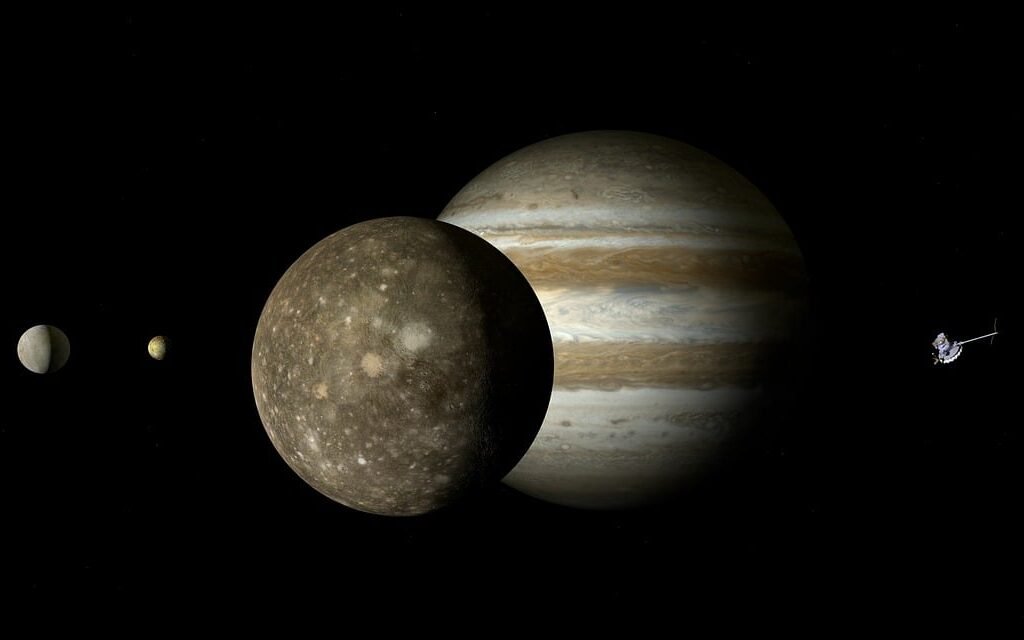
However, JUICE’s primary objective is the detailed exploration of Jupiter and its surroundings. As highlighted in the press release, Jupiter has the most moons of any planet in our solar system, and this planet has been the subject of research among astronomers for several centuries. The mission places particular emphasis on the three large moons—Europa, Ganymede, and Callisto—which were first discovered by Galileo.
According to current theories, oceans of liquid water could be hidden beneath their thick ice crusts, which is why the probe will also investigate the formation of habitable worlds in the vicinity of the gas giant.
The PEP instrument package will play a key role in this effort. The instrument will study the moons’ thin atmospheres—known as exospheres—and provide information about their chemical composition.
The instrument is capable of detecting the presence of water and organic compounds in the exosphere. It will study the interactions caused by particles accelerated by Jupiter’s magnetic field as they strike the moons, as well as the magnetosphere of Ganymede, the only moon in the solar system that has its own magnetic field.
As the probe approaches Jupiter, the mission program will be expanded to include another target.
JUICE is expected to fly past Kallichore—a moon discovered in 2003—at a distance of just 700 to 800 kilometers, therefore a direct study of this moon has also been added to the scientific program. In the coming years, the probe will thus not only explore the mysteries of a distant planetary system on its way to Jupiter, but will also help us understand how potentially habitable worlds in the solar system might develop.

Via hun-ren.hu, Featured image: Pixabay