Follow the money, and you’ll often end up at a government contract. Roads, schools, consultancies, supplies, public works; every year, millions of dollars in taxpayer funds are awarded through Belize’s procurement system. But the public does not always get a clear view of who benefits, why they were selected, or whether the process was properly followed. That lack of visibility, reformers warn, creates room for favoritism, manipulation, and abuse. Tonight, we take a closer look at the major gaps in Belize’s public procurement framework and why calls are growing for stronger enforcement, online disclosure, and greater transparency in how public money is spent. Here’s News Five’s Isani Cayetano with the following report.
 Isani Cayetano, Reporting
Public procurement is how government spends taxpayers’ money, whether it’s buying office supplies, hiring a consultant, building a road, or launching a major infrastructure project. When the system works, taxpayers get value for money, businesses get a fair shot, and projects are completed the way they should be. But when the system is weak, the risks grow quickly. Contracts can go to favored companies, prices can be inflated, ownership can be hidden, and political influence can creep into decisions. In the end, taxpayers may pay more, honest businesses may lose out, and public trust takes the hit.
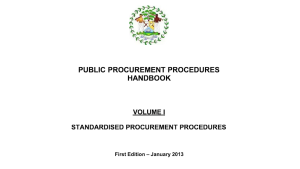
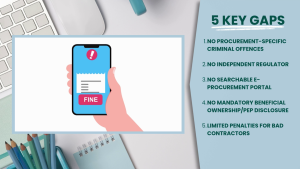 A new reform analysis says Belize’s public procurement system has the basic rules on paper, but not enough muscle to enforce them. The review points to five major weaknesses. Belize does not have a procurement-specific criminal law, an independent regulator to police the system, or a national online portal where the public can track contracts. It also does not require companies to disclose who really owns them or whether politically connected persons are involved. And when companies break the rules, the system for banning them from future contracts remains weak. The analysis says Belize’s procurement system is built mostly on older financial laws and guidelines, including the Financial and Audit Reform Act of 2005, the Financial Orders from 1965, and the 2013 Procurement Handbook. But reformers argue that those rules don’t go far enough. They do not create strong, procurement-specific criminal offences for serious misconduct, such as bid rigging, tender fraud, splitting contracts to avoid scrutiny, or hiding political ownership behind companies. In other words, Belize has procedures for how contracts should be awarded, but not enough tough penalties for those who manipulate the process.
 Belize has no independent watchdog focused solely on public procurement. Unlike Trinidad and Tobago, which has a dedicated procurement regulator, Belize depends on oversight offices with limited powers. The Contractor General can review some issues, but reformers say that office cannot fully police how contracts are awarded across government. They are calling for a new independent regulator that reports directly to the National Assembly, with power to stop questionable contracts, hold public hearings, blacklist bad contractors, issue orders, and send suspected wrongdoing to the D.P.P. Here’s what we’re asking: when ministries award contracts, who checks that the process was fair, clean, and free from political influence?
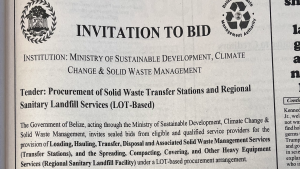
Belize still has no one-stop website to track government contracts. Today, many notices appear in the Gazette or newspapers, but there is no searchable public portal showing tenders, awards, cancellations, contract values, winning companies, owners, complaints, or performance records. That leaves key information scattered, or out of sight. An e-procurement portal would put public contracts in one place, make spending easier to track, and make questionable deals harder to hide.

Isani Cayetano
Isani Cayetano
“In a modern procurement system, the public should not have to search through scattered notices or make repeated requests to find out how public money was spent. The recommendation here is one central online portal; free, searchable, and updated in real time.”
A company may win a government contract, but the public may still not know who is really behind it. Belize does not require bidders to disclose their true owners or reveal whether politically connected persons are involved. Without that information, someone with political influence could hide behind a nominee company, a relative, or a layered ownership structure and still benefit from public contracts. That’s a major loophole. If the country wants clean procurement, the public must know not just which company won the contract, but who really stands to profit.
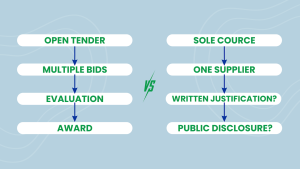 Sole-source contracts are one of the riskiest parts of public procurement. They are not always wrong. Emergencies, special equipment, or unique services may justify hiring one supplier directly. But because competition is limited, or removed completely, the process needs stronger checks. The analysis says Belize’s rules are too vague. It recommends that sole-source awards get written approval from an independent review panel, and that government publish the reasons online within forty-eight hours.
 Belize’s current framework does not require publication of evaluation scores or bidder rankings, and debriefing is not guaranteed as a legal right. It recommends publishing evaluation summaries and giving unsuccessful bidders a debriefing within 10 working days. If one company bids lower but loses, or another company wins despite controversy, the public should be able to understand the basis of the decision. Was it price? experience? technical quality? delivery time? Without scoring transparency, suspicion can grow.
Belize’s debarment system is weak because the 3-to-5-year debarment mentioned in the Handbook is administrative, not statutory, and is not maintained in a publicly searchable registry. It also raises the concern that a debarred person could create or use another company if ownership is not properly tracked. A debarment list is only useful if ministries, businesses, journalists, and the public can search it, not only by company name, but by the people behind the company. At its heart is accountability. If taxpayers are footing the bill, they should be able to see how every dollar is spent. Belize needs to go beyond procurement procedures and build a system that prioritizes transparency, public disclosure, independent oversight, and penalties for wrongdoing. Isani Cayetano for News Five.
Attention readers: This online newscast is a direct transcript of our evening television broadcast. When speakers use Kriol, we have carefully rendered their words using a standard spelling system.
Watch the full newscast here: