“We are the lucky ones,” he says in the nice café of the Theater Ján Palarik in Trnava, playwright Jakub Molnár. “We do not feel the impact of consolidation as brutally as other colleagues from other theaters, not to mention an unorganized stage that is on the verge of liquidation.”
The Ján Palárik Theater is established by the county. According to Molnár, the latter helps the theater with shortfalls in income that they were used to, for example from the Art Support Fund, and always seeks some kind of consensus with the theater.
However, it is not ideal. The theater saves on scenography and cannot take a big audience risk when choosing a production.
“The long-term problem is table salaries, this does not only concern consolidation, but it accelerated it,” says the playwright, who is also the chairman of the theater unions.
Table salaries have not been valued since 2022, and some people only have the minimum wage. It concerns people from the technical department, from the administration, i.e. sound engineers, technicians, lighting people, many of whom have been in the theater for many years. According to Molnár, they try to make up for it in the theater with personal allowances.
Even Molnár can’t make ends meet from Trnava’s salary, which is why he has various projects outside his home scene. Since he lives in Brno and commutes to Trnava, he needs two jobs to be able to pay the rent or afford the occasional vacation. However, he is thinking that he will soon leave Slovakia for good.
How to live in Slovakia in 2026
Jakub Molnár’s story is part of a series of stories of people with whom we spent time in their daily activities and talked about how they manage their daily lives.
The question of how to live in Slovakia has become one of the main topics of political struggle after two waves of consolidation. However, this is often far from the daily reality of people all over the country who do what they can to ensure decent living conditions for themselves, their families or their employees. What does this mean at the turn of 2025 and 2026?
Denník SME answers in a series of stories of people from different corners of Slovakia. If you also want to share your story, contact us at spravodajstvo@sme.sk.
Other stories in the series:
-
The government throws logs under our feet, but we also do it ourselves, bakers say
-
I have been thinking about closing for three years, now it will probably happen, says the shop owner
-
One would not believe how much the body can withstand, says the train driver
-
I already feel fear that the costs will only increase, says the dancer
-
Here, a person has to be good to survive, says a Syrian businessman from Košice
-
Many people don’t even choose medication because it doesn’t work for them, says the pensioner
They save on scenography
As one of the few theaters in Slovakia, the Trnava Theater has its own workshops, so they can make their own costumes and sets, which Molnár perceives as a luxury. However, they do not know how to produce everything and have to give orders to other companies as well.
“Our partner companies also raised prices. It is even more difficult for us to balance all these expenses so that we are not completely financially unprofitable,” describes the playwright.
This is reflected in the production processes of the production.
“From the beginning, we try to explain to the creative team that we will do everything in our power to create the best possible production, but unfortunately if it becomes more expensive for us to produce a scene, then we simply have to cut costs there,” he says.
They were also negatively affected by the change in the system support of the Art Support Fund, where some sub-programs in which they were regular applicants were dropped. The regular budget of the theater did not previously cover royalties or the creation of the scene.
“Now we asked the FPU for support for only two productions in the season, we received only one, and only ten percent of the requested amount.” So they received a total of two thousand euros, which does not cover even one fee for one creator,” Molnár describes. “We had to take that into account. I hope that it did not affect the quality of the productions, but rather their material burden. We financed it from our own resources.”
How to remain an ambitious theater
Dramaturgically, according to him, the theater still remains ambitious. At the same time, they want to be a theater for everyone, which means creating productions in the comedy genre, as well as productions for children, and something for a more demanding audience.
“That was true and I hope it will continue to be true, even if the financial burden enters the decision-making more and more, next season we are preparing several more intimate titles,” he explains.
“However, in relation to consolidation, we are more cautious in that we don’t want to take any major audience risk in all new productions,” he continues.
So they can’t afford to create a production that will cost a lot of money and after three reruns they will have to proceed to the finale because the audience doesn’t go for it.
“This has always been there, especially for regional theaters we have to take into account the audience’s appetite. But now we are stricter on ourselves not to make a mistake.”

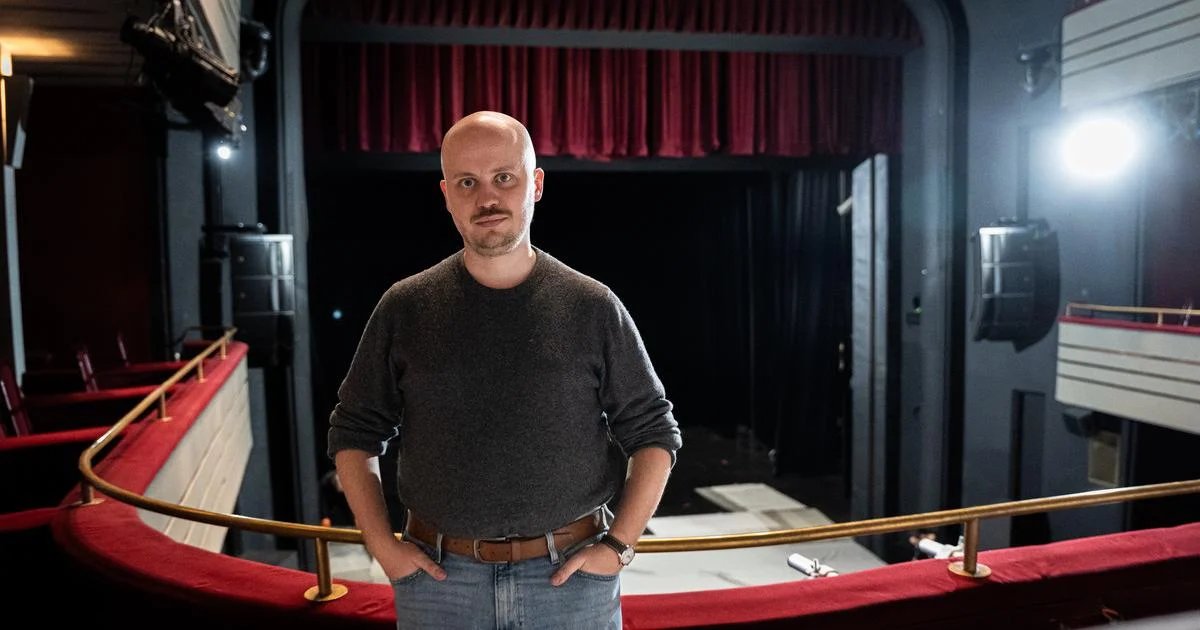
Jakub Molnár in the workshops of the Ján Palárik Theater in Trnava (source: Marko Erd, SME)
They generally responded to price increases by raising ticket prices. Molnár says that this has not yet changed the audience’s habits and the theater continues to have good attendance. On average, performances fill 85 percent of the hall’s capacity.
“But we already have news from our box office, or when we talk to our viewers, that the price of tickets is already on the edge,” he says. If consolidation will continue, and if they have to raise prices further, according to him, it will negatively affect their relationship with the audience.
“We don’t want to be a theater only for the elite,” says the dramaturg. Now the cheapest performances for children cost from nine to 13 euros, while evening performances from 18 euros and above.
The theater has 12 titles in its repertoire, which change. The theater also helps itself financially by renting the premises of the halls and the cafe.
Functions are accumulated, overtime is solved
Approximately 70 employees work in the Ján Palárik Theatre, of which roughly two-thirds are administrative and technical personnel, i.e. technicians, production or sound engineers.
In addition to low salaries, Molnár also perceives the under-dimensioning of the theater’s personnel as a problem.
Even though they managed to open the organizational structure and create new job positions in recent years, for example in the new independent section of informal education and audience development, they still lack people for various positions.
This is also why several functions are accumulated among employees. “This then creates another problem, and that is overtime, especially when a new production is being created or large projects are being prepared,” says Molnár. Then the employees pull twelve-hour shifts for several weeks at a time.
“Consolidation has exposed these vulnerabilities even more and is trapping us in collective fatigue and exhaustion,” states the playwright.
However, he highlights the role of theater unions, thanks to which it was possible to enforce various benefits and rewards in collective agreements. “We updated the collective agreement and the article on working time, thanks to which we eliminated the vast majority of overtime,” says Molnár.
It is not only the merit of the trade unions, but of collective bargaining in general, which took place a long time ago, he reminds.

Jakub Molnár (source: Marko Erd, SME)
While the state theaters were ordered by the ministry to lay off ten percent of their employees due to consolidation, the county in Trnava did not go in this direction. Instead, they optimize spending on the creation of productions and cut back on accompanying events and marketing.
Molnár also has an overview of the situation of theater workers throughout the country. More than seven thousand people work in theater in Slovakia. Half of them, according to the statistical data of the Theater Institute, are self-employed or SZČO, who do not have an employment relationship.
“In other words, around four thousand people in Slovakia who make theater are in a very precarious situation. Despite the fact that they call themselves independent theater, they were quite dependent on various funds and subsidies. And because many of these funds fell out this year, they are the most vulnerable group,” he says.
Molnár is also in contact with other theaters that are much worse off than his. “There are theaters where working hours are reduced, where employees haven’t seen their paychecks for months, where they save on heating, where they don’t run hot water, where premieres are canceled, where they put on more frequent shows with the potential to only entertain, i.e. chamber comedies,” he describes.
He is preparing to leave for the Czech Republic
Even though Jakub Molnár works in Trnava, he still lives in Brno, Czech Republic, where he stayed after his studies at JAMU.
It can work that way, because the work of a dramaturg is a lot about creative writing, meeting with directors, or going to festivals as part of collaborations.
If he is the dramaturg of a specific production, he spends most of the month in Trnava, then he sleeps in the theater or goes on a tour, i.e. he gets up at five in the morning and returns before midnight.
“I also work with Czech theaters, so I can somehow compare the situation here and there,” he says.
In the Czech Republic, the position of dramaturg has a more narrowly specified job, in Slovakia it is not so defined. Some theaters don’t even have a dramaturg position. “But at the same time, someone has to perform the role of dramaturgy. Someone chooses the titles, someone edits them, creates a repertoire and builds a vision, a theater strategy,” he says.
Molnár is gradually preparing to leave Slovakia completely and is looking for job opportunities mainly in Brno.
“My motivation is pragmatic, not only political. Since I travel all the time and the ticket prices are more expensive and the trains are burning and running late, it is difficult for me personally to combine life in the Czech Republic with commuting to Slovakia,” he explains. However, he still wants to cooperate with Slovak institutions and theaters, but only as an extern.
He says that he is, of course, nervous about the results of the Czech elections and the actions of the Czech Minister of Culture, Oto Klempíř. The latter also begins to use aggressive rhetoric directed against “liberal elites” as a tool to justify radical personnel purges in cultural institutions and to assert state control over artistic creation in the name of protecting national traditions.
“It still doesn’t look like culture is being destroyed as quickly and easily as it is happening in our country, but there are already some signals, including from public television and radio, that the way of potential control of culture is beginning to be very similar to that in Slovakia,” he says.
However, he is more optimistic in the fact that in the Czech Republic the debate about working conditions in culture or about ways to oppose political intervention was present a little earlier than in our country.