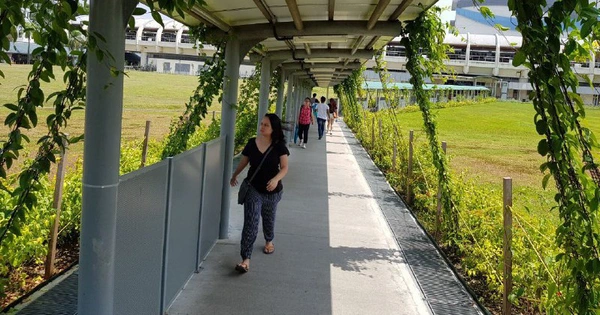
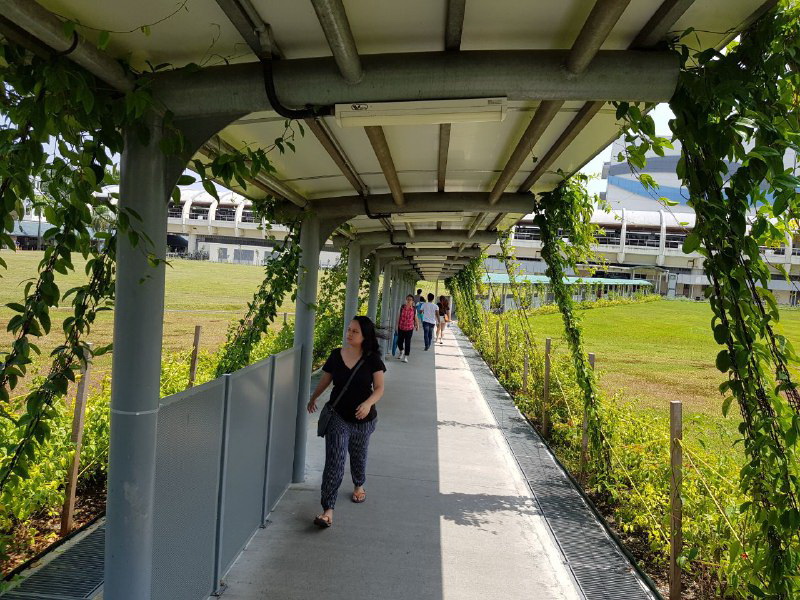
Pedestrians walk beneath a covered linkway in Singapore. Photo: Trinh Phuong Quan
Installing covered walkways to protect pedestrians from sun and rain as they travel from home to bus stops and metro stations is a practical, achievable, and fast-to-implement solution for cities across Vietnam.
In recent weeks, Ho Chi Minh City, Hanoi, and other major urban centers nationwide have been struggling under record-breaking heatwaves.
Outdoor temperatures have at times reached 40 degrees Celsius, making travel and daily activities in public spaces increasingly difficult.
The shortage of urban greenery has only worsened conditions, leaving pedestrians exhausted as they walk to bus stops and metro stations.
A practical, achievable solution
The idea of installing covered pedestrian walkways connecting metro stations and bus stops – a proposal that has been raised before – is a practical, achievable, and fast solution, especially as Ho Chi Minh City continues to experience rising temperatures.
The question now is no longer whether such infrastructure should be built, but how to build it properly, transparently, and according to clear standards.
The most relevant model for Vietnamese cities to study is Singapore’s linkway system.
Singapore and Ho Chi Minh City share many similarities, including high urban density and a tropical climate characterized by intense sunshine and sudden rainstorms.
Singapore began addressing pedestrian mobility challenges in the 1990s, and its model could be readily adapted to Ho Chi Minh City.
In Singapore, pedestrian shelter systems generally fall into two categories, covered linkways and covered walkways.
Covered linkways are standalone sheltered pathways built along sidewalks, typically in areas without adjacent shophouses or buildings that provide protection from the elements.
Covered walkways are sheltered pedestrian routes incorporated into the frontages of existing buildings.
The more pedestrians pass beneath these walkways, the more property owners tend to welcome them, as they create additional opportunities for people to enter shops and businesses.
The first linkway system was introduced along Orchard Road in the 1990s as part of Singapore’s urban infrastructure redevelopment.
By 2018, the city-state had built more than 200 kilometers of covered walkways and continued expanding the network.
The concept, however, dates back much further.
Singapore’s 1822 master plan, drafted by Stamford Raffles, required every shophouse to include a 1.5-meter-wide covered corridor for pedestrians.
Singapore did not roll out the system on a massive scale from the outset.
The early linkways along Orchard Road suffered from numerous shortcomings: discontinuous segments, inconsistent dimensions, poor drainage, and in some cases awkward intersections that created pedestrian bottlenecks.
By around 2000, Singapore had established standardized design guidelines for covered linkways.
Under those standards, an ideal covered linkway is 2.4 meters wide and between 2.1 and 2.4 meters high.
Maximum slope is limited to 1:12 to accommodate wheelchair users and elderly pedestrians, while lighting is installed where necessary for nighttime use.
Covered walkways integrated into buildings typically have a minimum width of three to 3.6 meters.
Glass roofs are generally avoided for safety reasons in the event of breakage, and roofing materials must provide thermal insulation.
The foundations of linkways are often integrated with drainage infrastructure or built larger to withstand Singapore’s short but intense thunderstorms and strong winds — a weather pattern that closely resembles conditions in Ho Chi Minh City.
Roofs are typically sloped toward roadside green strips, allowing rainwater to drain efficiently while also helping irrigate vegetation.
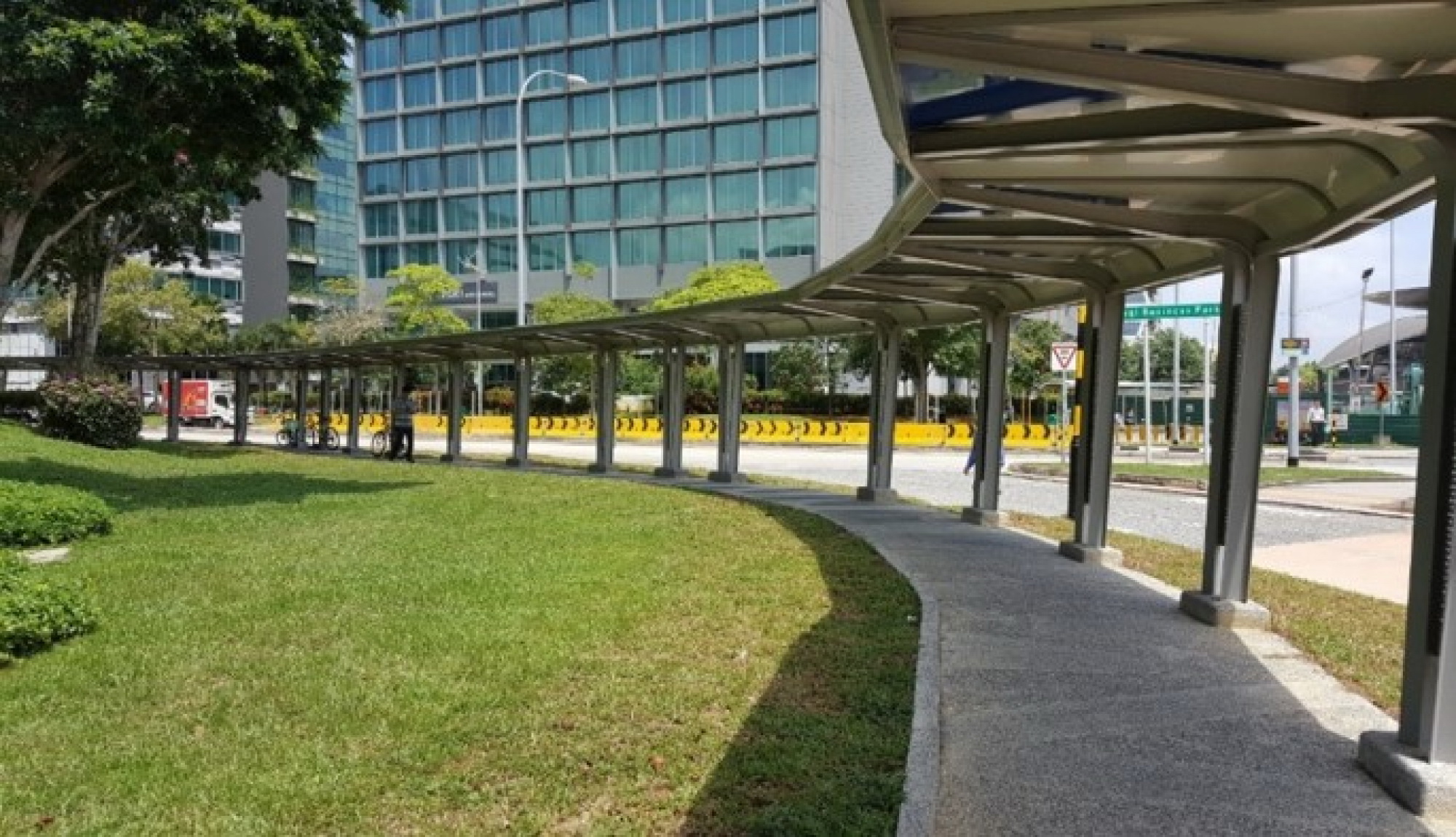
A covered pedestrian walkway lines a street in Singapore. Photo: Trinh Phuong Quan
Improving convenience for pedestrians, bus riders, metro users
One important point should be made clear: the primary purpose of covered walkways is not protection from the sun, it is protection from the rain.
In tropical climates such as Ho Chi Minh City’s, sudden downpours are frequent, intense, and often prolonged.
A pedestrian walking from home to a bus stop or metro station can be completely soaked after just a 15-minute rainstorm if no shelter is available.
This is a major inconvenience for public transit users.
Singapore recognized this reality early in the design of its linkway network.
The system was built first and foremost to ensure that residents could move continuously without being interrupted by rain.
Protection from sunlight is an added benefit, but not the primary objective.
Because of these covered connections, Singaporeans can walk from home to a bus stop, from a bus stop to a metro station, and from a station to their workplace without needing an umbrella or raincoat.
That convenience encourages people to shift away from private vehicles and toward a combination of walking and public transportation.
Ho Chi Minh City is currently expanding its metro system and feeder bus network.
If policymakers genuinely want residents to reduce their dependence on motorbikes, pedestrian infrastructure must function year-round, not just on pleasant, sunny days.
Rain accounts for a significant portion of the year in Ho Chi Minh City.
Ignoring weather protection effectively means that public transportation remains fully usable only part of the time.
If the city moves forward with a covered walkway network, several considerations should guide implementation:
First, priorities must be clearly defined.
Walkways should be designed primarily to provide effective protection from rain, with sufficient roof overhangs, efficient drainage, no standing water, and protection from wind-driven rain.
Sun protection should be the second priority and can be enhanced through trees and climbing plants growing over the structures.
Second, covered walkways should complement, not compete with, urban greenery.
The shelter structure can serve as a permanent framework, while vines provide a green canopy and roadside trees add supplemental shade.
Third, covered walkways should be mandatory along all routes connecting bus stops and metro stations with residential neighborhoods, office quarters, schools, and hospitals.
The network must be continuous rather than fragmented.
Finally, the Ho Chi Minh City People’s Committee should publicly release clear regulations and design standards so that both public agencies and private developers can comply easily.
Uniformity is not achieved through administrative orders alone; it comes from a transparent and clearly defined set of standards.