The current scenario in the global automotive industry no longer allows the use of euphemisms. If a decade ago the Chinese market was seen as an experiment laboratory or a source of low-cost copies, the panorama in 2026 reveals a drastically opposite reality. Who walked through the pavilions of Auto China 2026in Beijing, quickly realized that the sector’s center of gravity had shifted. A reality that is reinforced when you have the opportunity to visit some of the factories and development centers of leading brands in the automotive sector – PÚBLICO visited half a dozen in four cities. China is not just producing more; is producing better. With a level of technological integration that historic European and American builders are now struggling to keep up with. This dominance did not emerge by chance, resulting from a deliberate strategy of investment in massive infrastructure, artificial intelligence and manufacturing capacity that challenges the limits of automation.
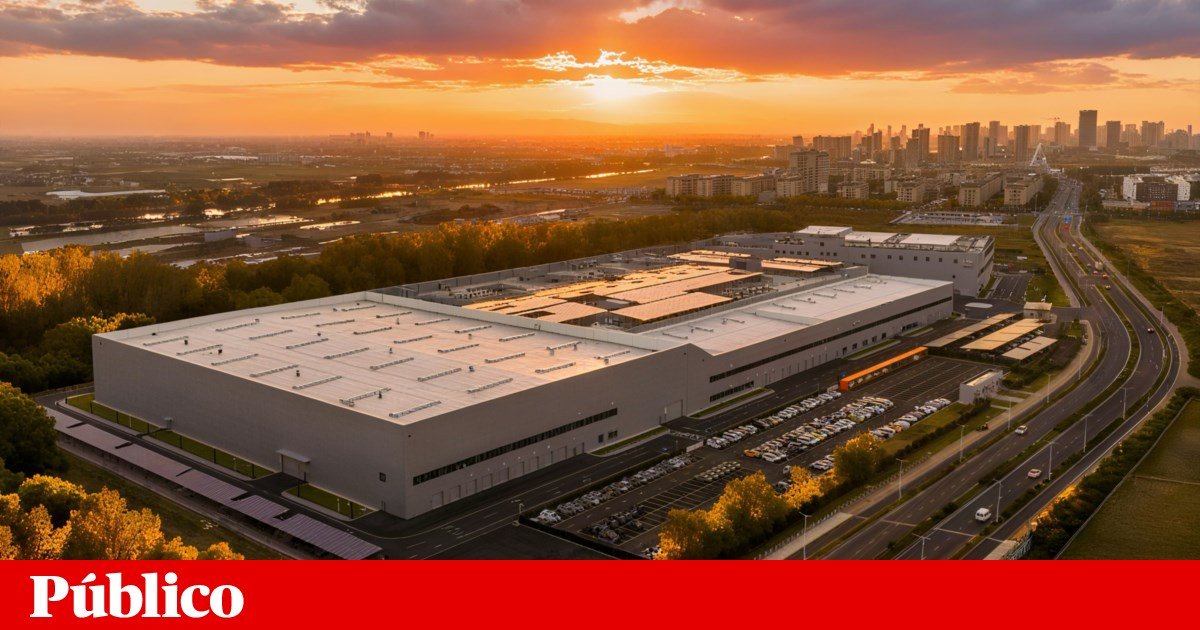
One of the most striking examples of this new industrial order can be found in Ningbo, in the “Golden South Wing” of the Yangtze River Delta. That’s where the company’s smart factory operates. Zeekra unit that extends over an impressive 7.87 square kilometers, around a thousand football fields. Construction, which began at the end of 2018, gave rise to an ecosystem that Zhejiang province classifies as the pioneer of “factories of the future”. This is not a conventional assembly line, but a structure that integrates private 5G networks and artificial intelligence to power what the brand describes as a “digital brain”.
In this unit, efficiency reaches almost perfect levels. In the stamping workshop, single mold techniques are used for several parts, while the welding section is dominated by almost 900 flexible robots that guarantee an automation rate close to 100%. The ratio of robots to humans is about nine to one. This level of control allows Zeekr to implement the C2M model (customer to manufacturesomething like custom production, in Portuguese), offering a multitude of personalized configurations for each model, such as the Zeekr 001, which will arrive in Portugal this year, or the Zeekr 009, ensuring that the final product is exactly what the customer envisioned, without sacrificing production speed. The technological highlight goes to the 7200-ton casting and stamping machines, among the largest in the world in terms of series production capacity, which allow the creation of large structural sections of the chassis in a single piece, reducing weight and increasing rigidity.
However, Chinese dominance is not just made of steel and robots; It is also done in the advertised obsession with technology, comfort and safety. Clearly with the aim of refuting one of the most repeated preconceived ideas about Chinese brands: supposed poor construction quality. In this regard, it is important to highlight that the Geely bought Volvo in 2010 and, consequently, all the knowledge of the Swedish company in the area of security. In fact, Geely’s chief safety engineer is Swedish Jerker Andersson. An engineer who spent more than 15 years at Volvo.
DR
The Geely Auto Safety Center, opened on December 12, 2025, also in Ningbo, is today presented as the largest and most advanced automotive safety testing center on the planet. With an initial investment of more than two billion renminbi (around 260 million euros), this facility covers the entire spectrum of global testing, from high-speed collisions to pedestrian protection and battery safety.
The center boasts five Guinness world records, which help illustrate the magnitude of the project: it has the largest automobile safety laboratory in the world (81,930.745 m2), the longest indoor track for crash tests (293.39 meters), the largest wind tunnel with high-altitude climate simulation — capable of reproducing snow, rain and solar radiation with winds of 250 km/h — and the largest crash test zone with arbitrary angles between 0 and 180 degrees. In total, 27 different types of tests are available, which is another record for a car manufacturer’s laboratory. Security extends into the digital domain, with dedicated cybersecurity testing infrastructures to chips, firmware (software basic that deals with hardware operating system) and over-the-air (OTA) updates.
This investment in safety and quality translates into market numbers that should keep brand managers from Stuttgart or Detroit up at night. In 2025, Geely Auto Group achieved accumulated sales of more than three million units, exceeding the annual target with growth of 39%. The most revealing data is the performance of new energy vehicles (NEV), whose sales reached 1.7 million units, which represents a stunning increase of 90% compared to the previous year.
Chinese leadership is equally visible in the transition to the era of artificial intelligence 2.0. THE Geely positioned itself as the first global builder to establish a layout comprehensive in this area, having started research into large-scale models in 2021. The result is the Xingrui AI Large Model, the first independently developed full-scenario artificial intelligence model for the automotive industry. This system is powered by the Geely Xingrui Intelligent Computing Center, which has a computing capacity of 23.5 EFLOPS, the highest among Chinese manufacturers.
DR
At the 2026 Beijing Motor Show, the practical demonstration of this capability was the EVA Cab, the first prototype of a robot taxi in China designed specifically for this purpose. This vehicle uses the EEA 4.0 electrical and electronic architecture, which uses quantum cryptography to guarantee bank-level security in communications between the vehicle and the cloud. THE hardware is equally imposing: three chips top of the range — Nvidia SuperChip, Nvidia Thor U and Qualcomm Snapdragon 8397 — deliver computing power exceeding 3000 TOPS. For comparison, a good current computer has an AI processing capacity in the region of 50 TOPS. To make autonomous driving a safe reality, the EVA Cab is equipped with the world’s first 2160-line digital LiDAR system, with a range of 600 meters and the ability to process 25.92 million points per second.
From the roads to the air
But Chinese technological ambition does not stop at the asphalt. THE Aridgefocused on air mobility, established the world’s first flying car mass production factory in Guangzhou (Guangzhou). With 120,000 square meters, this unit is dedicated to manufacturing the aerial module of the Land Aircraft Carrier. Production combines the rigorous standards of aviation with the efficiency of the automotive industry.
DR
In this factory, the technical challenges are considerable. Because aircraft extensively use carbon fiber and aerospace-grade aluminum and titanium alloys, materials that are extremely heat-sensitive, Aridge has abandoned traditional thermal welding in favor of “cold joining” techniques such as riveting and adhesive bonding. The composite materials workshop developed a molding process by airbag high pressure to produce hollow components with complex geometry, such as aircraft propellers and arms, ensuring lightness and high resistance to vibration. These components reach the Class A aeronautical quality standard.
Efficiency is guaranteed by automation: the use of robots for automatic riveting tripled the production speed compared to traditional methods. Node workshop of painting, a mixed and flexible system improved performance by four times. The final stage of assembly features a cloud-based intelligent calibration line, which allows testing of flight, navigation and driving systems, or rather, autonomous piloting without the need for external cabling. The first unit rolled off the experimental production line in November 2025, marking the start of mass production of this new type of mobility. And we could see, on siteof which a few dozen have already been produced during the development phase of series production.
DR
If Geely impresses with its scale and safety, the visit to the Xiaomi factory in Beijing transports us to a scenario that seems like something out of a science fiction film. It is, without a doubt, the production unit with the most sophisticated and futuristic appearance that this journalist has ever visited.
With an annual production capacity projected for 150 thousand units in the first phase, the Xiaomi factory stands out for its automation taken to the extreme, where human intervention is minimal in critical areas. In the body shop, the level of automation is total, with hundreds of robots operating simultaneously with surgical precision. This is where the already famous SU7 takes shape, the brand’s first car that sold out orders in a few minutes, and where the YU7 is already being produced, a model that should mark the brand’s international expansion and whose arrival in Europe is scheduled for 2027.
Like Zeekr, Xiaomi invested heavily in large-scale pressing technology (hypercasting). The brand’s die-casting machine, called Xiaomi Hyper Die-Casting 9100t, makes it possible to drastically reduce the number of components at the rear of the chassis, transforming 72 parts into a single cast element. This approach not only reduces the weight of the vehicle by 17%, it also reduces noise in the cabin, proving that Xiaomi is not just applying what it has learned in mobile phones, but raising the bar in mechanical engineering.
Survival alliances
Faced with this show of force, the paradigm of Western manufacturers changed drastically. Arrogance has given way to pragmatism and the current strategy seems to boil down to the maxim “if you can’t beat them, join them”. What would once have been unthinkable — historic European and American brands turning to Chinese technology to survive — is now the norm in a globalized market.
Examples of strategic partnerships multiply. Renault, for example, established Horse, a joint company with Geely dedicated to the development of high-efficiency thermal and hybrid engines. In the Stellantis group, the movement was even more aggressive with the investment of around 1.4 billion euros to acquire a stake in Leapmotorcreating Leapmotor International to sell Chinese cars with the support of Stellantis’ European logistics network.
Germany, the birthplace of the modern automobile, also surrendered. THE Volkswagen invested around 650 million euros in Xpeng to use the Chinese brand’s technical platform in new models for the local market. In the same sense, Audi sealed an agreement with SAIC to accelerate the development of its electric vehicles, taking advantage of the architectures of software and hardware which China now masters masterfully.
This integration movement is personified by Geely’s omnipresence. The group founded by Li Shufu did not limit itself to buying Volvo or revitalizing Lotus. Through your holdingGeely consolidated itself as the largest individual private shareholder in the Mercedes-Benzholding around 9.7% of the shares in the historic Stuttgart house. It is the clearest sign that the reins of the global automotive industry have changed hands and that the future of the sector will be written, to a large extent, in Chinese characters.
PÚBLICO traveled at the invitation of Salvador Caetano