
Listen to this article
Estimated 3 minutes
The audio version of this article is generated by AI-based technology. Mispronunciations can occur. We are working with our partners to continually review and improve the results.
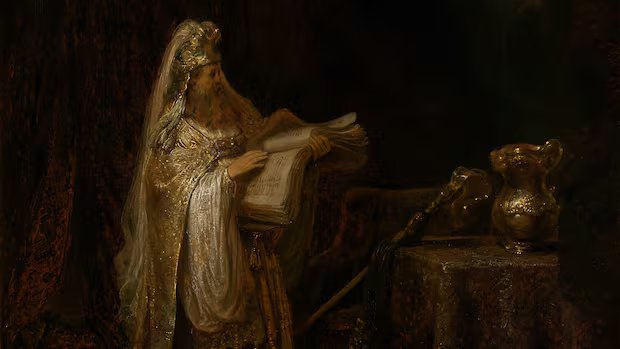
After 60 years, a painting thought to be fake has been discovered, by a team led by a Hamilton curator, to be the authentic work of the 17th-century Dutch master Rembrandt Harmenszoon van Rijn, worth millions.
Jonathan Bikker, a curator at the Rijksmuseum in Amsterdam, led the effort to authenticate Vision of Zacharias in the Temple, a painting that had been dismissed by scholars in the 1960s and largely disappeared from public view.
“Since 1961, no one had seen it, and no scholar had seen it either,” Bikker told CBC Hamilton.
Rembrandt is widely regarded as one of the greatest painters of the Dutch Golden Age. While hundreds of his works survive, new authentications are exceptionally rare.
The discovery, announced earlier this year, adds another work to the catalogue of the famed Dutch master and turns a painting once worth thousands into one valued in the millions.

A Hamilton-born curator at Amsterdam’s Rijksmuseum helped authenticate a painting long dismissed as a fake. After two years of research, it was found to be a genuine Rembrandt, worth millions, adding a new work to the Dutch master’s catalogue.
From Hamilton to Amsterdam
Bikker grew up in Hamilton and studied art history at McMaster University before pursuing graduate studies at Queen’s University.
Research for his PhD brought him to the Netherlands, where a temporary contract at the Rijksmuseum eventually became a permanent job
Twenty-five years later, he is the museum’s curator, and he’s uncovered a painting that disappeared for decades.
“The most exciting part of the research is discovering new paintings,” Bikker said. “This doesn’t happen every day.”
Many people reach out to him, claiming they own a masterpiece worth millions of dollars.
“Almost always, it’s not,” Bikker said.
But one email in late 2023 felt different, he said. The image in the email shows a picture of a painting that did resemble a Rembrandt.
“The owner wasn’t actually asking, ‘Is this by Rembrandt?'” Bikker said. “His question was who painted it?”

Painting now sits on loan in the Rijksmuseum
Bikker and his team spent two years examining the painting, studying everything from the wood panel and pigments to the brushwork and composition.
“We discovered that Rembrandt had made changes to the painting,” Bikker said. “So this painting had to be the first version.”
That helped establish the work as the original, rather than a later copy.
The findings also overturned assumptions about a similar version of the painting held in a German museum, which some experts had previously considered superior, Bikker says.
When the Rijksmuseum shared its conclusion with the owner, the reaction was shock.
“They had been told so long that it wasn’t by Rembrandt,” he said. “So, when we told them that it was, they were very pleasantly surprised.”
The painting is now on display at the Rijksmuseum on long-term loan.