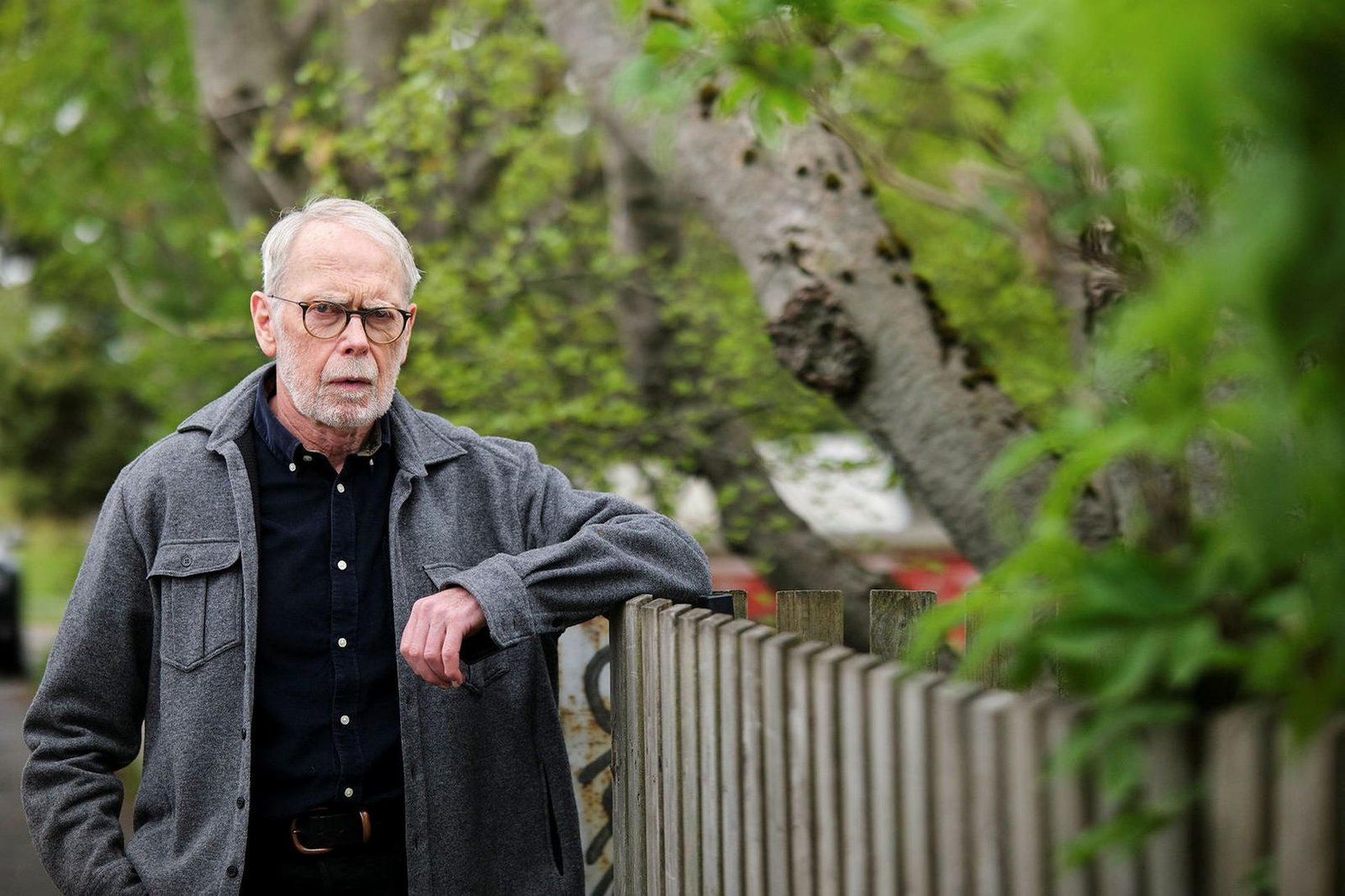
“It surprised me. I haven’t been thinking much about film production in the last few years. The last premieres were in 2013. Since then I’ve been busy writing, first film scripts and then books. The reason for the honorary award is perhaps that after I decided to devote myself to filmmaking, for almost fifty years I have stuck to it. Almost on all fronts, as a writer and director and also as the chairman of the Society of Filmmakers and later as managing director of the Film Fund,” says Þorsteinn Jónsson, director and winner of the Icelandic Film and Television Academy’s honorary award this year, wondering if the recognition surprised him.
Þorsteinn accepted the award last night when Eddan was presented at a ceremony, which he receives for his decades-long contribution to Icelandic cinema.

“This is of course an honor and I see this as recognition of what I have accomplished and no less of the work of those who have worked with me and taught me.”
mbl.is/Anton Brink
“This is of course an honor and I see this as recognition of what I have accomplished and no less of the work of those who have worked with me and taught me,” adds Þorsteinn, but he decided to follow the film path at a young age, or immediately after finishing high school.
“I was lucky enough that Þorgeir Þorgeirson hired me as an assistant and I got to carry the gadgets for him, a 35 millimeter Arriflex with a battery that was like a small car battery and a tripod. Þorgeir was my first teacher and emphasized the importance of the documentary film. Then I got a job as an editor at Sjónvarpið, which had just been founded, and after that there was no turning back.”
Studied abroad
Þorsteinn was born in Reykjavík in 1946. In 1968, at the age of 22, he went to Prague to study filmmaking, which was the heyday of Czech films. Thorsteinn had just arrived in Prague when the Russians invaded Czechoslovakia, so he witnessed those world-historical events. In his novel Spring days in Praguewhich was published in 2023, he recalls his memories of that time and vividly describes the mixed atmosphere when the Russian invasion was imminent.

At the age of 22, Þorsteinn went to Prague to study filmmaking, which was the heyday of Czech films.
mbl.is/Anton Brink
After studying in Prague and further studies in Japan, Þorsteinn made a series of documentaries together with Ólaf Hauk Símonarson, including the films Fish under a rock, Life goal, Ash Wednesday, Useful and fun and Daily bread. Þorstein’s movies should also be mentioned, which are three in number; Period, period, comma, dash (1980), The nuclear power plant (1984) and The Cloud Palace (1994).
Up to 40 photos
Now you have a long and distinguished career behind you. Is there anything that stands out when you look back?
“All in all, the films are almost 40. Three feature films, 23 documentaries and some promotional films, and in addition we can mention four scripts for films and a script for an animated series that are awaiting production. For example, the screening of The nuclear power plant at the Cannes Film Festival in 1984. We had taken far too many risks because we never received a production grant from the Film Fund.
But we left Kvikmyndafélagin Óðinn at Cannes with optimism, along with me Örnólfur Árnason and Jón Ragnarsson and the main actors Gunnar Eyjólfsson and Tinna Gunnlaugsdóttir. In Cannes, everyone thinks they are winners, and there we believed that the film would sell all over the world,” says Þorsteinn and mentions that the income is not enough to pay off debts.

There are three of Thorstein’s movies; Dot, dot, comma, dash (1980), Atómstöðin (1984) and Skýjahöllin (1994).
mbl.is/Anton Brink
“Better went along.” The Cloud Palace. It was sold to 32 countries. The crowd around was also memorable Fish under a rock. The shipping companies tried to convince the people that I and Ólafur Haukur Símonarson, my co-author, had been harassing the people in the sea areas when we were drawing attention to the poor conditions of those who worked with fish, the nation’s main industry at the time.”
Did a good job with the Cloud Palace
In the sequel, depending on whether he has a favorite work, Þorsteinn says it is quite difficult to make up between his films.
“I still think it worked out well The Cloud Palace. It was not very well received in Iceland, but it was well received elsewhere. Here at home, the competition was on Star Wars and adventure heroes Hollywood difficult. The Cloud Palace was taken to the Berlin Film Festival and received good distribution. I was in a special position The Cloud Palace. The story came from Guðmund Ólafsson’s book, Emil and Skundibut I had three major roles, screenwriter, director and executive producer.”

After studying in Prague and post-graduate studies in Japan, Þorsteinn made a series of documentaries together with Ólaf Hauk Símonarson, including the films Fish under a Stone, Lífsmark, Ashday, Gagn og Gaman and Daily Bread.
mbl.is/Anton Brink
But wasn’t it complicated to be all in all?
“No, I didn’t find it difficult to be in multiple roles. I emphasized it in the film studies at FAMU in Prague to learn and train myself in all the key functions of filmmaking; writing, directing, shooting and editing. As a director, I think I was more comfortable in collaboration because of that experience,” he says.
Invaluable to have a sense of various jobs
Asked in the sequel if he has any good advice for those who want to follow in his footsteps, Þorsteinn answers that it is important to try to gain experience in many jobs within the movies.
“In a film crew, people try to understand each other. For an author, it is also invaluable to have a sense of the various jobs. But even if people have mastered the gadgets and the technology, which changes from year to year, the most important thing is to think about the content.”
A technically perfect film can be elusive if the viewer takes nothing away. The story, the content and the meaning, to varying degrees hidden, is what it’s all about. I think it’s more fun that the authors of films have something to say.”

“I focused on the film studies at FAMU in Prague to learn and train myself in all the key functions of filmmaking; writing, directing, shooting and editing.”
mbl.is/Anton Brink
“Quality material has not been emphasized”
When it comes to Icelandic filmmaking and its status today, Þorsteinn says many things have changed.
“My impression is that it has become more of a business than before. Those of us who started after the Film Fund was founded had an ideal. We were building Icelandic cinema and we had ideas. Television and utilities are an insatiable age. If you want to please everyone, there is a risk that everyone will start saying the same thing.
A market based on getting as many people as possible to watch and show them ads is not fertile ground for cinematic art. The danger is that people try to enter a certain type of image and certain standard subjects. The target group can be those who make themselves happy with the least,” he says for emphasis.

“I think that Sjónvarpið or RÚV could have done a better job. Over the years, it has served entertainment first and foremost. Quality material has not been emphasized.”
mbl.is/Anton Brink
“I think that Sjónvarpið or RÚV could have done a better job. Over the years, it has primarily served entertainment. Quality material has not been emphasized. For taste, for example, we have few good documentaries. An example of this attitude was the reaction of Sjónvarpið’s management to our films by Ólaf Hauk, but we had started with cheap but analytical films about culture and national life. The Broadcasting Council stopped that work.”