Seven years after the devastating eruptions of Ambae’s Manaro volcano forced thousands of people from their homes, Juliette Woi has returned to the island she never stopped calling home.
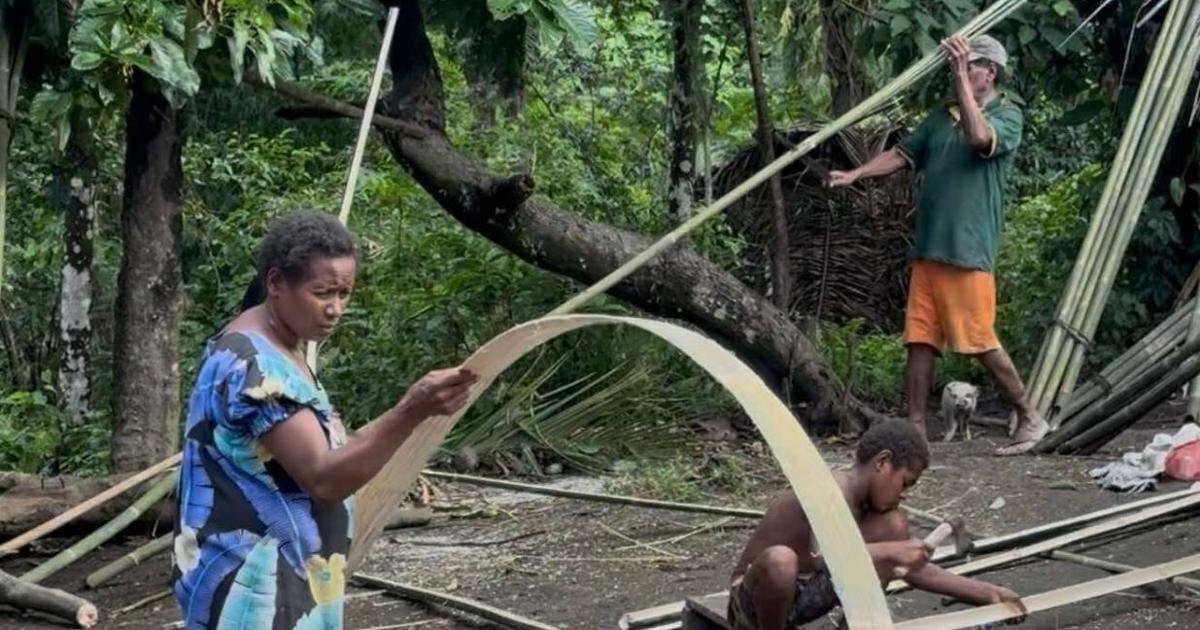
{p data-start=”283” data-end=”483”}Standing beside the modest house she and her husband are rebuilding in South Ambae’s Sakau community, Woi reflects on the journey that took her family from fear and uncertainty to hope and homecoming.
{p data-start=”485” data-end=”638”}“Home is where our heart is,” she says quietly. “We will never run away from it forever. Even if we have to start again from nothing, we must come back.”
{p data-start=”640” data-end=”835”}Her words echo the emotions of many Ambae families whose lives were turned upside down during the 2017 and 2018 volcanic eruptions, one of the worst natural disasters in Vanuatu’s recent history.
{p data-start=”837” data-end=”1202”}The eruptions of Manaro Voui triggered the evacuation of about 11,000 residents after heavy ashfall contaminated water supplies, destroyed food gardens, killed livestock and blanketed the island in darkness. Entire communities were relocated to neighbouring islands, including Maewo, Pentecost, Santo and Efate, as authorities declared it unsafe to remain on Ambae.
{p data-start=”1204” data-end=”1302”}For families living closest to the volcano, including those in Sakau, every eruption brought fear.
{p data-start=”1304” data-end=”1338”}“It was terrifying,” Woi recalled.
{p data-start=”1340” data-end=”1472”}“Our village is directly beneath the Manaro volcano. When it erupted, people panicked because we knew the danger was getting worse.”
{p data-start=”1474” data-end=”1559”}Although some villagers left immediately, Woi and her family delayed their departure.
{p data-start=”1561” data-end=”1642”}“We stayed as long as we could because it was very difficult to leave,” she said.
{p data-start=”1644” data-end=”1770”}“We had many children, and moving an entire family was not easy. But eventually it became too dangerous. There was no choice.”
{p data-start=”1772” data-end=”1988”}Like many others, the family first moved to Longana before boarding a ship to Lolowai and then to Maewo. They stayed there for about a month before deciding to relocate to Santo, where relatives offered them support.
{p data-start=”1990” data-end=”2039”}In Santo, the family started life all over again.
{p data-start=”2041” data-end=”2142”}They bought a piece of bush land, cleared it, planted gardens and built a new life through hard work.
{p data-start=”2144” data-end=”2256”}“We planted kava, taro and other crops,” Woi said. “Life was good there, and we were able to support ourselves.”
{p data-start=”2258” data-end=”2458”}Although many evacuated families gradually returned to Ambae as volcanic activity subsided, the Woi family remained in Santo for several more years, making only occasional visits to their home island.
{p data-start=”2460” data-end=”2550”}It was only earlier this year that they made the difficult decision to return permanently.
{p data-start=”2552” data-end=”2606”}“We have started building a new home again,” she said.
{p data-start=”2608” data-end=”2766”}“It hasn’t been easy because we are starting from scratch after being away for so many years. But this is our island. No matter what happens, we belong here.”
{p data-start=”2768” data-end=”2805”}Returning has brought new challenges.
{p data-start=”2807” data-end=”2901”}Rebuilding houses, restoring food gardens and establishing a livelihood again have taken time.
{p data-start=”2903” data-end=”2970”}“Food is still a challenge, and we are still rebuilding,” she said.
{p data-start=”2972” data-end=”3020”}“But little by little, life is becoming easier.”
{p data-start=”3022” data-end=”3220”}The family has left their Santo property in the care of one of their sons, who continues to look after the land, while Juliette and her husband have chosen to spend the rest of their lives on Ambae.
{p data-start=”3222” data-end=”3292”}“We still have our home in Santo, and we will always visit,” she said.
{p data-start=”3294” data-end=”3380”}“But this is our real home. No matter where you go, your home always brings you back.”
{p data-start=”3382” data-end=”3490”}She now looks forward to raising her grandchildren on the island where generations of her family have lived.
{p data-start=”3492” data-end=”3563”}“We built another home here because this is where we want to grow old.”
{p data-start=”3565” data-end=”3626”}Her story is shared by many others who survived the eruption.
{p data-start=”3628” data-end=”3716”}An elderly Samuel Boe remembers the terrifying day when ash clouds swallowed the island.
{p data-start=”3718” data-end=”3778”}“When the volcano erupted, everything became dark,” he said.
{p data-start=”3780” data-end=”3841”}“You couldn’t see the light. People were running everywhere.”
{p data-start=”3843” data-end=”3967”}Boe and his family fled first to Sarambulu before travelling by truck to Saratamata and eventually boarding a ship to Santo.
{p data-start=”3969” data-end=”4061”}His son settled on Maewo while the rest of the family began rebuilding their lives in Santo.
{p data-start=”4063” data-end=”4102”}Two years later, Boe returned to Ambae.
{p data-start=”4104” data-end=”4143”}“The whole place had changed,” he said.
{p data-start=”4145” data-end=”4216”}“My house was covered in volcanic ash, and the roof was badly damaged.”
{p data-start=”4218” data-end=”4258”}The landscape was almost unrecognisable.
{p data-start=”4260” data-end=”4309”}“There were no leaves on the trees,” he recalled.
{p data-start=”4311” data-end=”4376”}“Only bare trunks were standing. The hills were completely grey.”
{p data-start=”4378” data-end=”4474”}The eruption had killed livestock, destroyed gardens and left the island stripped of vegetation.
{p data-start=”4476” data-end=”4517”}“Cows, pigs and chickens died,” Boe said.
{p data-start=”4519” data-end=”4650”}“But after two or three years, the grass started growing again. People came back, planted gardens and began raising animals again.”
{p data-start=”4652” data-end=”4725”}Despite the hardship, he never considered settling permanently elsewhere.
{p data-start=”4727” data-end=”4758”}“I was born on Ambae,” he said.
{p data-start=”4760” data-end=”4807”}“I cannot live anywhere else. This is my home.”
{p data-start=”4809” data-end=”4868”}Boe admits leaving during the evacuation was heartbreaking.
{p data-start=”4870” data-end=”4935”}“We didn’t want to leave, but we had to for our safety,” he said.
{p data-start=”4937” data-end=”5004”}“I worried every day about my house and everything we left behind.”
{p data-start=”5006” data-end=”5061”}Looking back, he still remembers the overwhelming fear.
{p data-start=”5063” data-end=”5198”}“When the volcano erupts, you feel like you are going to die because there seems to be no way out. Everything becomes dark so quickly.”
{p data-start=”5200” data-end=”5354”}Today, as children once again play in villages that were abandoned during the crisis and gardens slowly return to life, Ambae continues its long recovery.
{p data-start=”5356” data-end=”5470”}For families like the Wois and the Boes, rebuilding is about far more than replacing houses or planting new crops.
{p data-start=”5472” data-end=”5644”}It is about reclaiming identity, reconnecting with ancestral land and proving that, despite nature’s fury, the bond between people and their home can never truly be broken.
{p data-start=”5646” data-end=”5697”}For Juliette Woi, the journey has come full circle.
{p data-start=”5699” data-end=”5745”}“You may leave because you have to,” she said.
{p data-start=”5747” data-end=”5826”}“But your home never leaves your heart. One day, it will always call you back.”