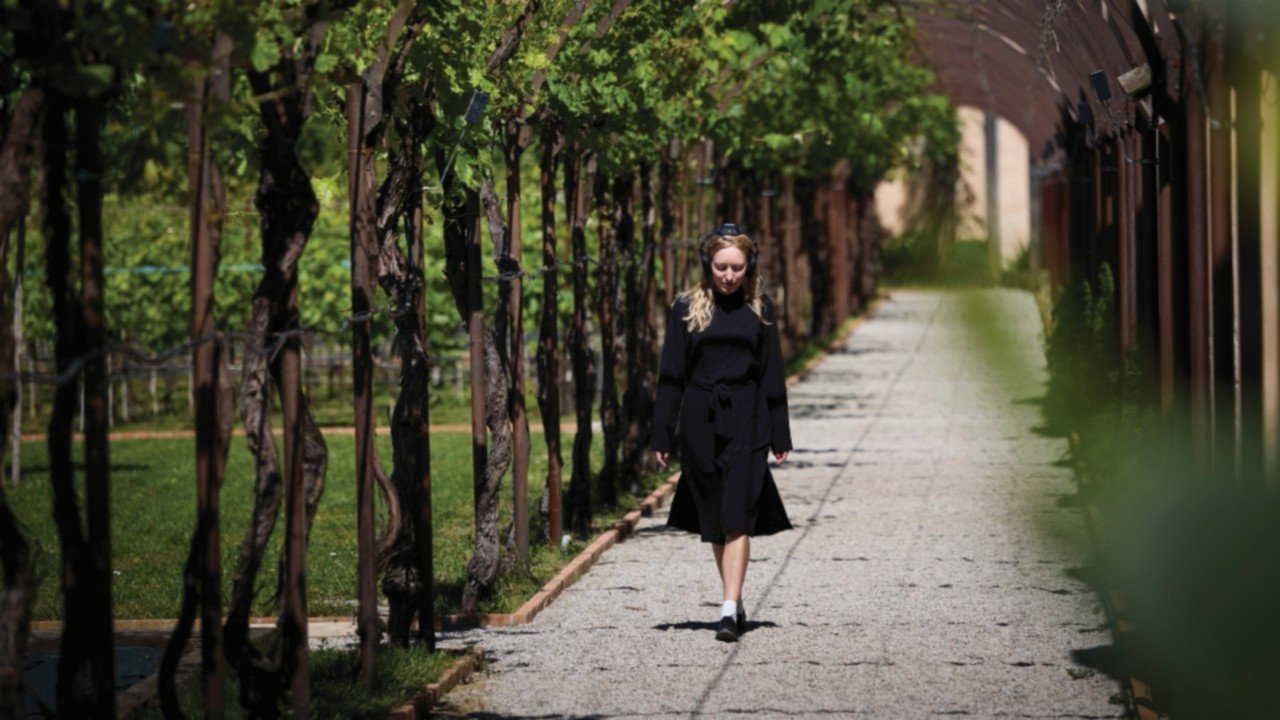
When the first visitors began to cross the threshold of the Holy See Pavilion at the Venice Biennale, the effect was not that of an exhibition to “see”, but of a place to pass through. An experience rather than a journey, something that resembles slow, almost internal listening. And perhaps it is no coincidence that at the center of everything there is a woman who lived in the 12th century: Saint Hildegard of Bingen, a figure capable of speaking in the present with a surprisingly clear voice.
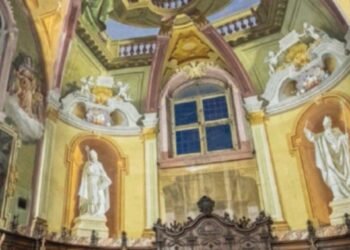
The Pavilion of the Holy See, at the 61st International Art Exhibition of the Venice Biennale, does not limit itself to “telling” Hildegard. He puts it into circulation. He makes it resonate within two Venetian places that become an integral part of the work: the Mystical Garden of the Discalced Carmelites, in Cannaregio, and the Complex of Santa Maria Ausiliatrice, in Castello. Two different spaces, almost mirror images, which respond to each other like two voices of the same song.
Whoever enters the garden immediately encounters a suspended dimension. There is no rush, there is no obligatory direction. The soundscape constructed by Soundwalk Collective seems to emerge from the plants themselves, as if nature remembered something that we have forgotten. It is here that the figure of Hildegard takes shape not as a historical portrait, but as a presence: a woman who listens to the world and translates it into vision, music, medicine, words.
In the other space, that of Castello, the experience becomes more intimate, almost meditative. The works of the invited artists – twenty-four, coming from very different cultural contexts – do not illustrate the saint, but question her. Each seems to ask itself the same question: what does knowledge that does not separate, but connects mean today? Which doesn’t fragment, but holds together?
This is perhaps the strongest key to the project curated by Hans Ulrich Obrist and Ben Vickers: not the celebration of a figure from the past, but the construction of a living constellation. Ildegarda becomes a point of convergence between contemporary languages, spirituality and artistic research. A figure that cannot be archived, because she belongs to that rare genealogy of women who have experienced knowledge as a total experience.
This idea of totality is clearly felt in the Pavilion. Hildegard was not just a mystic. She was a composer, a healer, a theologian, a visionary. He wrote, composed, illustrated his visions, studied nature and the human body. And above all she never separated these areas: for her the world was a single living fabric, crossed by the same energy. A thought that today, in a time of extreme specializations and increasingly closed languages, appears almost revolutionary.
Cardinal José Tolentino de Mendonça remembered him with words that seem to resonate within the entire project: every artist, even the most distant from the religious horizon, resembles a monk in some way, because he experiences a form of radical interior research. And in this sense Hildegard is not an exception from the past, but a profoundly contemporary figure.
There is a moment, crossing the rooms, in which this contemporaneity becomes almost physical. It’s not in the contents, but in the way the space forces you to slow down. To stay. Not to consume the work but to linger inside it. It is an experience that has something feminine in the broadest and non-stereotypical sense of the term: a temporality that welcomes, that does not force, that allows it to emerge.
And perhaps it is precisely here that the Pavilion communicates with today’s public in a more direct way. It does not propose answers, but listening conditions. It doesn’t simplify, but it opens. And in this gesture we recognize a profoundly Christian and at the same time secular dimension: the idea that knowledge is not possession, but relationship.
Hildegard’s “lingua ignota” – her attempt to invent a new language, capable of saying what common words were unable to contain – then becomes a powerful metaphor. Not so much a code to decipher, but an invitation to imagine differently. To seek less rigid, more porous forms of communication, more open to the complexity of reality.
It is interesting to note how, among the visitors, many talk about a specific sensation: that of entering a space that is not exhausted by the visit. Something that remains with you even afterwards, like an echo. Perhaps because the Pavilion does not limit itself to exhibiting works, but builds a sort of perceptive ecosystem. Sound, light, architecture, memory: everything contributes to the same threshold experience.
In this sense, the project is in continuity with the Holy See’s reflection on art as a space for encounter and transformation. But here there is something more intimate, almost domestic in the spiritual sense of the term: a call to return to oneself by listening to the world.
And while Venice continues to flow outside – its flows of visitors, its queues, its blinding light on the water – a different time is built inside the Pavilion. Slower, more layered. A time that seems to belong to Hildegard herself, and which nevertheless speaks with surprising clarity to our present.
The true legacy of the project lies here, probably: remembering that contemporaneity is not only what happens today, but also what we can still hear of what comes from afar. And that some voices, when they manage to cross the centuries, do not become silent. They become necessary.