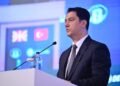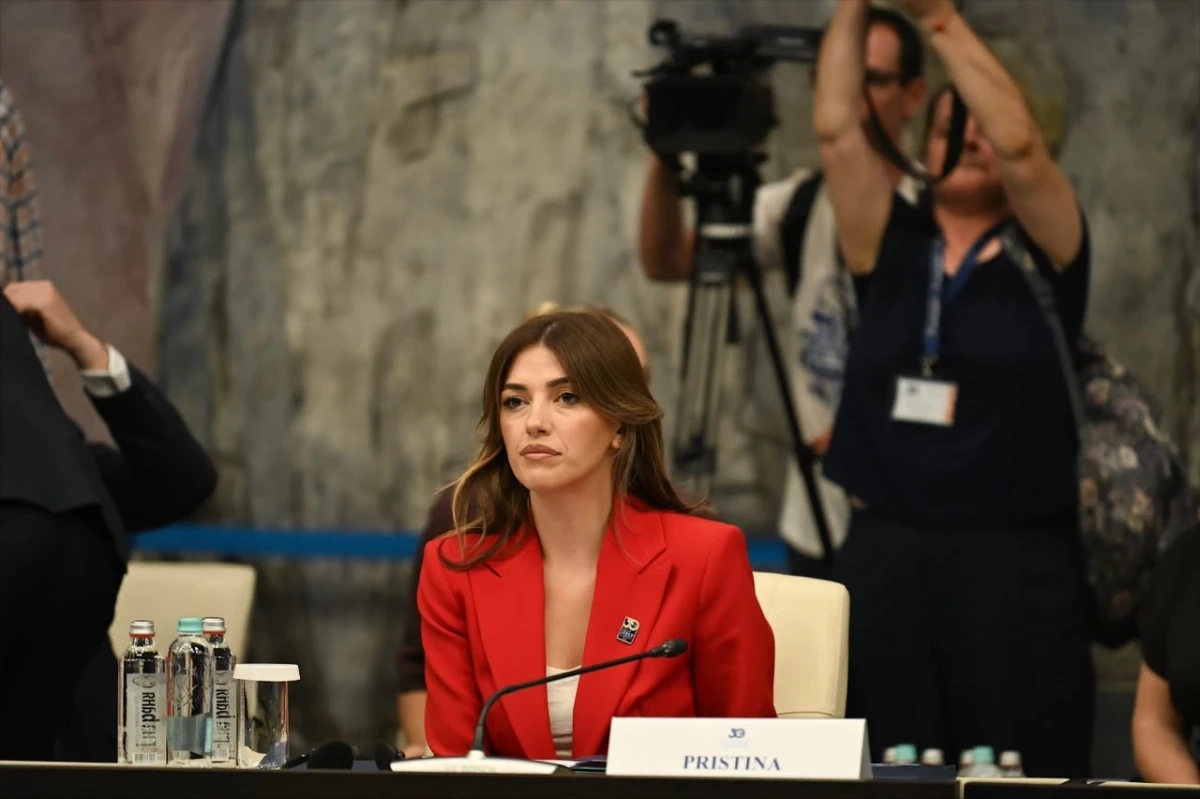
During the participation in the Sofia Summit, the acting president, Albulena Haxhiu, said that Kosovo has made measurable progress in international indices and in the process of European integration. She requested that this progress should be recognized. Haxhiu has emphasized that after more than three years from the application, Kosovo should move towards the status of a candidate country and the opening of membership negotiations.
The Acting President, Albulena Haxhiu, at the Summit of the South East European Cooperation Process (SEECP), which was held in Sofia, has requested further advancement of the integration process, including obtaining the status of a candidate country and the opening of negotiations for membership in the European Union (EU).
Haxhiu emphasized that the process should be meritocratic and based on standards.
“I reaffirmed Kosovo’s clear orientation towards the European Union and our commitment to reforms, rule of law, economic development and sustainable growth. Kosovo has made measurable progress in international indices and in the process of European integration”, said Haxhiu. “This progress must be recognized. After more than three years from our application, Kosovo must move towards the status of a candidate country and the opening of membership negotiations.”
Haxhiu said that over 90 percent of Kosovo’s citizens support membership in the European Union, which percentage he said constitutes one of the highest levels of support in the region.
“We are ready to start the work for the opening of membership negotiations”, she said.
The Southeast European Cooperation Process Summit was organized in Sofia, on the 30th anniversary of this process.
Haxhiu emphasized that during the summit proceedings, he emphasized that regional cooperation has value only when it is equal, comprehensive and applicable in practice.
“Our region needs more security, better connectivity, more opportunities for young people and a European process that moves forward when the standards are met,” said Haxhiu.
The issue of the integration process was also discussed on the margins of the Summit, where Haxhiu held separate meetings with the president of Slovenia, Natasa Pirc Musar, and with the president of North Macedonia, Gordana Siljanovska-Davkova.
Based on the announcement of the Presidency, the meeting with the Slovenian president discussed “the good relations between Kosovo and Slovenia, as well as the continuous Slovenian support for Kosovo’s European and Euro-Atlantic path”.
“UD President Haxhiu expressed Kosovo’s gratitude for Slovenia’s support in the process of membership in the Council of Europe and emphasized the importance of this support continuing until the successful completion of this process”, the announcement states. “The next steps of Kosovo on the road to the European Union were discussed at the meeting, including the need for progress in reforms, alignment with the EU’s foreign and security policy, as well as commitment to European values to be followed by concrete moves in the integration process.”
And in the meeting with the president of North Macedonia, according to the announcement of the Presidency, the relations between the two states were discussed, “as two neighboring countries with a common interest in regional stability, connectivity and European integration”.
“UD President Haxhiu emphasized the importance of continuing mutual support in international organizations, including support for Kosovo’s membership in the Council of Europe and for a clearer path towards NATO”, the announcement states.
And, based on a press release issued by the Presidency, during his participation in the Summit, Haxhiu also emphasized the importance of regional economic integration, strategic infrastructure projects, implementation of existing agreements and equal respect for all countries of the region in regional organizations.
“In her speech, she emphasized the importance of regional cooperation, security and European integration of the countries of the Western Balkans, appreciating the role of the SEECP as a key platform for the stability of the region. Haxhiu strongly condemned the Russian aggression against Ukraine and underlined that its consequences are affecting security in all of Europe, including South-Eastern Europe”, the communiqué reads.
Haxhiu has assessed the SEECP as an important mechanism for regional cooperation and has reiterated Kosovo’s readiness to contribute to strengthening the region’s stability and European perspective.
The Sofia Declaration was also approved at the summit, which reaffirms the importance of regional cooperation, security, connectivity, economic development and the European perspective of the region.
Even last Friday, Haxhiu asked the leaders of the EU and the leaders of the main member countries to unite for the status of the candidate country for Kosovo.
He gave the message during the speech he gave at the plenary session of the EU-Western Balkans Summit, organized in Tivat, Montenegro, where, in addition to the high representatives of the countries of the region, the president of the European Council, Antonio Costa, the president of the European Commission, Ursula von der Leyen, as well as leaders of countries such as the French president, Emmanuel Macron, the German chancellor Friedrich Merz, the Italian prime minister, Giorgia Meloni, and the Spanish prime minister, Pedro Sanchez, also participated.
Haxhiu appealed that Kosovo’s progress be recognized.
“More than three years after our application in Prague for membership, it is time for the European Union to unite around the decision on the status of the candidate country for Kosovo and on the opening of membership negotiations”, she said. “We believe that the very process of joining the European Union has the transformative power to take democracy even further, to strengthen our democratic institutions and to grow the economy. The process is as important as membership.”
Haxhiu has expressed the belief that all EU member states, present at the summit, can and should join in this goal.
Kosovo is the only country from the region, to which the EU has not given the status of a candidate country.