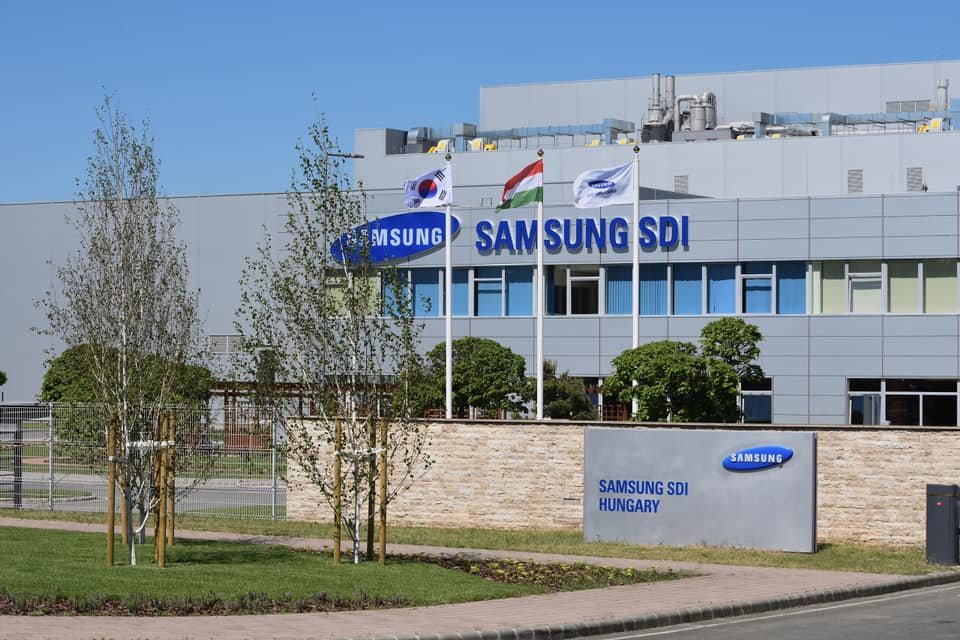
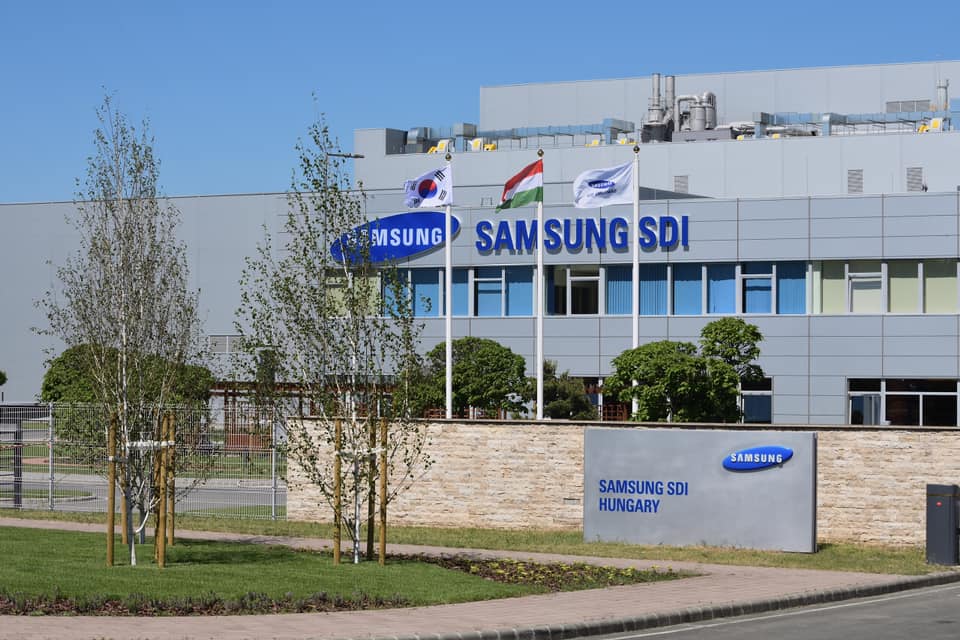
An investigation conducted by Greenpeace has yielded clear results. They investigated environmental pollution at Hungarian battery factories, including at the Samsung and SK Innovation plants in Göd and Komárom, and the results were completely different from what had been claimed in recent months.
There has been a significant turnaround regarding the battery factories in Hungary, which, during the election campaign, were widely reported in the domestic media as causing severe environmental pollution.
It is worth recalling that in February, in the heat of the parliamentary election campaign, the public discourse was dominated by the claim that the government had known for years that the level of toxic exposure affecting workers at the Samsung factory in Göd (near Budapest) far exceeded permissible limits.
Although the Supreme Court had already ruled on Samsung Zrt.’s integrated environmental permit, opposition parties, citing newspaper articles, began making claims one after another that
with the government’s knowledge and consent, the residents of Göd and the surrounding area continued to be poisoned, more than 88 tons of teratogenic substances were released into the air, endangering at least 100,000 people, not to mention those forced to work within the factory grounds, whose bodies may have been exposed to carcinogenic substances and heavy metals.
Citing this, they called on the government to have an independent group of experts conduct on-site sampling. Meanwhile, statements such as “we don’t want a Samsung county” and “we don’t want CATL-City either” were made in the Hungarian Parliament.
The government immediately refuted the rumors and called the allegations regarding the Samsung factory in Göd a smear campaign. It was pointed out that the Pest County Government Office has regularly conducted and continues to conduct environmental and occupational safety inspections.
Irregularities occurred only within the factory, in enclosed spaces, and were sanctioned with the strictest penalties. One such fine was imposed on March 4, 2025, due to fine particle emissions. However, this black dust clearly originated from graphite and had no harmful consequences.
Greenpeace reported that in March 2026, it conducted tests in the vicinity of battery factories and N-methylpyrrolidone (NMP) processing plants, following recent reports on environmental emissions of various metals used in battery production.
During the investigation, Greenpeace staff and experts collected samples from shallow wells belonging to local residents and transported them to an accredited laboratory for analysis to assess public exposure. The organization tested a total of 10 samples:
- Three samples in Göd, near the Samsung SDI facility
- Three samples in Komárom, near the SK battery factories and the NMP processing plant
- Two samples each in Sóskút and nearby Tárnok, in the vicinity of the Dongwha electrolyte and NMP processing plants.
The laboratory tests covered the following substances:
- Metals and metalloids: antimony, arsenic, cobalt, lithium, nickel
- N-methylpyrrolidone (NMP)
The results led to a completely clear conclusion:
No contamination exceeding limit values or significant from a health perspective was found in any of the samples.
In one sample from Komárom, the lithium concentration was slightly elevated; however, this value is still orders of magnitude lower than what could pose a risk to human health.
Greenpeace informed the affected residents and local decision-makers of the results.
Overall, therefore, it can be concluded that the press and political claims that flooded the public sphere during the election campaign in February are not supported by, and are in fact refuted by, the findings of this independent environmental organization.
Via Világgazdaság; Featured image: Facebook/Péter Szijjártó