Among the artifacts returned to Poland were a medieval manuscript, a gold ring and miniature models from a Warsaw museum. As part of the 35th anniversary of the Good Neighbor Treaty, Berlin and Warsaw marked the challenges posed by the war against Russia.
The German government has returned for Poland several cultural treasures that were stolen during World War II. The return of the cultural items, which coincides with the 35th anniversary of the Good Neighbor Treaty, is “an expression of mutual respect, Germany’s long-standing responsibility and a trusting partnership,” German Foreign Minister Johannes Wadeful said at the Germany-Poland Forum in Berlin on Wednesday, June 17, according to Deutsche Welle. (DW).
The event “further strengthens the strong ties between our countries,” he said. “Remembrance of the past, responsibility for the future and reconciliation as a multi-generational task continue to shape our actions today,” Vadeful emphasized.
A medieval manuscript with a fragment of a hymn
Among the returned artifacts is a medieval manuscript containing a fragment of the hymn “Gaude Mater Polonia” and dating from the end of the 14th century. The manuscript, consisting of six sheets of parchment, ended up in the Berlin State Library in an unknown way and was kept there as an item not belonging to the library’s collections. It was previously part of the collection of the Theological Seminary in Plock, Poland, which was looted and largely destroyed during World War II. German Minister of State for Culture and Media Wolfram Weimer called the manuscript “one of the oldest examples of religious poetry” in Poland. “Today’s return is an important gesture of recognition of historical injustice,” he said. “In doing so, we are writing a new chapter in our countries’ culture of remembrance.”
Antique ring and railroad models
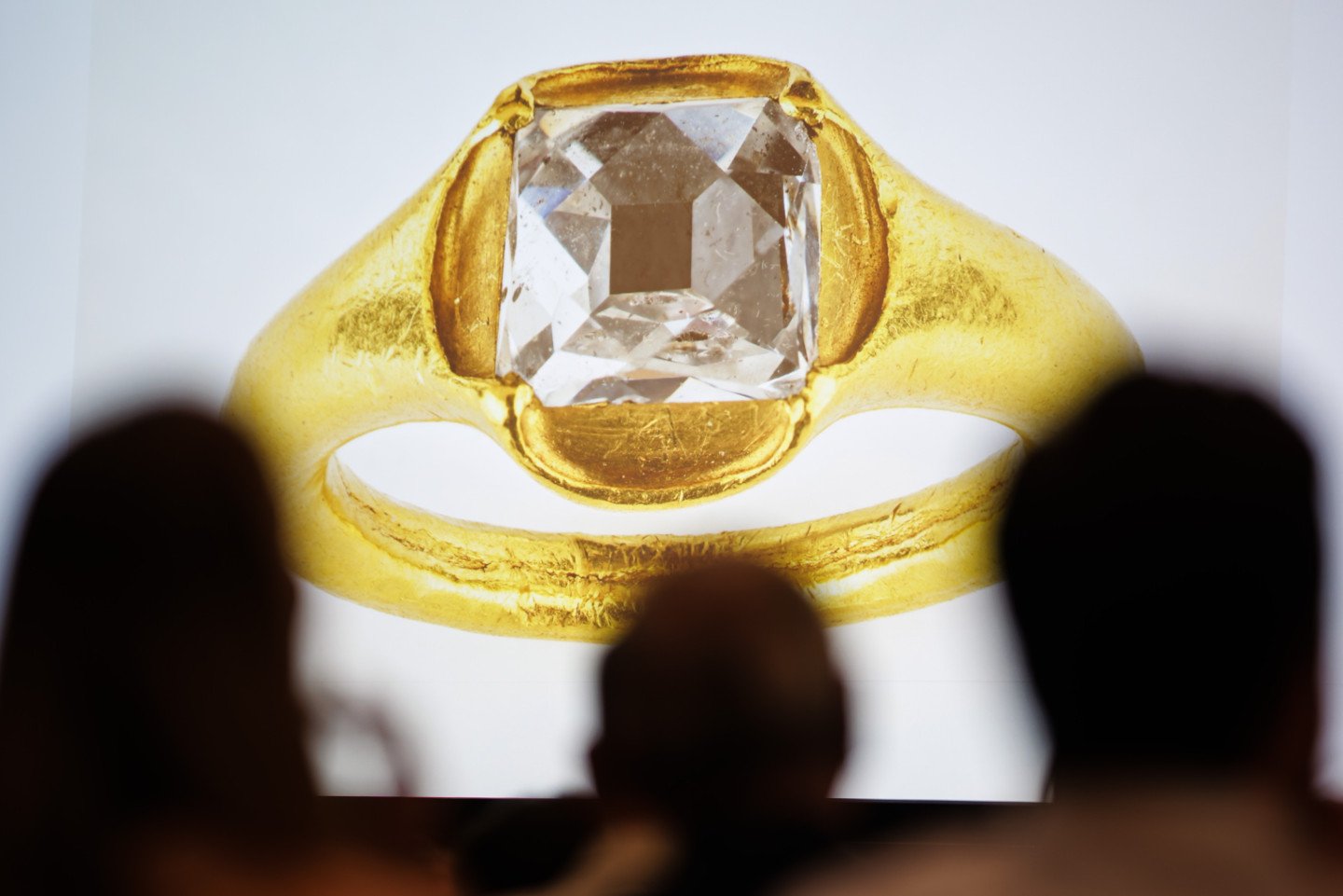
In addition, a gold ring from the first half of the 16th century, believed to have belonged to the Polish king Sigismund I, was returned to Poland. The diamond-encrusted ring was most likely stolen from a Polish collection during the German occupation in September 1939. It then went to Germany and since 1963 has been kept in the Jewelery Art Museum in Pforzheim.
The German Ministry of Transport transferred to Warsaw 11 items from the collections of the Federal Railway Property Administration, which were previously part of the collection of the Warsaw Transport Museum. They are miniature models of railway equipment.
The German Foreign Ministry said that the return of cultural treasures that ended up in Germany during World War II “has significantly increased” following intergovernmental consultations between Germany and Poland in December 2025. A joint German-Polish task force led by the German Foreign Ministry in cooperation with the Polish Ministry of Culture is currently working on further returns of valuable items.
“Deep, trusting cooperation at all levels”
In a joint statement, Vadeful and Polish Foreign Minister Radoslav Sikorski called the Agreement on Good Neighborly Relations and Friendly Cooperation a turning point in the relations between the two countries.
“This agreement has become not only an important element in the reconciliation process between Poland and Germany after long periods of mistrust, but also a starting point for deep, trusting cooperation at all levels of our societies,” the ministers noted. The statement also notes the fundamental changes in geopolitical conditions over the past few decades, particularly in relation to Russia’s full-scale war against Ukraine.
“Remembering the tragic history of the 20th century, we, as NATO allies and partners in the European Union, take special responsibility for our region and continent. Russia’s aggression against Ukraine has put us in front of the new political reality. Our response to it has become a measure of our responsibility and ability to act,” the statement said.
Joint response to Russian aggression
According to the ministers, Russian aggression, especially hybrid activities and disinformation, is also directed against Germany and Poland. “Their goal is to divide our society, destroy public order and destroy trust in the state and its institutions. We will not allow ourselves to be intimidated. We will successfully strengthen our resilience and educate our society,” the authors of the statement emphasized.
They described their main goal as “defending European values, including the rule of law and free elections, and achieving a just peace in Ukraine that will strengthen European security. We take the lessons of history seriously. Preventing another war is not just empty words, but a commitment to future generations,” Vadeful and Sikorsky said.
The German-Polish award was given to the former ambassador and the cross-border cooperation center
At the forum, the two foreign ministers presented the German-Polish award to Polish diplomat Janusz Reiter, who headed the Polish embassy in Berlin and the Frankfurt-Slubice cooperation center in the 1990s. The award was presented for a long-term contribution to the development of German-Polish relations.