This Monday, a crisis cabinet evaluated the riots and looting occurred over the weekend across Francein what constituted some of the worst scenes of public disorder in the country’s modern history.
The Minister of the Interior, Laurent Nuñeztried to present his resignation, as announced by the Elysee Palace (seat of the Presidency) on Monday morning. However, the president Emmanuel Macron asked him to analyze how to improve safety on the streets of France and to carry those responsible for the weekend’s violence are brought to justice.
More than half a million protestersmostly peaceful, protested Saturday against the rising cost of living and declining access to quality public services, including a good education.
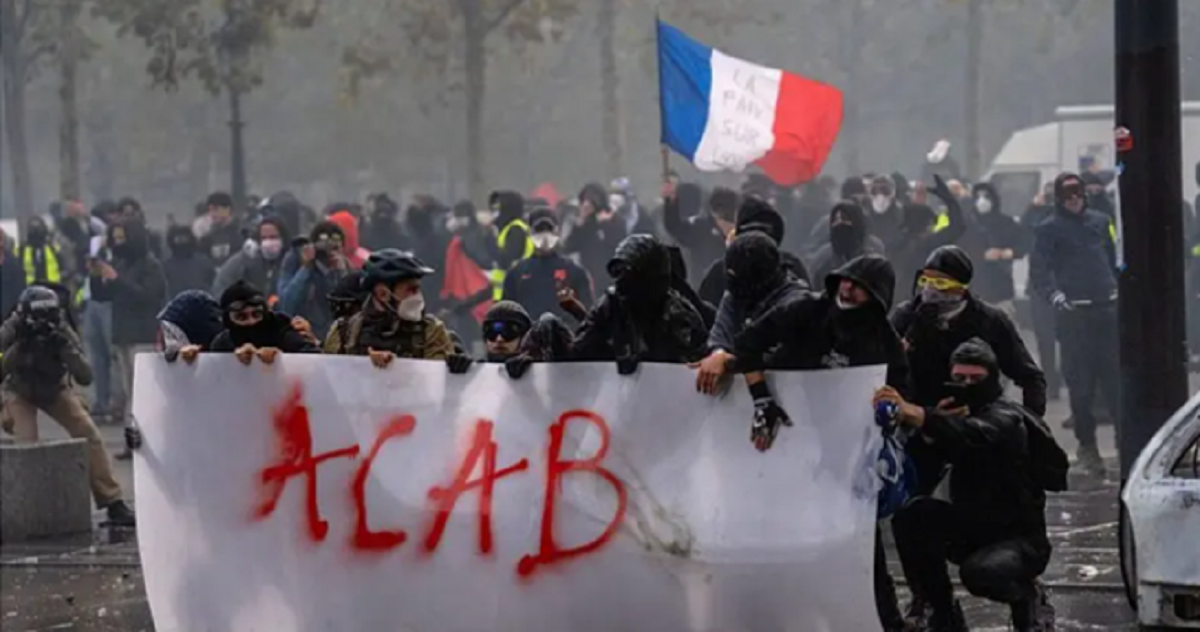
However, the protests turned violent after the appearance of groups of activists and vandals dressed in black and with their faces covered.
It is estimated that 1,500 shops and businesses were looted and destroyed. Riot police fired tear gas and water cannons into the crowd. In several places, they were seen hitting people with their batons.
The French Ministry of the Interior reported that around 1,000 police officers were injured on Saturday, seven of them seriously.
Minister Nuñez has been accused by political opponents, some unions and in social media forums of not having been prepared and of having had an insufficient police presence to confront the multiple protests on Saturday.
The president of the Lower House of the French Parliament, Yaël Braun-Pivet, declared that he wants open an investigation to clarify what happened.
On Sunday night in Paris, I read, painted in red paint on a wall next to a row of destroyed shops, graffiti that said “things are dark in the City of Light.”
On the same Sunday, President Macron used a televised address to the nation to call for national unity and attempt to assure the French public that the perpetrators of the violence would be punished.

Questions
Macron’s speech has been harshly criticized in the French media for lacking concrete details.
How will vandals and rioters be held accountable now?
How could France’s cities and towns be better protected, especially now that new mass demonstrations have been announced for a couple of weeks?
How exactly will the destroyed companies be compensated?
And when will there be a dialogue with the student and teacher unions on the issue of education? That’s how these demonstrations began last month.

On Sunday, the general secretary of the CGT union, Sophie Binetaccused Macron of failure to address student concernsthe cost of living crisis or the deterioration in the quality of public services in France.
The president has apparently passed the baton to Prime Minister Lecornu, who led the crisis cabinet meeting this Monday. In France, Macron is seen by many as an outgoing president. He is about to leave office.
A tight race is underway to become his successor, with elections scheduled for six months. The presidential candidate of the anti-immigration nationalist right, Marine Le Pen, and also that of the anti-capitalist left, Jean-Luc Mélenchon, are competing for headlines.
This is exacerbating current tensions in France, both in politics and on the streets.
Parliament is paralyzed, deeply divided between three rival political blocs.
Furthermore, France is going through serious financial problemss. Investors are putting strong pressure on the country to control its growing public debt. However, the French government fears that if it cuts public services or social welfare, even more angry people will take to the streets.
And now what? What’s next? Is our country broken? These questions are heard a lot lately.
Saturday’s events shocked and worried people throughout France. Images of gassed cities, looters acting with apparent impunity and burning public buildings have unsettled the nation.
This Monday, Prime Minister Lecornu said he had asked the prefects to “establish a series of curfews”, which will be “partial” and “localized”, in order to protect, in particular, businesses.
More protests
Many bystanders I speak to express frustration that, while they worry about the future, their top politicians seem instead to be passionately focused on pointing fingers and blaming each other for the volatility.
“While we worry about our safety, they use this situation as a political weapon in the face of the presidential elections,” Edouard, a teacher and father of three children, told me.
Macron and his prime minister attributed Saturday’s violent chaos to radical left-wing radical groups already criminals; the leader of the radical left, Jean-Luc Melenchonalleged “incompetence” of the government; Marine Le Penof the nationalist right, which presents itself as firm on law and order, published a video sitting in front of the French flag, giving a presidential-style speech in which it blamed the “Macronist administration, which is exhausted, exhausted and disoriented.”
French authorities hope for a respite over the next two weeks. Students begin their half-term holidays this Monday.
But on November 5, various unions, in addition to the heterogeneous French “yellow vest” movement (yellow gilets), which organized demonstrations for more than a year in 2018 – during Macron’s first term as president – have announced massive protests.