After 14 years in the United States Army and combat experiences in Iraq and Afghanistan, a former US Marine Corps officer makes a controversial claim in Western military circles: in modern warfare, a Ukrainian infantry unit would have an advantage over a similar unit in the US Army.
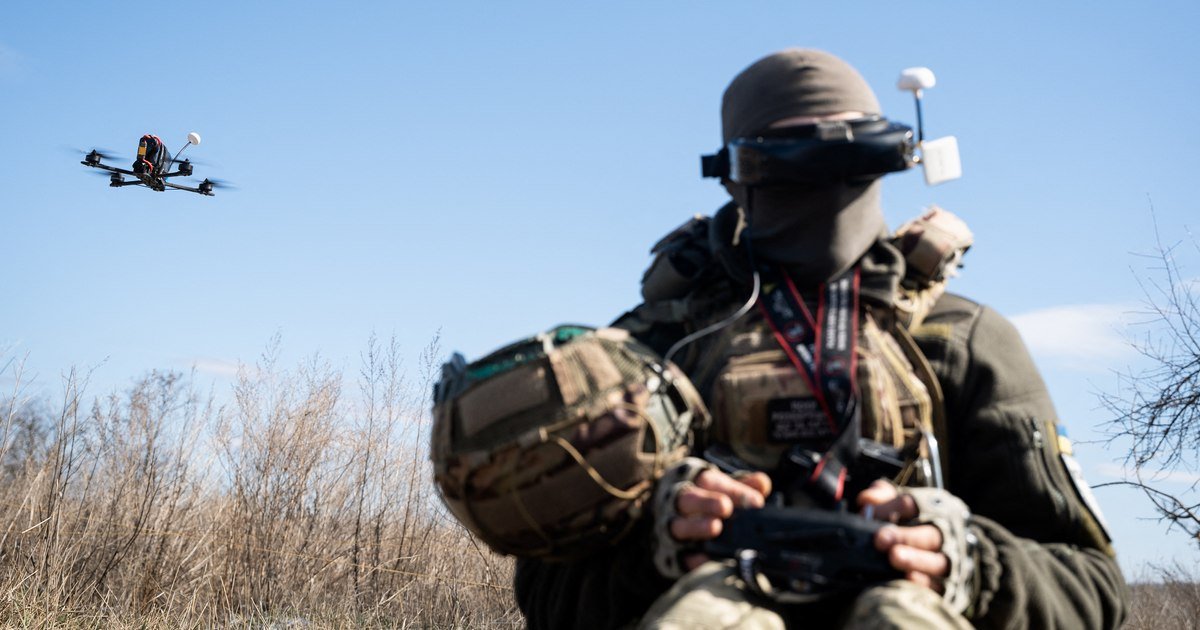
Ukrainian soldier handling a drone/PHOTO: AFP
The veteran, who volunteered to fight for Ukraine after the Russian invasion in 2022, claims that the experience gained by the Ukrainian military during more than four years of conflict has made it one of the most adaptable and effective military forces in the world.
“It’s hard to accept for the Americans, who are proud of their army. I am too. But the reality does not take pride into account,” says the former soldier, quoted by kyivindependent.com.
From Iraq and Afghanistan to the trenches of Ukraine
From 2003 to 2017, he served in one of the most active periods in recent US military history. He commanded an infantry company and participated in the planning of complex military operations.
The difference between the conflicts in the Middle East and the war in Ukraine, however, is huge.
In Iraq and Afghanistan, US forces enjoyed total air superiority, real-time intelligence, impeccable logistics, and virtually unlimited resources. In front of them were poorly equipped insurgent groups.
In Ukraine, the situation was exactly the opposite.
When he joined the Ukrainian army in the spring of 2022, he found a military force in the midst of reorganization, under-equipped and made up of many hastily mobilized volunteers.
However, instead of collapsing in the face of a vastly superior army, Ukraine held on.
The “experts” who were wrong
At the start of the invasion, many Western analysts predicted that Kiev would fall within days.
Four years later, Ukraine not only exists, but continues to strike deep into Russian territory.
The counter-offensive in the Kharkiv region, the liberation of Kherson and the subsequent operations on Russian territory contradicted many of the predictions made in the first months of the war.
According to the former US military, the conclusion drawn in the West is often wrong.
“Many have said that Russia failed because its military was weaker than thought. The real lesson is that Ukraine has turned out to be much stronger than almost all experts anticipated.” he claims.
The front where drones decide life and death
The great transformation of modern warfare, the veteran says, is represented by drones.
On the Ukrainian battlefield, any vehicle or group of soldiers moving on the surface can be identified within seconds by drone operators.
And once discovered, the target can be hit almost immediately.
“Warfare today is both World War I and World War III: trenches and robots,” explained the former officer.
Infantry survive in networks of bunkers and tunnels, and positions are camouflaged with nets and makeshift protection systems.
In many cases, the most effective weapon is not a tank or an airplane, but electronic warfare.
Jamming communications, jamming navigation systems and jamming signals became essential on the front.
The $500 drone that destroys equipment worth millions
The veteran provides an example that illustrates the radical change in the rules of war.
An FPV drone that costs a few hundred dollars and is operated by a soldier in a basement can destroy military hardware valued at millions of dollars.
This reality forces modern militaries to rethink the entire concept of technological superiority.
“Cheap systems force expensive platforms to hide or avoid combat“, he explains.
“Without Ukraine, NATO has no chance in a conflict of this type”
According to estimates cited by the former military, Ukraine produced around five million drones in 2025 and plans to exceed eight million this year.
In parallel, Kiev is developing tens of thousands of ground robots for combat and logistics missions.
Comparatively, all NATO states combined produced less than one million drones in a year.
“Without Ukraine, NATO has no chance in a conflict of this type,” he states.
Criticism of the West
According to the veteran, the North Atlantic alliance still has huge advantages: industry, finance, logistics and information.
The problem is that for decades he has been preparing for a different kind of war.
NATO has invested in sophisticated, extremely expensive systems that require years of development and billions of dollars to produce.
Meanwhile, the Ukrainian front proves that flexibility and speed of adaptation are as important as cutting-edge technology.
The ex-serviceman even recalls an exercise during his service, in which two American anti-tank missiles completely missed their target.
“In Ukraine, a system with such probleme would never reach the front,” he says.
“Ukraine is the most tested army of the free world”
The veteran also criticizes the idea that military superiority is guaranteed by huge budgets.
In his opinion, the experience gained by Ukrainian soldiers in direct confrontation with one of the world’s largest armies is an advantage that NATO cannot ignore.
“The Ukrainians spent four years intercepting Iranian drones, neutralizing the Russian Black Sea fleet, adapting to electronic warfare and developing real-time combat management software”he states.
His conclusion is a trenchant one: the Ukrainian army is today the most experienced military force in the democratic world.
“The West has a rare opportunity to learn from this experience without paying the price of war itself. If NATO is to remain dominant in future conflicts, supporting and integrating Ukraine’s lessons is no longer an option, but a necessity“, concludes the former US Marine.
The US is changing its military strategy after the harsh lessons of Ukraine
The war in Ukraine is not only changing the battlefield in Europe, but also how the world’s most powerful military prepares for its future.
The United States is gradually abandoning the philosophy that has dominated the defense industry for decades – few, highly sophisticated and very expensive weapons – and is moving towards the mass production of drones and autonomous systems capable of being quickly adapted to the realities of the front.
The announcement was made by US Secretary of War Pete Hegseth, who explained that the lessons learned by the Ukrainian military in the confrontation with Russia prompted a profound change in strategy in Washington.
According to the American official, the budget proposed by the administration of President Donald Trump for the year 2027 includes no less than 56 billion dollars aimed at strengthening the superiority of the United States in the field of drones and integrating the experience gained on the Ukrainian front.
Ukraine has changed the rules of war
In recent years, the conflict in Ukraine has shown that technological superiority is no longer enough if it is not accompanied by the ability to quickly and on a large scale produce the necessary equipment.
Drones costing a few hundred or a few thousand dollars have been able to destroy tanks, air defense systems and armored vehicles worth millions.
This reality forced the Pentagon to reassess its priorities.
“The most important lesson is that it is not enough to have the most advanced technology. You must be able to produce quickly, constantly adapt systems and respond in real time to changes on the battlefield,” Hegseth explained at the Shangri-La Dialogue security summit held in Singapore.
Less sophistication, more flexibility
The new American approach emphasizes the ability of the defense industry to quickly modify the design of drones, their communication frequencies and software.
Basically, the Pentagon is trying to replicate the model adopted by Ukraine, where engineers and the military collaborate directly to adapt weapons to the new tactics of the adversary.
In many cases, solutions developed on the front reach production in just weeks, not years, as is traditionally the case in the Western military industry.
This speed of reaction is considered one of the main explanations for Ukraine’s resistance in the face of a much larger army.
A relationship from which both Washington and Kiev win
US officials describe the current partnership between the US and Ukraine as mutually beneficial.
On the one hand, Washington continues to provide military and financial support to Kiev. On the other hand, the US military has access to one of the most complex experiences of conventional warfare in recent decades.
Basically, Ukraine has become a military laboratory where technologies and tactics that will influence the conflicts of the future are tested in real combat conditions.
“Ukrainian armed forces have demonstrated remarkable efficiencyon the battlefield,” Hegseth stated.
The US Secretary of War insisted that support for Kiev remains a strategic objective of Washington.
“Where we could help Ukraine, we did. Where we could allow Europe to do more, we did. We want Ukraine to be able to defend itself, and we will find ways to contribute to that.”Hegseth stated.
The message from Singapore is clear: after four years of war, the Pentagon believes that the future of conflicts will not be decided solely by tanks, planes or aircraft carriers, but by a military’s ability to rapidly produce millions of drones, constantly adapt technology and learn faster than the adversary.
And in this regard, the lessons from the Ukrainian front have become a source of inspiration for the world’s largest military power.