First Nations leaders from western British Columbia to southern Ontario are expressing concern at governments’ lack of consultation with them before two recent high-profile pipeline announcements.
Chiefs in three provinces told CBC Indigenous there was no consultation at all before the plans were unveiled.
The head of the Anishinabek Nation, which advocates for 39 communities in Ontario, is urging the province to apologize and take a step back after announcing a plan to build an oil pipeline from Hardisty, Alta., to Sarnia, Ont.
“It was blindsiding, but at the same time it’s not surprising considering the behaviour of both levels of government,” said Grand Council Chief Linda Debassige.
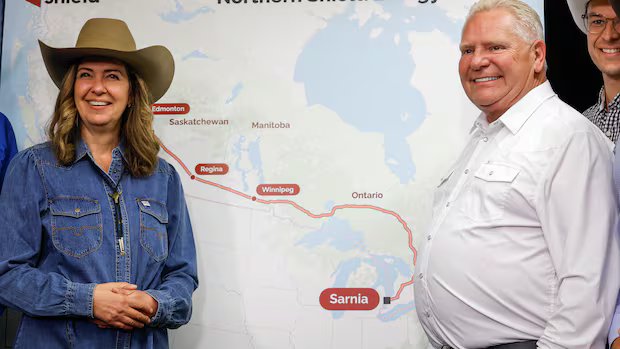
Ontario Premier Doug Ford and Alberta Premier Danielle Smith on Monday announced a proposed “Northern Shield Energy Corridor,” a 3,300-kilometre pipeline that would snake through much of Ontario.
Ford told reporters in Calgary his government is beginning consultation with Indigenous communities, which Debassige disputed, calling it “simply an email blast.”
“They need to put a pause on this idea and start to work with our First Nations in designing a path forward,” she said.

Debassige said Anishinabek Nation doesn’t yet have a firm position for or against the proposal. She intends to seek direction and feedback from chiefs at the Assembly of First Nations’ annual summer meeting next week in Ottawa.
Ontario Regional Chief Abram Benedict likewise said “direct engagement has not happened with the Chiefs of Ontario,” an umbrella organization advocating for 133 First Nations.
“Before projects start heading into more than just announcements, nations need to be engaged. Nations need to be able to make informed decisions,” he said.
Ontario’s Ministry of Infrastructure said via statement that letters were sent out to Indigenous communities with an update about the feasibility study into the proposed pipeline.
“The government recognizes that this is the beginning of an ongoing consultation process and will continue to fulfil any consultation obligations that may arise as the study progresses,” wrote spokesperson Sofia Sousa-Dias.
Pipeline to B.C. also a surprise
Meanwhile south of Vancouver, Tsawwassen First Nation Chief sxʷamisaat (Laura Cassidy) said they were not consulted about the proposed Alberta pipeline through British Columbia.
That pipeline, estimated to cost between $35.2 billion to $43.7 billion, is set to follow two existing routes roughly 1,200 kilometres south through British Columbia and terminate in Tsawwassen territory at Roberts Bank.
“It actually came as a big surprise to us,” Cassidy said.
Tsawwassen chief administrative officer Kim Baird said the nation heard rumours of a southern pipeline route just days before Alberta and the federal government announced it on July 3.
Baird said governments are only now reaching out to start discussions with Tsawwassen.
“We’re really concerned that consultation meets the treaty and constitutional standards that we set out in our modern land claim agreement,” Baird said.
“It’s so early, it’s hard for us to say how it would impact us, and therefore whether we would oppose it, support it, and what other conditions we may have in relation to it.”
Smith submitted the pipeline to Canada’s Major Projects Office to be considered for fast-tracking as a project of national interest, to be completed between 2032 and 2034.
“The accelerated project processes do not replace impact assessments, environmental reviews, permits, or the Crown’s duty to consult with First Nations,” Cassidy said.
B.C’s Ministry of Indigenous Relations and Reconciliation did not respond to a request for comment by time of publishing.
‘A communication breakdown’
Troy Knowlton, chief of Piikani Nation and president of the Blackfoot Confederacy, said chiefs in Alberta did not hear about the proposed pipelines until they were announced.
“There’s been a communication breakdown with the province of Alberta and many First Nations, including us,” said Knowlton.
“There was very little to no consultation or seeking any type of consent from us.”

Knowlton said chiefs are concerned about how the pipelines will impact treaty rights but also environmental concerns like water sources.
“We’re not against prosperity and looking for ways to create revenue and bring opportunity to the province,” he said.
“However, it’s the ways that the business is being conducted.”
Knowlton said because of sentiments in Alberta, including the chief’s recent litigation against the province for its referendum on separatism, he is “not anticipating a open door” to bring people in to discussions.
Karah Folk, a spokesperson for Alberta’s Ministry of Indigenous Relations, said in a statement Alberta began early engagement about a potential pipeline in fall of 2025, and since has “engaged with more than 100 First Nation and Métis communities across central and northern Alberta and B.C.”

A proposed new oil pipeline through southern B.C. to Canada’s West Coast is energizing the Alberta energy sector, but past broken pipeline promises have some in the province approaching the plan with cautious optimism.
Folk said these included “40 one-on-one, in-person meetings between the minister and Indigenous community leaders, as well as other calls, correspondence and regional meetings.”
“Alberta’s government will continue robust and respectful engagement and consultation to develop the pipeline in partnership with Indigenous communities along the corridor,” the statement said.
The Alberta and federal governments said the proposed west coast project will include “meaningful equity stake reserved for Indigenous Peoples.”
Knowlton said the government is doing a “divide and conquer” strategy by offering equity opportunities to certain First Nations and not all.
“It should be all First Nations rather than just a few who are being engaged with to push this through,” he said.