Wednesday, June 24, 2026
    The GeoStrategic Consensus
    No Result
    View All Result
    • Login
    • HOME
    • AMERICAS
      • Argentina
      • Brazil
      • Canada
      • Chile
      • Colombia
      • Costa Rica
      • Cuba
      • Dominican Republic
      • Ecuador
      • El Salvador
      • Greenland
      • Guatemala
      • Honduras
      • Mexico
      • Nicaragua
      • Panama
      • Paraguay
      • Peru
      • United States
      • Uruguay
      • Venezuela
    • ASIA-PACIFIC
      • Australia
      • Brunei Darussalam
      • Cambodia
      • China
      • Federated States of Micronesia
      • Fiji
      • Indonesia
      • Japan
      • Kiribati
      • Laos
      • Malaysia
      • Marshall Islands
      • Mongolia
      • Myanmar
      • Nauru
      • New Zealand
      • North Korea
      • Palau
      • Papua New Guinea
      • Philippines
      • Samoa
      • Singapore
      • Solomon Islands
      • South Korea
      • Taiwan
      • Thailand
      • Timor-Leste
      • Tonga
      • Tuvalu
      • Vanuatu
      • Vietnam
    • CARICOM
      • CARICOM – Non-English
        • Haiti
        • Suriname
      • CARICOM Associates
        • Anguilla
        • Bermuda
        • British-Virgin-Islands
        • Cayman-Islands
        • Curacao
        • Turks-and-Caicos
      • CARICOM English
        • Antigua and Barbuda
        • Barbados
        • Belize
        • Dominica
        • Grenada
        • Guyana
        • Jamaica
        • Montserrat
        • Saint Kitts and Nevis
        • Saint Lucia
        • Saint Vincent and the Grenadines
        • The Bahamas
        • Trinidad and Tobago
    • EURASIA
      • Armenia
      • Azerbaijan
      • Balarus
      • Georgia
      • Kazakhstan
      • Kyrgyzstan
      • Moldova
      • Russia
      • Tajikistan
      • Turkmenistan
      • Ukraine
      • Uzbekistan
    • EUROPE
      • Albania
      • Andorra
      • Austria
      • Bosnia and Herzegovina
      • Bulgaria
      • Croatia
      • Cyprus
      • Czech Republic
      • Denmark
      • Estonia
      • Finland
      • France
      • Germany
      • Greece
      • Holy See
      • Hungary
      • Iceland
      • Ireland
      • Italy
      • Kosovo
      • Latvia
      • Liechtenstein
      • Lithuania
      • Luxembourg
      • Malta
      • Monaco
      • Montenegro
      • Netherlands
      • North Macedonia
      • Norway
      • Poland
      • Portugal
      • Romania
      • San Marino
      • Serbia
      • Slovakia
      • Slovenia
      • Spain
      • Sweden
      • Switzerland
      • United Kingdom
    • MIDDLE EAST AND NORTH AFRICA
      • Algeria
      • Bahrain
      • Egypt
      • Iran
      • Iraq
      • Israel
      • Jordan
      • Kuwait
      • Lebanon
      • Lybia
      • Morocco
      • Oman
      • Palestinian Territories
      • Qatar
      • Saudi Arabia
      • Syria
      • Tunisia
      • Turkey
      • United Arab Emirates
      • Western Sahara
      • Yemen
    • SOUTH ASIA
      • Afghanistan
      • Bangladesh
      • Bhutan
      • India
      • Maldives
      • Nepal
      • Pakistan
      • Sri Lanka
    • SUB-SAHARAN AFRICA
      • Angola
      • Benin
      • Botswana
      • Burkina Faso
      • Burundi
      • Cabo Verde
      • Cameroon
      • Central African Republic
      • Chad
      • Comoros
      • Cote d’Ivoire
      • Democratic Republic of the Congo
      • Djibouti
      • Equatorial Guinea
      • Eritrea
      • Eswatini
      • Ethiopia
      • Gabon
      • Gambia
      • Ghana
      • Guinea
      • Guinea Bissau
      • Kenya
      • Lesotho
      • Liberia
      • Madagascar
      • Malawi
      • Mali
      • Mauritania
      • Mauritius
      • Mozambique
      • Namibia
      • Niger
      • Nigeria
      • Republic of the Congo
      • Rwanda
      • Sao Tome and Principe
      • Senegal
      • Seychelles
      • Sierra Leone
      • Somalia
      • South Africa
      • South Sudan
      • Sudan
      • Tanzania
      • Togo
      • Uganda
      • Zambia
      • Zimbabwe
    • HOME
    • AMERICAS
      • Argentina
      • Brazil
      • Canada
      • Chile
      • Colombia
      • Costa Rica
      • Cuba
      • Dominican Republic
      • Ecuador
      • El Salvador
      • Greenland
      • Guatemala
      • Honduras
      • Mexico
      • Nicaragua
      • Panama
      • Paraguay
      • Peru
      • United States
      • Uruguay
      • Venezuela
    • ASIA-PACIFIC
      • Australia
      • Brunei Darussalam
      • Cambodia
      • China
      • Federated States of Micronesia
      • Fiji
      • Indonesia
      • Japan
      • Kiribati
      • Laos
      • Malaysia
      • Marshall Islands
      • Mongolia
      • Myanmar
      • Nauru
      • New Zealand
      • North Korea
      • Palau
      • Papua New Guinea
      • Philippines
      • Samoa
      • Singapore
      • Solomon Islands
      • South Korea
      • Taiwan
      • Thailand
      • Timor-Leste
      • Tonga
      • Tuvalu
      • Vanuatu
      • Vietnam
    • CARICOM
      • CARICOM – Non-English
        • Haiti
        • Suriname
      • CARICOM Associates
        • Anguilla
        • Bermuda
        • British-Virgin-Islands
        • Cayman-Islands
        • Curacao
        • Turks-and-Caicos
      • CARICOM English
        • Antigua and Barbuda
        • Barbados
        • Belize
        • Dominica
        • Grenada
        • Guyana
        • Jamaica
        • Montserrat
        • Saint Kitts and Nevis
        • Saint Lucia
        • Saint Vincent and the Grenadines
        • The Bahamas
        • Trinidad and Tobago
    • EURASIA
      • Armenia
      • Azerbaijan
      • Balarus
      • Georgia
      • Kazakhstan
      • Kyrgyzstan
      • Moldova
      • Russia
      • Tajikistan
      • Turkmenistan
      • Ukraine
      • Uzbekistan
    • EUROPE
      • Albania
      • Andorra
      • Austria
      • Bosnia and Herzegovina
      • Bulgaria
      • Croatia
      • Cyprus
      • Czech Republic
      • Denmark
      • Estonia
      • Finland
      • France
      • Germany
      • Greece
      • Holy See
      • Hungary
      • Iceland
      • Ireland
      • Italy
      • Kosovo
      • Latvia
      • Liechtenstein
      • Lithuania
      • Luxembourg
      • Malta
      • Monaco
      • Montenegro
      • Netherlands
      • North Macedonia
      • Norway
      • Poland
      • Portugal
      • Romania
      • San Marino
      • Serbia
      • Slovakia
      • Slovenia
      • Spain
      • Sweden
      • Switzerland
      • United Kingdom
    • MIDDLE EAST AND NORTH AFRICA
      • Algeria
      • Bahrain
      • Egypt
      • Iran
      • Iraq
      • Israel
      • Jordan
      • Kuwait
      • Lebanon
      • Lybia
      • Morocco
      • Oman
      • Palestinian Territories
      • Qatar
      • Saudi Arabia
      • Syria
      • Tunisia
      • Turkey
      • United Arab Emirates
      • Western Sahara
      • Yemen
    • SOUTH ASIA
      • Afghanistan
      • Bangladesh
      • Bhutan
      • India
      • Maldives
      • Nepal
      • Pakistan
      • Sri Lanka
    • SUB-SAHARAN AFRICA
      • Angola
      • Benin
      • Botswana
      • Burkina Faso
      • Burundi
      • Cabo Verde
      • Cameroon
      • Central African Republic
      • Chad
      • Comoros
      • Cote d’Ivoire
      • Democratic Republic of the Congo
      • Djibouti
      • Equatorial Guinea
      • Eritrea
      • Eswatini
      • Ethiopia
      • Gabon
      • Gambia
      • Ghana
      • Guinea
      • Guinea Bissau
      • Kenya
      • Lesotho
      • Liberia
      • Madagascar
      • Malawi
      • Mali
      • Mauritania
      • Mauritius
      • Mozambique
      • Namibia
      • Niger
      • Nigeria
      • Republic of the Congo
      • Rwanda
      • Sao Tome and Principe
      • Senegal
      • Seychelles
      • Sierra Leone
      • Somalia
      • South Africa
      • South Sudan
      • Sudan
      • Tanzania
      • Togo
      • Uganda
      • Zambia
      • Zimbabwe
    No Result
    View All Result
    Agentially
    No Result
    View All Result
    Home EUROPE Estonia

    Feature | June 23, Estonia’s Victory Day | Feature

    The Analyst by The Analyst
    June 24, 2026
    in Estonia
    Feature | June 23, Estonia’s Victory Day | Feature


    Victory Day, or võidupüha, commemorates Estonia’s triumph at a watershed battle for the entire region, fought through June 1919, that ultimately led to the end of approximately 600 years of German-led hegemony in the region.

    READ ALSO

    Work progressing on Saatse Boot bypasses in south Estonia | News

    Police receiving more calls about potential bomb threats | News

    The battle took place in and around Cesis, a scenic Latvian town which crucially also sits on a railway line.

    Cesis was the site of a 13th-century Livonian crusades-era battle, but the 20th-century clash, part of the Estonian and Latvian wars of independence, was far more significant. 

    Central Cēsis. Source: Helen Wright/ERR News

    The background

    The opponents of June 1919 were not “Red” Russian forces, the main enemy in the independence war, but troops fighting to keep the old Baltic German aristocracy in place; just as the crusaders had been. The “auld enemy” in other words.

    While the Reds aimed for a radical and forced redistribution of land in these primarily agrarian countries, the opposing side at Cesis was fighting for a centuries-old status quo.

    Estonia and Latvia simply wanted to manage their own lands, in every sense…

    So, far from being a sideshow, the battle’s outcome practically midwifed the independence of not one but two modern-day democracies, both once part of Livonia.

    Cēsis castle dates back to the early 13th century and is synonymous with the Livonian crusades. Source: Helen Wright/ERR News

    The German-speaking landowner class had ruled the region for hundreds of years in agreement with the Russians. World War One was the conflict that transformed everything: Russia capitulated through the course of 1917 – the Bolsheviks seized power in November of that year, sparking a horrendous civil war.

    In a sign of things to come, the 1918 Treaty of Brest Litovsk, which carved up the Russian Empire, placed Estonia, without asking them, in a “sphere of influence,” in this case, a German one.

    Later that same year Germany signed a largely French-authored armistice with the Western powers, ending the war on the numerologically neat and tidy 11th hour of the 11th day of the 11th month.

    But while the armistice on the western front laid things to rest, in the east, things were far less clear cut.

    The Estonian War of Independence of November 1918-February 1920 was primarily fought against forces of the fledgling Soviet Russian state and their sympathizers, but at Cēsis the enemy was a much older one. The Baltische Landeswehr fought to preserve the Source: Andrew Whyte/ERR News

    For the fledgling Baltic states, one pressing matter in addition to the Reds was what to do with a large, armed and organized German force ranging around their backyard…

    The aims

    The lynchpin of these German troops was the Baltische Landeswehr, centered on the VI Reserve Corps commanded by Maj. Gen. Rüdiger von der Goltz.

    Von der Goltz was of noble stock and had led a division that in 1918 had “intervened” in Finland’s civil war, also fought between Reds and Whites.

    VI Corps in the Baltic states were bolstered by troops from the (in)famous Freikorps, disaffected World War One German veterans.

    The victorious western entente powers – the United States, France, and Great Britain – used VI Corps as a hedge against Bolshevik/Red incursions into the region; a requirement arose at the ongoing Paris Peace process that the German troops actually remain in the area.

    Baltische Landeswehr memorial in a cemetery in Riga. Light blue and white were Baltic German colors. Source: Dr. Hans-Dieter Handrack/Wikimedia Commons

    Their intended use may have reached as far as helping to install a pro-western White Russian force in Petrograd; certainly von der Goltz’s memoirs, and many former Landeswehr members’ actions in late 1919, back this possibility up.

    Estonian and Latvian aims were far more straightforward: Take advantage of the collapse of Russia and the emergence of smaller, independent democracies – the spread of Wilsonianism across the central and eastern European region.

    Red Russian forces certainly needed expelling, but the German troops too presented a threat to the integrity of Baltic sovereignty – having already occupied Riga and Tallinn through much of 1918.

    So these two sides were on a collision course. Estonian forces moved into northwestern Latvia in early 1919 (see map above), while von der Goltz’s VI Corps detoured from chasing the Reds in the east to meeting with the Estonians – who they did not regard as allies – in the north.

    Map of Latvia as of the eve of the Battle of Cēsis, with areas under the nominal control of the Estonian army (purple), the Baltische Landeswehr/Freikorps (orange), the Latvian Red Army (pink) and forces loyal to the Kārlis Ulmanis government (yellow). Source: Renata3 / Wikimedia Commons.

    The sides

    Thanks to efforts made by Estonian commander-in-chief, Gen. Johan Laidoner, Estonia’s military had grown six-fold to around 13,000 people in the year between independence and early 1919.

    While today’s Estonian Defense Forces has one division, by summer 1919, Laidoner had three at his disposal.

    The 3rd Estonian Division, commander Maj. Gen. Ernst Põdder, was joined at Cesis by the 2nd Latvian regiment under Col. Krišjānis Berkis.

    This brought around 6,000 Baltic states’ infantry to the field, plus around 100 cavalry, over 200 machine guns, and artillery at Cesis.

    Estonia also had three Tallinn-built armored trains to hand, commanded by (despite being a navy man) Rear Admiral Johan Pitka, and control of the rail line running north to the Estonian border.

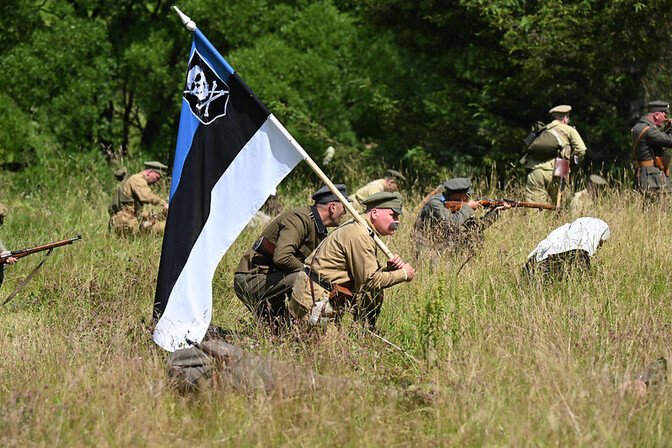
    Battle of Cēsis/Võnnu reenactors from the Estonian side at an event this week marking the anniversary of the battle. Source: Office of the President of the Republic of Estonia / Raigo Pajula

    Pro-German forces’ numbers at Cesis were similar, though they enjoyed superiority in artillery and cavalry.

    Estonia’s breakthrough, June 23, 1919

    Ignoring an ultimatum from Gen. Laidoner to pull back, initial, fierce clashes started in early June, with a brief pause during an armistice called by the Entente.

    The Germans then broke through on the summer solstice, splitting Estonian and Latvian forces and rendering the situation critical for the 3rd Division. (The gallery here gives us some idea of uniforms and equipment at the battle.)

    Thanks in no small part to Pitka’s armored trains, this German advance was stemmed, however, and a counter-attack by the reinforced Estonians led to a general retreat to the southwest, toward Riga by the Germans, meaning the day, on June 23, was won.

    Anachronous map showing the main actions of the 1918-1920 Estonian War of Independence. Source: Vabadussõda.jpg/ Wikimedia Commons

    Gen. Põdder gave his command of the day as follows: “The victories won over our stagnant and surrendered enemy, in cities and in the countryside, flags and armed units in the local garrisons were set up.”

    The aftermath

    Casualties at Cesis were in the hundreds, on all sides.

    There was an immediate expiry date on Estonia’s triumph; the 3rd division was ordered to refrain from taking Riga despite nearly doing so.

    The Baltische Landeswehr was temporarily placed under British authority, while the pro-entente Kārlis Ulmanis government was reinstalled in Riga, replacing a German puppet.

    Many German soldiers joined up with Prince Pavel Bermondt-Avalov’s West Russian Volunteer Army, to fight the Reds; the Estonian troops in Latvia helped repel a bid by this force to take Riga too.

    The original Treaty of Tartu briefly on public display at the National Archives of Estonia. February 2, 2017. Source: Aili Vahtla/ERR

    Back in Estonia, the Land Reform Act confiscated and redistributed the large Baltic German estates that had covered more than half of the territory of the country for generations.

    By late 1919, Jaan Tõnisson’s government was pursuing a negotiating-while-fighting approach, and the 3rd division, the heroes of Cesis, was instrumental in pressing to exhaustion the Red forces attacking Narva.

    A ceasefire came into effect on January 3, 1920, and the famous Treaty of Tartu was signed on February 2. Latvia’s equivalent treaty was signed in August.

    The legacy

    The Battle of Cesis represented a decisive victory for Estonia and Latvia alike, and finally spelled the end of the German-led hegemony in the region.

    President Alar Karis with President of Latvia Edgars Rinkēvičs attending a ceremony marking the anniversary of the Battle of Cēsis/Võnnu. Source: Office of the President of the Republic of Estonia / Raigo Pajula

    For comparison, while the Soviet occupation of Estonia lasted less than a human lifespan – someone in their teens when it started would have been a retiree when it ended – the Baltic German aristocracy in Estonia continued, under different nominal rulers, for around six centuries.

    First marked in 1934 and reinstated in 1992 after the restoration of independence, Victory Day parades are organized by the Defense League, in a different town each year, and presided over by the head of state. This year’s parade is in Narva. Not only do the armed forces of Estonia and Latvia take part, but those of many NATO allies do also.

    That the battle has its own name in Estonian: Võnnu – the Estonian name for Cesis – is significant too.

    The complicated story behind the lead-up to the battle also gives the lie to the rather pat apothegm “my enemy’s enemy is my friend.” Not always, but sometimes…

    Victory Monument in Cēsis/Võnnu. Source: Helen Wright/ERR News

    Estonia and Latvia had proved they were able to defend their home turf against all comers, and that they wanted to rule themselves, rather than be ruled over by foreign powers, be they German, Russian, or anyone else.

    Ultimately, the Estonians had managed to ditch a sometimes repressive, certainly not democratic, aristocratic rule, yet without replacing it with totalitarian Bolshevik rule. No small feat…

    More information on the battle is here and here, and this video covers the Estonian War of Independence more broadly. More information about the first Victory Day celebrations in 1934 (link in Estonian) is here.

    Editor’s note: This article was first published in June 2024.

    —

    Follow ERR News on Facebook and Twitter and never miss an update!


    Source link

    Related Posts

    Work progressing on Saatse Boot bypasses in south Estonia | News
    Estonia

    Work progressing on Saatse Boot bypasses in south Estonia | News

    June 24, 2026
    Police receiving more calls about potential bomb threats | News
    Estonia

    Police receiving more calls about potential bomb threats | News

    June 24, 2026
    Tartu’s Shooters nightclub to close after 14 years | News
    Estonia

    Tartu’s Shooters nightclub to close after 14 years | News

    June 24, 2026
    Attack drone carrying 5 kilograms of explosives found in south Estonia | News
    Estonia

    Attack drone carrying 5 kilograms of explosives found in south Estonia | News

    June 24, 2026
    Estonian universities add programs and change admissions rules | News
    Estonia

    Estonian universities add programs and change admissions rules | News

    June 23, 2026
    Police to relax speed camera fine threshold | News
    Estonia

    Police to relax speed camera fine threshold | News

    June 23, 2026
    Next Post

    EXPLAINED: Why is Denmark delaying new property valuations once again?

    POPULAR NEWS

    Bhutan Football Steps onto a Bigger Stage with Hummel Partnership

    Bhutan Football Steps onto a Bigger Stage with Hummel Partnership

    June 23, 2026
    Trump’s threats have angered the Iranians — tense talks in Switzerland

    Trump’s threats have angered the Iranians — tense talks in Switzerland

    June 23, 2026
    Nicuşor Dan on Ceban’s meetings with Romanian mayors: “He was received out of politeness”

    Nicuşor Dan on Ceban’s meetings with Romanian mayors: “He was received out of politeness”

    June 23, 2026
    What the Iran war cost the Pentagon, the economy — and Trump

    What the Iran war cost the Pentagon, the economy — and Trump

    June 23, 2026
    Magical Messi makes World Cup history to send Argentina into last 32

    Magical Messi makes World Cup history to send Argentina into last 32

    June 24, 2026

    EDITOR'S PICK

    FIFA appoints Alejandro Hernández Hernández to lead Brazil vs Haiti match

    FIFA appoints Alejandro Hernández Hernández to lead Brazil vs Haiti match

    June 24, 2026
    Justice orders Jesica Cirio to appear within 24 hours to hand over her cell phone

    Justice orders Jesica Cirio to appear within 24 hours to hand over her cell phone

    June 23, 2026
    Modern health care is changing, but one thing remains constant: the humanity of the healthcare worker. Anahit Avanesyan

    Modern health care is changing, but one thing remains constant: the humanity of the healthcare worker. Anahit Avanesyan

    June 23, 2026
    Montreal shooting leaves officer, civilian and suspect deadIt was the first time in 24 years that a Montreal police officer was  killed in the line of duty, the city's police chief said.59 mins agoUS & Canada

    Montreal shooting leaves officer, civilian and suspect deadIt was the first time in 24 years that a Montreal police officer was killed in the line of duty, the city's police chief said.59 mins agoUS & Canada

    June 24, 2026

    Recent Posts

    • Temporary road closure: Ravine Public Road, St George
    • Haiti-Brazil: “Haiti’s best performance in the World Cup of all time”, estimates Philippe Vorbe
    • St. Kitts Launches Stakeholder Consultations to Strengthen Upcoming Cruise Season
    • Social Archives – St. Lucia Times

      © 2026 Agentially - Navigating shifting sovereignties and global risk .

      Welcome Back!

      Login to your account below

      Forgotten Password?

      Retrieve your password

      Please enter your username or email address to reset your password.

      Log In
      No Result
      View All Result

        © 2026 Agentially - Navigating shifting sovereignties and global risk .

        This website uses cookies. By continuing to use this website you are giving consent to cookies being used. Visit our Privacy and Cookie Policy.