The scammer sent an ID and a QR code with the visual appearance of Yape. Both documents had the same name. The payment of S/50 was made as an advance, but the ballots did not disappear and the supposed processor stopped responding.
A subsequent search with the name Jorge Luis Ramírez Rodríguez revealed that the DNI we received belonged to a SAT official. Furthermore, in a Facebook group in the Jesús María district, a user already pointed him out as allegedly responsible for a charge of S/300 under the same modality.

The scammer introduced himself as Jorge Luis Ramírez Rodríguez and offered to delete two ballots in exchange for S/100. Photo: El Comercio
When he went to the SAT facilities, official Jorge Luis Ramírez Rodríguez agreed to testify. “I don’t have Yape, I never have,” he stated. He reported that between September and October 2025, a person showed up at the SAT headquarters on Argentina Avenue and confronted him, demanding the return of money for an alleged promise to eliminate a ballot that he denied having made.
“He confronts me directly and tells me to pay him what I owe him. When he shows me the phone number they used, I answer that that is not mine,” he said.
According to the worker, he invited the affected person to accompany him to the Police to formalize the complaint, but he withdrew. “When I told him that we were going to the Dirincri so that he could also testify, the boy left,” he indicated.
Jorge Luis Ramírez Rodríguez has worked at the SAT since 2014 in administrative tasks within the coercive execution area. On October 11, 2025, he filed a complaint with the Dirincri for identity theft and, currently, it is under preliminary investigation for 60 days by the Public Ministry.
When consulting with Yape about the transaction, an advisor confirmed that the payment was made, but warned that the QR code presented actually corresponded to a disguised IziPay account. “It is an IziPay QR code, but they are using it with the Yape color and format,” he explained.
Asked about this, IziPay responded that for “security reasons” it could not share information about its users and maintained that the business registered with that name “is blocked.” The SAT worker told us that he also did not have an IziPay account and indicated that he had requested from that company, on June 10, a document confirming that he does not have any account associated with his name.

Complaint filed in 2025 by Jorge Luis Ramírez Rodríguez (right) and request for information to IziPay (Left).
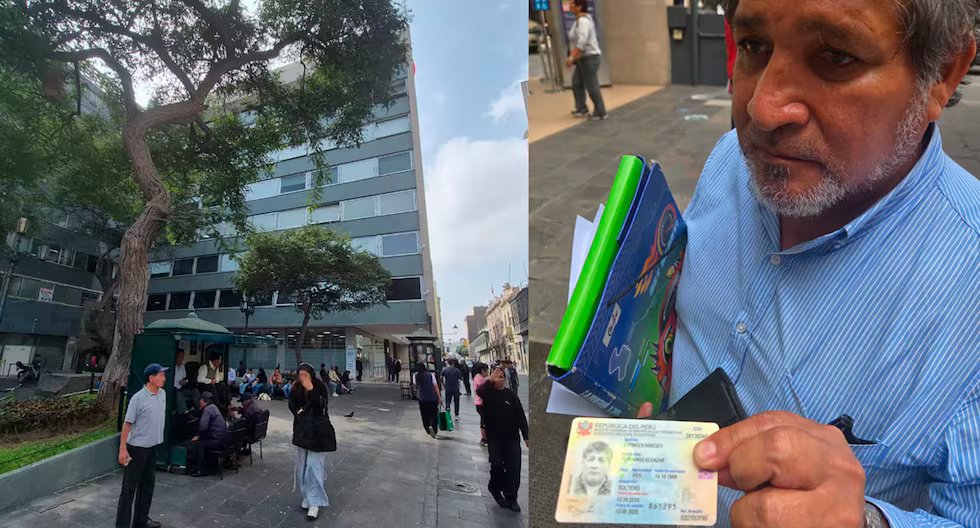
The modality is not limited to social networks. When we went to the SAT headquarters in Lima, a man who identified himself as Fernando Eleazar Espinoza Narcizo approached us. He offered to eliminate a ballot with coercive debt from the current year in exchange for S/100. “I ask for an annulment. I do it with the people above. I will charge you 100 lucas,” he stated. He showed his ID before receiving the money to his number 926 969 439 and did not return. A search of his background revealed complaints of injuries, theft, crimes against property and six police interventions. A person close to him was direct when asked: “It’s bad. He’s already scammed. He’s not coming back.”
On a second visit to the same place, a young man who identified himself as Cristofer Cáceres Castro offered the same service for S/60 and showed his ID as collateral. “There are cameras here. If the ballot is not erased, I will return your money. Plus, you are going to bring me more clients,” he assured. No payment was made, but the episode confirmed that informal processors operate openly in front of the SAT facilities.

Fernando Eleazar Espinoza Narcizo (left) and Cristofer Cáceres Castro (right) are the false processors who offered to eliminate a ballot from us. Photo: El Comercio
Wilfredo Calderón, SAT spokesperson, assured that the entity’s systems are completely traceable and that no ballot can be canceled outside of its official channels. Likewise, he indicated that since an infraction enters the entity – after being sent by the National Police and scanned – it is registered without anyone else physically manipulating it.
“There is no such thing as annulment of ballots through informal attention. What is made is a claim through a defense, where the person maintains that they did not commit the infraction, and that is resolved through a resolution that is registered in the systems,” he noted.
Likewise, they maintain that they have deployed awareness campaigns so that citizens make their payments through formal channels. However, the problem continues because false processors take the name of the entity to obtain their own benefit and people continue to fall for this scam, which also reaches drivers’ cell phones through text messages.

Fake text message. Drivers should not enter the link to avoid scams.
For its part, the Municipality of Lima recognized the presence of groups of processors outside the SAT and assured that they are monitoring the area and are close to carrying out new inspections. However, the three times we went we detected that the false processors were known in the area and acted without any supervision.
“The recurring presence of groups of processors that operate in certain areas near the SAT headquarters has been identified, mainly in the Plaza San Agustín and Jr. Camaná sectors, a situation that has been monitored through coordinated actions with the competent authorities,” the entity said and urged citizens not to use false intermediaries in order to eliminate this problem definitively.
Lawyer César Nakasaki Seminario pointed out that these behaviors can constitute crimes punishable by sentences of up to four years in the case of influence peddling, and up to six years if it constitutes aggravated fraud.