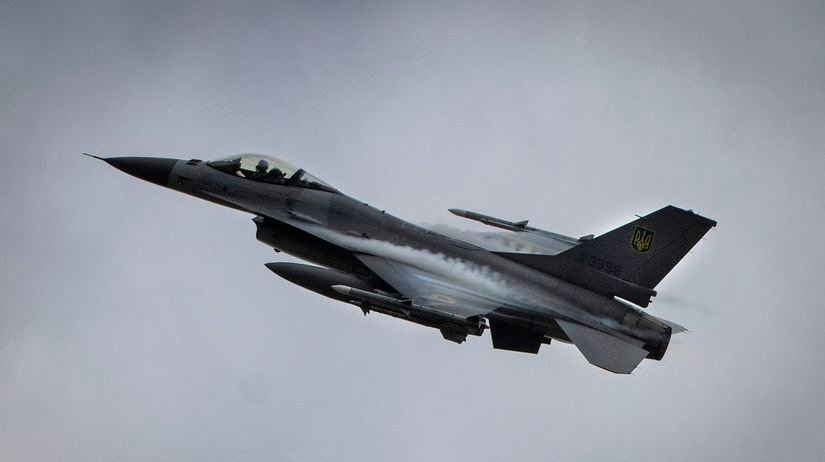
On the Ukrainian front, there was another event that shows the growing role of Western F-16 fighters in the country’s air defense.
A video has been released online that shows a Ukrainian F-16 fighter jet intercepting a Russian Ch-101 cruise missile during one of Russia’s recent large-scale strikes.
The video shows the tracking of an aerial target and the subsequent launch of an air-to-air missile against a Russian cruise missile. After a direct hit, the Ch-101 exploded in the air and failed to reach its target. The image also shows the wreckage of the destroyed guided missile, which fell into the field after being hit. The authenticity of the footage and the exact location and time of the incident are not known.
The Russian Ch-101, also referred to in Western databases as the Kh-101 or AS-23A Kodiak, is among the most important weapons of Russia’s long-range air campaign against Ukraine. It is a subsonic cruise missile launched from strategic bombers. According to the Missile Threat database of the US think tank CSIS, it is 7.45 meters long, has a diameter of 0.51 meters, a launch weight of about 2,300 to 2,400 kilograms and carries a conventional warhead weighing about 450 kilograms. It is powered by a TRDD-50A turbofan engine, at a flight speed of approximately Mach 0.58 and a maximum speed of up to Mach 0.78. According to CSIS, the stated range is between 2,500 and 2,800 kilometers, but Russian sources claim higher values in some versions.
Structurally, the Ch-101 is a weapon designed to penetrate air defenses. It is supposed to fly at low altitudes, use the terrain and reduce the probability of radar detection. CSIS reports that the missile combines inertial navigation, GLONASS satellite correction, electro-optical terrain comparison with the on-board computer map and, in the final stage, television or infrared guidance. According to open sources, the accuracy is stated to be approximately 6 to 20 meters of circular deviation.
The Russian army launches these missiles mainly from Tu-95MS and Tu-160 strategic bombers. They are dangerous for Ukraine not only because of their long range and warhead, but also because Russia gradually modernized them during the war. According to the Mezha/Oboronka portal, the Ukrainian Ministry of Defense claims that Moscow modified the Ch-101 at least four times. Changes include a tandem warhead with a total weight of approximately 800 kilograms, guidance modifications and the installation of electronic protection means including decoys, thermal decoys and dipole reflectors. These claims are based on the Ukrainian analysis of the debris of the downed missiles.


Similar videos also appeared in the fight against Russian drones. In February, The Aviationist described footage of a Ukrainian F-16 shooting down a Geran-2 drone, the Russian designation for Shahid-136, using a 20mm M61 Vulcan cannon. The drone exploded in mid-air almost over the person filming the scene, and shortly afterwards a fighter jet flew over the scene. The portal pointed out that although such an attack is cheaper than using a rocket, it means a greater risk for the pilot, because he has to get very close to a slow target and at the same time consider where the unhitched 20-millimeter projectiles will end up.
Ukrainian F-16s have also previously been associated with shooting down guided missiles. In January 2025, Ukrainian Air Force spokesman Yuriy Ihnat claimed that a Ukrainian F-16 pilot shot down six Russian cruise missiles in a single mission during a massive Russian attack in December 2024, including two with an onboard cannon. Interfax-Ukraine reported at the time that, according to Ihnat, this was the first such recorded case in the history of the deployment of the F-16 fighter.