European stock markets closed with doubts this Thursday, with a mixed trend, while Wall Street took a turn and ended the day in green, with increases of less than 1%. in the midst of the fragility in the Middle East and after Israel announced direct negotiations with Lebanon that will begin soon and that have increased expectations of progress in the conflict.
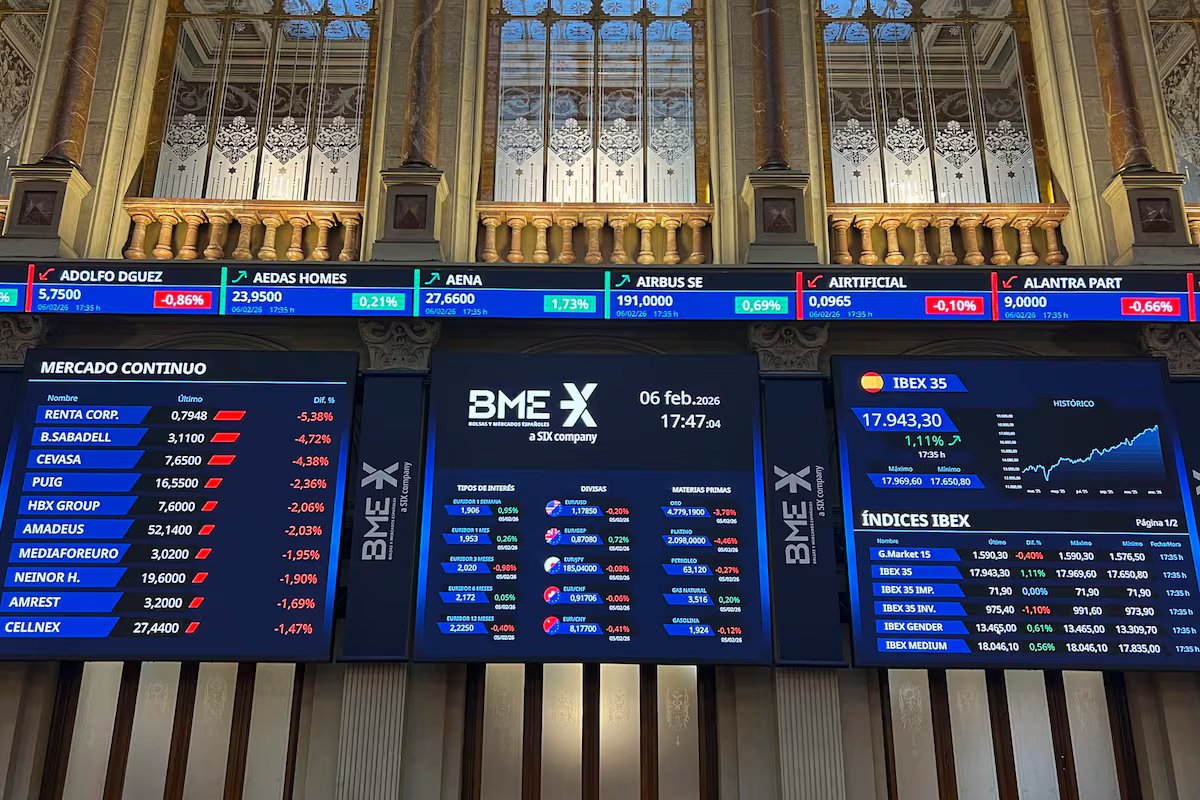
Uncertainty continued to weigh on the stock markets due to the weakness of the ceasefire agreement between the United States and Iran: Frankfurt was the most penalized stock market and lost 1.14%; behind, the Euro Stoxx 50 index, where the largest capitalization companies of the Old Continent are listed, 0.29%; Paris, 0.22%; Madrid, 0.15%; and London, 0.05% and Milan gained 0.5%.
Meanwhile, the New York Stock Exchangewhich began the session in red, improved the mood after Israeli Prime Minister Benjamin Netanyahu announced “direct negotiations” with Lebanon to achieve a “historic and lasting peace agreement,” although he clarified that “there is no ceasefire” with Hezbollah.
At the ringing of the bell on the New York stock market, the Dow Jones Industrial Average rose 2.85%, to 47,909 points; The S&P 500 advanced 2.51%, to 6,782 units, and the Nasdaq advanced 2.80%, to 22,634 points.
By sector, profits predominated, especially in non-essential goods companies (2.46%) and industrial companies (1.04%), while energy companies closed in the red (-1.16%), in parallel with a moderation in the price of Texas crude oil, which closed at $97.87 a barrel.
Meanwhile, the benchmark Brent crude oil in Europe rose 1.23% to $95.92 at the close of the session on the London futures market. StoneX market analyst Fawad Razaqzada commented that markets are waiting for more “clarity” on developments in the Middle East.
According to Razaqzada, in the best of cases, with the relaxation of tensions, the reopening of the Strait of Hormuz and the recovery of crude oil supply in the marketcrude oil could start moving at $90 levels.
The worst scenario would be a breakdown of the ceasefire, which could lead to a new rise in crude oil prices above $100 and up to $120 depending on the severity of the situation, the expert added.
Meanwhile, the price of natural gas fell 1.53%, to 44.51 euros per megawatt hour (MWh).
On the sidelines, analysts are also paying attention to the personal consumption expenditure index (PCE), a measure of inflation closely followed by the Federal Reserve, which remained high in February, before the offensive against Iran.
The PCE rose 0.4% compared to the previous month, while the annualized increase was 2.8%, above expectations.
Meanwhile, the managing director of the International Monetary Fund (IMF), Kristalina Georgieva, warned today that central banks “must be prepared” to raise interest rates and tighten their monetary policies if the war against Iran leads to significant inflationary pressures.
In the debt market, the yield on the German sovereign bond, considered the safest in Europe, rose 4.4 basis points to 2.984%.
At the close of Wall Street, the 10-year US bond yield fell to 4.285%; Gold rose to $4,794 per ounce, the euro appreciated and was exchanged at $1,167, and bitcoin rose 1% to $72,300.