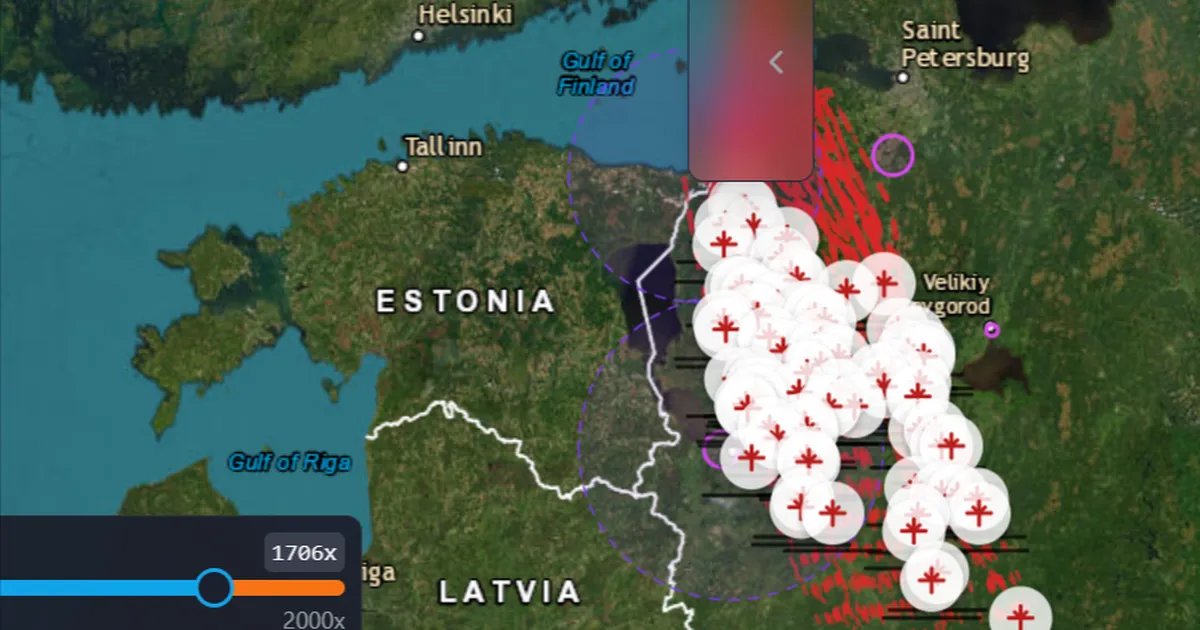
“Approaching via the Baltic Sea is not impossible. It’s not excluded that something like passing over Kaliningrad happened. I haven’t seen proof of that and haven’t modeled it so far,” Kannike said.
Claims circulating in the Russian information space—that Estonia, Latvia, Lithuania, and Poland are knowingly allowing Ukrainian drones to use their airspace—are considered impossible by Margus Sammelsaar, chief technology officer at technology company Atalanta Systems and a drone engineer, although he does not completely rule out the possibility of occasional borderline cases.
“Drone swarms coming from Ukraine would be heard by half of Estonia. These aircraft are loud enough that you can’t do it quietly,» he said.
»I believe the drones are flying closer to the Russian-Baltic border,» he added, pointing to the swampy Lake Peipus region, where conditions are favorable for avoiding radar detection, especially when drones fly very low – around 100–200 meters.
“They’re hard to detect. I think it’s very difficult for Estonian radars. The claim that we track and see everything isn’t entirely true, because otherwise we would have received clearer trajectory information. Even this morning (Monday), it was obvious that nobody really wanted to say much.»
Mostly decoy drones reach here
According to Sammelsaar, drones drifting into Estonian territory are mainly decoy drones, which use inexpensive GPS systems for cost efficiency and are therefore easy to jam.