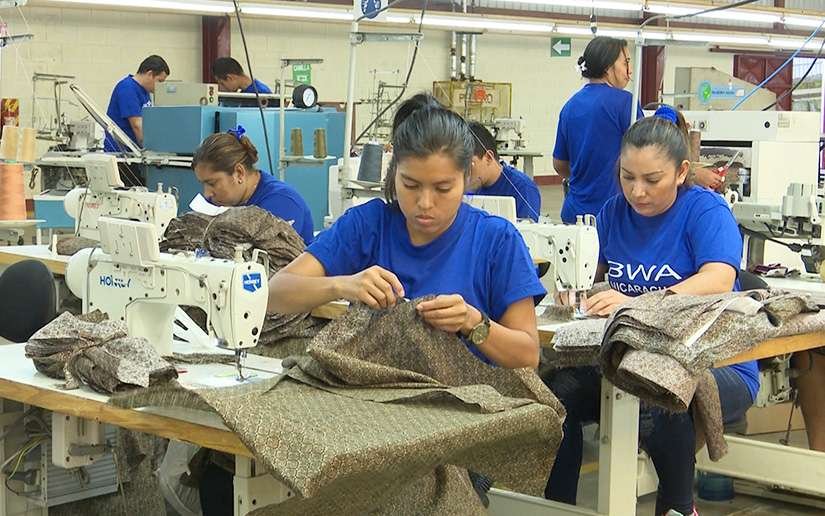
The executive director of the Free Zones Corporation, Fernando Sánchez, recognized the loss of “between 15,000 and 16,000” jobs in the sector during 2025. The fall occurs in a context in which more than 37,000 positions have been lost since 2022, according to official data.
The official, who for the first time recognizes the crisis in the sector, in a appearance on the official Channel 8explained that the “reciprocal” tariffs imposed by the United States in 2025, the decrease in work orders and the dependence on single clients caused the loss of those jobs in 2025.
“At the end of 2025, in the last quarter, as a result of the reciprocal tariffs that the United States government had imposed, many companies suffered from a lack of job orders (…) there were about 20 companies that were left without work, which resulted in a reduction in jobs of approximately 15%,” the official acknowledged.
Although the executive director of the Free Zones Corporation pointed out that “no company closed or has closed” of those operating in the sector, the official figures refute this. As of December 2025, 169 companies were registered, but as of January of this year, 167 were operating in the country.
The maquila sector, which constitutes between 50% and 60% of the free zone regime, “was affected by a drop in work.” Additionally, many of the companies “moved some operations to El Salvador, Guatemala (and) Honduras.”
In 2025, the free zone sector maintained an average of 116,762 jobs. However, in the last quarter of that year it went from 111,680 to 105,815 jobs, which represents a loss of 5,865 jobs, according to the BCN.
Sector does not recover
By January 2026, however, the figure dropped to 100,566 positions, losing 5,249 positions compared to December and 19,652 compared to January 2025, which shows that the free zone sector is still without momentum and jobs.
Employment has returned to levels similar to those recorded in 2012 when 102,029 positions were registered, according to official figures. The official, however, insisted that the “goal” at the end of 2026 is to have 120,000 jobs.
“The brands that had stopped placing orders are now slowly placing them again. There were many companies that at the beginning of the year were reducing spaces in industrial parks,” said Sánchez.
The sector reached its highest point in employability between June and September 2022 when more than 140,000 positions were registered. From then on, the numbers began to show a downward trend:
- 2022: 138 027
- 2023: 124 487
- 2024: 121 556
- 2025: 116 762
- 2026: 100,566, according to data up to January
Sánchez indicated that in the first quarter of 2026 there was a “slight recovery” of about 1,000 jobs, which could mark a change in the trend observed in recent years.
“Yes they compacted, they reduced work and employment,” he stressed, “but with the vision of being able to recover when the situation allowed it.”
Will the law reform offer more “benefits”?
On March 7, 2026, the regime of Daniel Ortega and Rosario Murillo ordered the reform of Law 917 or Law of Export Free Zonesin force since 2015, so that companies that already operate in that tax regime obtain similar benefits—or better—than those that companies that operate based on Law 1264 will receive. Special Economic Zones Law of the Belt and Road, effective December 19, 2025.
The initiative already in force, according to the official, “will expand the benefits” and “motivate investors, existing companies and new ones to work in Nicaragua.”
According to Sánchez, at the end of this year they also plan to “break the barrier” with 4 billion dollars in exports.