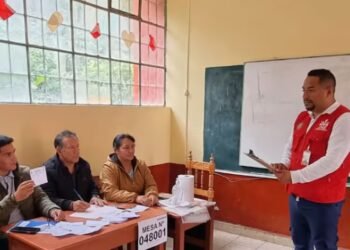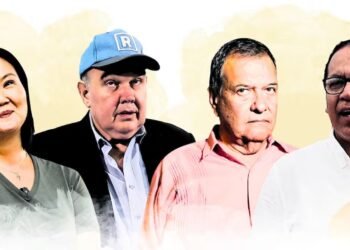
The General Elections This Sunday they reported a marked fight for second place that gives access to the second round, but also The clear losers were several candidates who emerged as potential relevant actors. in various passages of the campaign and ended up saying goodbye to this with discrete voting figures.
Candidates such as César Acuña, Mario Vizcarra or George Forsyth began this year with a relevant presence within the dispersed voting intention. The Datum electoral survey for El Comercio that was published in January of this year placed the brother of Martín Vizcarra with 5.8% of the preferences and occupying fourth place of these, while Forsyth and Acuña remained in expectant positions with 2.8% and 2.5% of voting intention respectively.
In dialogue with El Comercio, journalist and political analyst Enrique Castillo maintained that the common factor of these three candidacies was having “squandered the political capital with which they entered the campaign,” although with different nuances.
In the case of Mario Vizcarra, the specialist considered that he was a deficient political figure who did not know how to take advantage of the influence of his brother, former president Martín Vizcarra.

Mario Vizcarra in the JNE debate. (Photo: JNE)
/ AGQ JNE
“Mario Vizcarra had an inherited electoral pocket that was much larger than Pedro Castillo’s and he squandered it. That capital has ended up ruined by a very bad candidate who not only has not known how to run a good campaign, but has also not known how to be a good representative of his brother and his party,” commented the specialist.
After the good initial positioning in January, the candidate for the presidency of Perú Primero fell to 3.6% in the Datum poll in February and by March he barely reached 1.2%, worsening his position in subsequent electoral studies.
Enzo Elguera, CEO of Imasolu and political analyst, shares this vision, but added that another key element that ended up burying Vizcarra in the elections was his attempt to distance himself from the figure of his brother when his opponents mentioned the latter’s judicial processes.
“This tactical error made the voting public not see him as someone who was going to continue Martín Vizcarra’s line and, although Mario Vizcarra later tried to correct himself, I think it was too late,” Elguera said.
Regarding César Acuña, both specialists agree that the missed opportunity was based on the fact that he was unable to capitalize on his great influence in the government with Alianza Para el Progreso (APP) as the second force with the greatest presence in the Executive, in addition to having a vast presence in subnational governments and having ample economic resources.

César Acuña voting on election day this Sunday. (Photo: Johnny Aurazo)
Acuña’s candidacy was more stable than Mario Vizcarra’s in percentage terms, peaking at the fifth place he shared with Alfonso López-Chau in the survey at the beginning of March with 3.8%. Nevertheless, The poor performance in the debates and APP’s inability to respond to the questions of the former governor of Libertad were also decisive..
“The bad political strategy in the campaign and the abuse of what it means to use resources by showing off This has led to APP most likely not passing the fence or having a very small bench.”, said Castillo.
“There are investigations that the media reported on massively and the response capacity of Acuña and the spokespersons (of his party) was minimal. There was no clarification regarding the facts or response that weakened those arguments,” commented Elguera.
The case of Somos Perú was similar to that of APP from the perspective that it also had an important presence in regional and municipal governmentsbut that the election of a provenly failed representative ended up wasting that good starting point.
“Somos Perú did not know how to choose a candidate and insisted on a figure that had already lost and who clearly lacked the political race for a second chance,” said Enrique Castillo.

George Forsyth, candidate of Somos Perú. (Photo: Renzo Salazar/GEC)
The first Datum survey in 2026 showed the Democratic Integrity (ID) candidate, Wolfgang Grozo, in the group of “other candidates”, with just 0.5% of the preferences in said study. The next report, published on February 8, recorded a slight improvement for Wolfgang Grozo with 0.7% that still kept him far from the top positions in voters’ consideration.
March would mark the emergence of Grozo more clearly on the electoral landscape, since Datum’s study during the first half of March placed him in an expectant seventh place with a voting intention of 2.5%. Despite this, the vote simulation study at the end of that month would show a decline in his positioning because, despite the fact that the former director of intelligence of the FAP added 2.6% of the valid votes, these placed him in twelfth position in said study.

Wolfgang Grozo denied having ties to Zamir Villaverde during the campaign. (Photo: Álvaro Figueroa/@photo.gec)
The pollster’s next simulation would place Grozo much lower, in the “Others” group with a number of votes cast less than 1%.
From the point of view of Enzo Elguera, it is one of the most representative cases of what he calls the “emotional vote” in the current campaign, which is characterized by its high variability.
“In the case of Mr. Grozo and other candidates, their vote is mostly emotional; that is, they did not have a hard vote and lacking this, what has happened is that this voter quickly moved in search of another candidate who connects with specific audiences or with some programmatic axes and similar leadership styles,” explained the executive director of Imasolu.
“This emotional voter has made many candidates reach important peaks in recent weeks, but when their private lives have been scrutinized, they generated disappointment and with the same emotionality they have ended up falling electorally,” added the analyst.
For his part, Enrique Castillo attributes Wolfgang Grozo’s electoral fall not only to not having been able to dispel his questions and appearing to be a “liar”, but also to the notoriety of his candidacy on social networks, which gave high volatility to his vote. The only exception in the current campaign would be Jorge Nieto from the specialist’s point of view.
“As these candidates are launched temporarily and so abruptly they have no support and political structure, therefore, they grow like foam, but just like the foam they disappear quickly helped by their own mistakes,” said the journalist.

Carlos Espá, presidential candidate of the Sí Creo party, during his interview with Milagros Leiva for the El Comercio digital platform. (Photo: YouTube Capture / El Comercio)
Castillo also places Carlos Espá, a Yes I Can candidate, in this spectrum, who had an initial boost on the Internet, but who ended up falling prematurely for trying to support the parliamentary candidacy of Jorge Montoya in his group. In January Espá had 1% voting intention, but that figure evaporated to 0.6% in the two subsequent Datum surveys.
In the case of candidates such as Marisol Pérez Tello (Primero La Gente) and Mesías Guevara (Partido Morado), both began the year in unfavorable positions in the polls, with 0.4% and 0.2% of voting intention, respectively.
Pérez Tello was the one who managed to climb the most positions by reaching 4.6% of valid votes in the Datum simulation at the beginning of April, placing seventh in the preferences; However, the growth would be insufficient. Enzo Elguera mentions that the weak point of these electoral alternatives was found in the absence of appropriate foundations in their own parties.

Marisol Pérez Tello presented herself as a presidential candidate for Primero la Gente. (Photo: Joel Alonzo / @photo.gec)
“These candidacies were detected late, but they also lack the same. Pérez Tello connected with the debate and had visibility, but This notoriety was only partial and when this is the case it must be sustained with organization and logistics, which did not happen.”commented the analyst.
Enrique Castillo shares that vision and adds that Guevara and Pérez Tello are part of the group of candidates who gained notoriety—insufficient in most cases—in the debate along with figures such as Fernando Olivera (Frente de la Esperanza), Enrique Valderrama (Partido Aprista) and Ricardo Belmont.
“Before invisible, without a clear strategy and without a showcase to show themselves, they found in the debate the opportunity to become visible. What happens is that for several of them it was not enough because they do not have an important structure from a political point of view,” Castillo explained.
Candidates with more discreet results such as Roberto Chiabra (Unidad Nacional), José Williams (Avanza País), Rafael Belaunde (Libertad Popular) or Ronald Atencio (Venceremos) were around 1% in the polls or even below throughout the campaign and for Enrique Castillo this is directly attributable to the fact that they were “bad candidates” in the sense of their political potential.

Roberto Chiabra is a congressman for the current legislative period. (Photo: Congress)
The specialist consulted by El Comercio maintained that the status of Williams and Chiabra as ex-military members, added to the limitations of their groups and their presence in the current Congress were irremediable weak points of their candidacies.
“No soldier who has gone into retirement has ended up being a good politician. The same training does not allow them that flexibility that a politician does have to adapt to a certain audience. Secondly, people do not see the military well: our problem of insecurity was not going to be solved by a general of the Armed Forces and that is clear to the people. Secondly, and for me the most important thing is that they were part of this same Congress,” commented Castillo.
The political analyst added that Belaunde seemed to him an “intelligent man” and a competent technocrat, but not a figure capable of adding leadership.