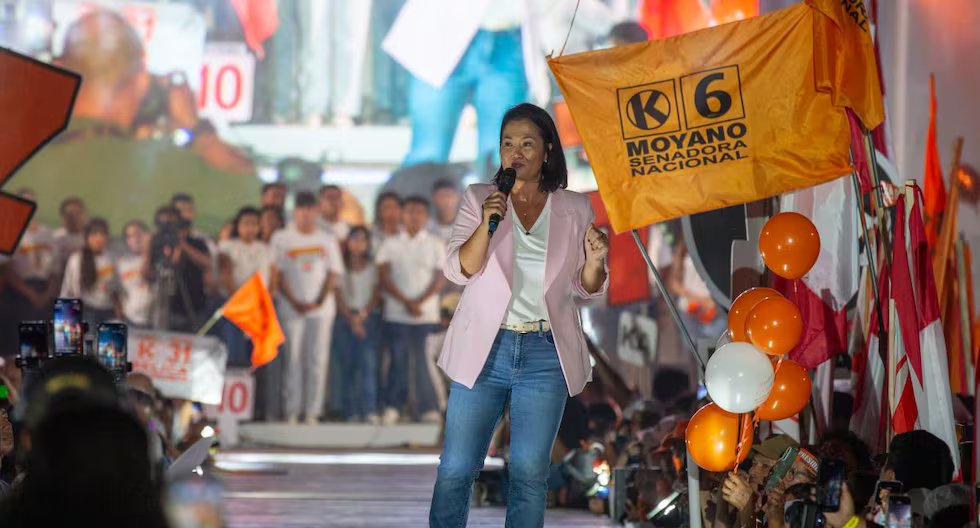
Fujimorism has competed in five of the seven ballot elections held in the history of Peru to elect the President of the Republic. Alberto Fujimori, founder of that movement, won two second rounds – the last, in 2000, with obvious irregularities – while Keiko Fujimorihis daughter and political heir, lost three consecutive elections in that electoral stage.
Until now, Fujimori has only been absent in two ballots. The first was in 2001, in the first electoral process after the fall of Alberto Fujimori’s regime. The other was in 2006: with Martha Chávez as presidential candidate, Alianza por el Futuro (AF) obtained 7.4% of the valid votes (912,420 adhesions).
How to interact with the map:
Travel in time: Use autoplay to see the electoral evolution, or use the top controls to pause and browse year by year at your own pace.
Explore the details: Click on each part of the map to discover which candidate received the most votes there and the percentage of valid votes they obtained.
Since 2011, Keiko Fujimori has maintained the hegemonic leadership of the Fuerza Popular party. The projections and initial figures released so far indicate that, next June, it would contest its fourth runoff in two decades. It is still not known with certainty who will be his electoral rival.
“Since the candidate emerged (Albert) Fujimori, Peru was divided into two: Fujimorism and anti-Fujimorism. Since then, Fujimorism may be more or less present in the elections, but it is always there.explains Alonso Cárdenas, professor of Political Science at the Antonio Ruiz de Montoya University (UARM).
In the first round of 2021, the former congresswoman also obtained the lowest vote of her three campaigns: 13.4%, less than two million endorsements. Even so, he reached the runoff, in which he fell to Pedro Castillo by just over 44,000 votes.
“A few years ago, the votes that Keiko had in 2021 would have placed her in fourth or fifth place. (…) “Fujimorism has less power than 20 years ago, but it is enough against leaderships as weak as those we saw”adds Jeffrey Radzinsky, director of GFP Consultores.
The 2021 elections showed a deterioration in support for presidential candidates. With 18.9% of the preferences, Castillo had the largest vote in the first round of that year. Until then, no candidate had entered the runoff with less than 20% support.
Álvaro Gálvez Pasco, principal investigator of the IEP, explains that, in a political system as chaotic as the Peruvian one, Fuerza Popular “it is the strongest party”because it is shown “cohesive and has a base of militants”in addition to a national presence, a structure and, above all, an important presence in Parliament.
However, adds Gálvez Pasco, there is an even more powerful political force in the country: anti-Fujimorism.
“This transcends a political position, it is a feeling of rejection of what Fujimori embodies and represents. There is anti-Fujimorism from the right, center and left, it is a sector that will vote for anyone, except for Fujimori”highlights Cárdenas.
In 2011, Keiko Fujimori obtained 48.6% of the votes in the runoff. Ollanta Humala defeated her by 447,057 votes. The differences were narrowed in the following electoral processes, but it was not enough to win the presidency.
In 2016, Pedro Pablo Kuczynski surpassed it by 41,057, the smallest advantage recorded in the history of runoff elections in the country. In 2021, 44,263 votes separated Castillo from the Fuerza Popular leader.
Gálvez Pasco and Cárdenas agree that anti-Fujimorism has weakened in recent years. “They have beaten him (to anti-Fujimorism) what happened with the Castillo government and the alliance between (Verónika) Mendoza and (Vladimir) Cerrón, among other factors”indicates the IEP investigator.
Meanwhile, Cárdenas maintains that “The problem is that anti-Fujimorism does not have its own political position, it does not define itself” outside of Fujimorism. “In terms of public management, he left us little or nothing: all the candidates, later presidents, who defeated Keiko are in prison or under investigation”says the UARM professor.