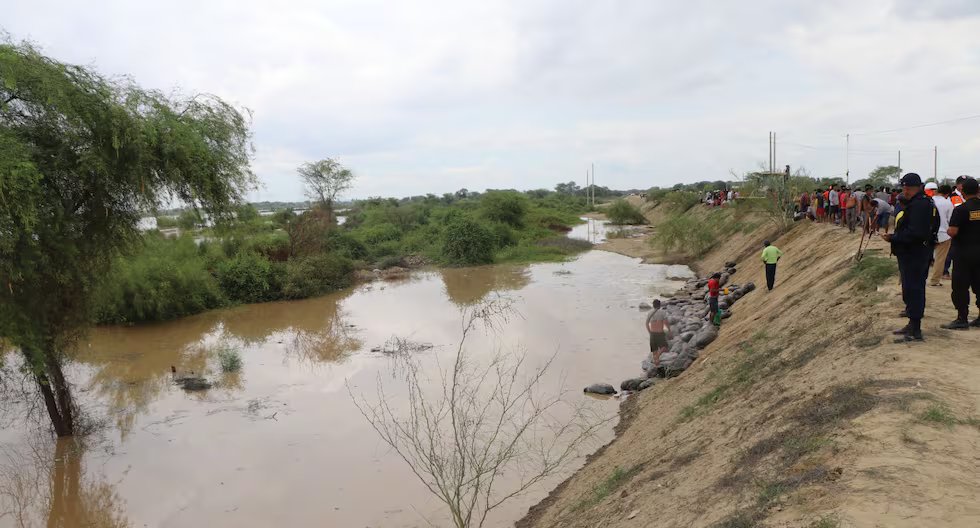

With the purpose of providing information that serves to show the current situation of the population and housing of the department of Piura before the arrival of El Niño Phenomenonhe National Institute of Statistics and Informatics (INEI) made the results of the 2025 National Censuses of said region available to regional and local authorities.
The head of the INEI, Dr. Gaspar Morán Floresindicated that this information is the strategic input for planning strategies for disaster risk management, emergency preparedness, the organization of humanitarian aid and the protection of the most vulnerable population.
The figures obtained from the national censuses show us the situation of the homes and the state of the population before the arrival of this natural phenomenon; as well as the demographic changes that occurred in the last intercensal period (2017-2025), indicated Morán Flores.
80.0% of the homes in Piura are occupied
The results of the 2025 National Censuses show that in the department of Piura there are around 747 thousand private homes, of which 80.0% are occupied (79.2% with occupants present and 0.7% with people absent), 8.1% are homes for occasional use and 11.9% are unoccupied. It should be noted that abandoned or closed homes reached 9.2%, 1.5% for rent or sale, and 1.3% under construction or repair.
53.3% of Piura’s homes are made of brick or concrete block
Regarding the material of the walls of the homes in Piura, 53.3% are brick or concrete block, 22.2% adobe, 13.3% plywood/calamine/mat, 1.4% wood, 0.3% rammed earth and 9.5% other material.
Meanwhile, 56.0% of private homes with occupants present have floors other than wood, earth or other material.
Access to basic services
In the year 2025, 61.6% of private homes with occupants present in Piura have water connected to the public network inside the home; 52.2% have a toilet service connected to the public network inside their home; 88.0% have electric lighting through the public network.
In relation to fuel or energy for cooking, 425 thousand homes use gas (LPG cylinder) for cooking, 212 thousand firewood, 149 thousand coal, 50 thousand natural gas, among others.
It should be noted that 60.5% of Piura homes have internet access, while cell phones are present in 94.1% of homes.
Total population of Piura is 2 million 115 thousand inhabitants
According to the 2025 National Censuses, the total population of the department of Piura reached 2 million 115 thousand people, a result that demonstrates a population increase of 185 thousand inhabitants compared to what was recorded in the 2017 Census with an annual growth rate of 1.2%.
The head of the INEI, Dr. Gaspar Morán Flores, reported from the city of Piura that 49.6% of the department’s population are men and 50.4% women. According to age groups, 26.1% are under 15 years of age, 60.5% are between 15 and 59 years of age, and 13.4% are adults aged 60 and over.
He explained that, between 2017 and 2025, a decrease in the population under 15 years of age and an increase in the population aged 60 and over has been observed, a dynamic that could be explained by the decrease in fertility and increase in life expectancy at birth, among some factors.
He explained that the department of Piura registered an aging index of 51.3, a result below the national average (65.0), which means that the proportion of older adults is still moderate compared to the child population.
At the provincial level, Morropón registers the highest aging index with 65.0; That is, for every 100 children and adolescents under 15 years of age, the province has 65 adults over 60 years of age.
Sechura reported the highest population growth
In the intercensal period 2017-2025, the provinces of the department of Piura with the highest population growth were Sechura, Paita and Piura (each with 2.0%), while Talara (0.3%) showed the lowest growth rate.
Twenty-six of October is the most populated district of the department of Piura
The district of Veintisirse de Octubre, with 204 thousand inhabitants, is the most populated in the department of Piura, according to the results of the 2025 National Censuses. It is followed by the districts of Sullana, with 194 thousand inhabitants; Castilla, with 191 thousand; and Piura, with 154 thousand. Of these four districts, only Sullana belongs to a distinct province (Sullana province); the other three are part of the province of Piura.
65.3% of immigrants come from Metropolitan Lima, Lambayeque and Tumbes
In the period 2020-2025, Piura’s migration structure is mainly composed of immigrants from Metropolitan Lima (45.2%), Lambayeque (10.6%) and Tumbes (9.5%), which together represent 65.3%. While 62.9% of the emigrants who left Piura went to Metropolitan Lima (42.9%), Lambayeque (13.2%) and La Libertad (6.8%).
Characteristics of the population of Piura
During the presentation of the results of the 2025 National Censuses of the department of Piura, the head of the INEI provided details of the characteristics of the population of Piura. Regarding the educational level, he pointed out that 51.2% of children between 3 and 5 years of age have initial education, 78.5% of those between 6 and 11 years of age have primary education; 69.6% of those aged 12 to 17 have secondary education; and of the population aged 18 to 26, 26.7% have a university education and the upper 19.5% do not have a university education.
Illiteracy rate in Piura reached 6.3%
In the department of Piura, the illiteracy rate of the population aged 15 and over reached 6.3% in 2025. However, gaps are observed between men (4.4%) and women (8.1%); as well as in the older adult population, particularly in women, the rate rises to 25.2%, that is, 1 in 4 women aged 60 and over are illiterate. At the provincial level, Huancabamba registers the highest rate with 18.9% of the illiterate population; They are followed by Ayabaca with 14.7% and Morropón with 9.9%.
96.0% of the population in Piura has health insurance
The 2025 National Censuses showed that 96.0% of the population of Piura has health insurance. By sex, women affiliated with this insurance reached 96.5% and men 95.5%. According to the type of health insurance, 74.7% of the population has Comprehensive Health Insurance (SIS), 23.2% EsSalud, 2.6% private health insurance, 0.9% insurance from the armed forces or police and 0.2% another type of insurance.
5.6% of the population of Piura has some type of disability
In the department of Piura, 5.6% of the population aged 5 and over has some disability, a prevalence that increases in the older adult population (22.7%), presenting a higher incidence in women (23.8%) than in men (21.5%). The population with difficulty walking or going up and down stairs reached the highest proportion (3.0%), followed by disability to see even when wearing glasses (2.1%), among others.
57.2% of the population identifies as mestizo
57.2% of the population identifies as mestizo, while 20.4% recognizes themselves as white; and another 20.4% also as black, brown, zambo, mulatto, Afro-Peruvian people or Afro-descendant.
Regarding the language learned in childhood, 99.1% of the population aged 3 and over learned to speak a single language.
ABOUT THE AUTHOR