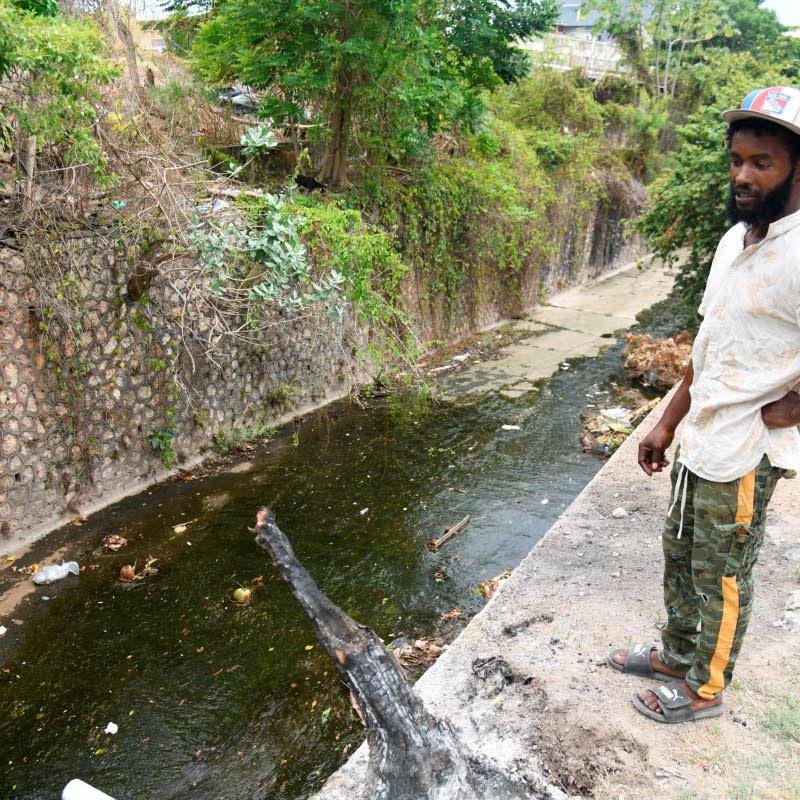
The Government’s plan to relocate people who live on the edges of the capital’s network of gullies is a good idea. It, however, ought not to be separated from a broader, structured programme to rectify the island’s crisis of squatting, growth of informal settlements, and urban decay.
There is a sense that there is a piecemeal, disjointed approach to these issues rather than a multi-year, holistic national policy that doesn’t become subject to the fits and starts of election cycles, or the shifting priorities of an administration or a particular minister.
With work on them beginning in earnest in the 1960s, the network of gullies comprises 11 paved natural watercourses, running east to west, beginning in the hills of St Andrew and emptying into Kingston Harbour. They drain the Liguanea Plain upon which much of the capital sits.
The largest of these waterways is the Sandy Gully, which, before it was concreted, was estimated to have a discharge capacity of 77,000 cubic feet of water per second “based on a 50-year storm cycle”. However, in the more than six decades since the paving of the gullies began, watersheds in the St Andrew hills have suffered substantial deforestation, mainly to make way for homes, including, in some cases, squatter and informal settlements. In the lower reaches of the gullies, in urban communities, people have moved illegally on their banks, with a mix of shanty housing and substantial concrete structures.
These settlements not only raise safety concerns for residents, particularly during periods of heavy rain and floods, but, according to experts, contribute to the worsening disrepair of gullies that will require billions of dollars to fix.
In a speech last week at the opening of a high-rise apartment building in East Kingston near the waterfront, Prime Minister Dr Andrew Holness said that the Government intended to remove the squatters and ‘reclaim’ the gullies.
“We are testing out a programme now where we have said to the NWA (National Works Agency) that we are going to reclaim the gullies in Kingston – reclaim the reservations 20 feet from the gullies,” the prime minister said.
GOVERNMENT-SUPPORTED RELOCATION
This will probably mean government-supported relocation of people, for which four communities in the Corporate Area (Kingston/St Andrew) have been selected for a pilot project. The Gleaner’s Editorial Board appreciates and supports the logic of this programme.
However, the gully relocation can’t, or shouldn’t, be addressed in isolation, or separately, from the larger question of squatting and urban decay across Jamaica.
According to the 2022 census, 61 per cent of Jamaicans live in urban communities, an 11-percentage-point increase from 2011. Many of these people live in informal settlements or squatter communities. Indeed, government studies estimate that between 750,000 and 900,000 Jamaicans, or up to a third of the population, either squat or live in informal settlements.
While it has been talked about a lot over several years, there is yet to emerge a comprehensive or overarching policy to deal with the problem, including the land tenure and land-titling issues that have faced Jamaica since the abolition of slavery. This is particularly evident in the island’s western parishes, as currently highlighted as Jamaica talks about resilient reconstruction from Hurricane Melissa, the Category 5 storm that devastated the western third of the island a year ago.
At the same time, several urban communities across the island, but especially in the capital, are, as Dr Holness observed in a speech in June, in an advanced state of decay. Meanwhile, the Government estimates that Jamaica has an active housing deficit of 150,000 homes, while other analyses put the historic, cumulative deficit at around 450,000.
GREENFIELD DEVELOPMENTS
In response to the housing crisis, Jamaican governments have tended to prioritise the construction of greenfield developments, which demand the installation of new and additional infrastructure while moving people farther from work and the services necessary for their lives and livelihoods.
In his June speech, the prime minister promised that his administration planned, as part of its housing strategy, to pay attention to urban renewal.
“It has to shift to focus on rebuilding our inner-city and long-established residential communities that are now in decay,” he said. “… There are neighbourhoods in Kingston where they were built 60 to 70 years ago, and they are in decline. The next chapter in Jamaica’s housing journey is the resuscitation, rehabilitation and renewal of existing housing developments and residential areas.” How this will unfold is not clear.
There are several factors in favour of inner-city redevelopment. Many of the homes have decent bones, and the communities already possess, even if deteriorated, basic infrastructure like roads, water and lines for sewage connections. They are close to services. Some people also hold titles to properties.
It is in that context that The Gleaner has in the past suggested, a long-term project of urban renewal, perhaps a decade-and-a-half where communities are structured into grids or blocks for rehabilitation, on a rolling basis. One doesn’t have to be completed for a new one to start.
The Government can leverage its own resources, including money from the National Housing Trust (NHT), the Housing Agency of Jamaica (HAJ) and the Consolidated Fund, to leverage private-sector capital, financing from international partners and the equity of homeowners, to fund this initiative.
An integrated housing, urban renewal and informal community/squatter settlement upgrading scheme is far more difficult than building greenfield housing schemes or new cities. It demands hard and focused work, and pulling disparate and potentially fractious communities together.
But, given the crisis Jamaica faces, it’s an inevitable job.